The most expensive sentence in an ISO 27001 project is the one that describes what the management system covers. Scope decisions made at Stage 1 are expensive to revisit, and the bill usually arrives twice: once to redraw the boundary, once to rebuild the risk assessment, asset register and Statement of Applicability that sat on top of it.
The trigger is familiar. A customer sends a security questionnaire, a tender deadline lands, and someone asks what exactly is being certified. The answer can't be a template line about information security across the business, because a certificate carrying that wording tells a procurement team nothing about which service, site or dataset has been assessed.
The seven ISO 27001 scope statement examples below each dissect the boundary logic, the audit exposure and the drafting tactics that make the wording defensible. Some suit a firm of forty people. Some suit a Lloyd's managing agent. None of them are templates to copy, because a scope that doesn't match how your organisation operates will fail at the first surveillance audit.
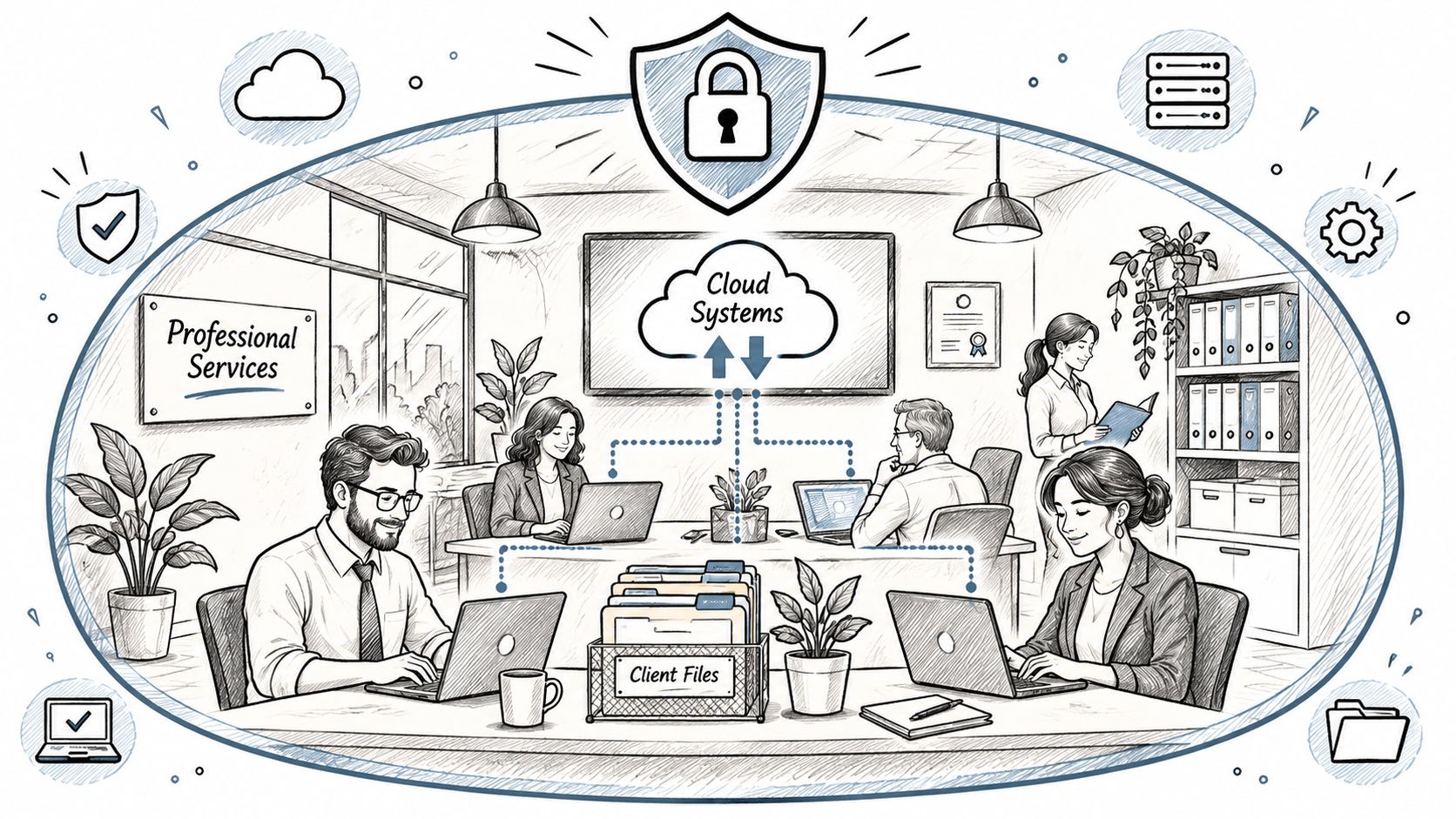
Table of Contents
- 1. Whole-Organisation Scope
- 2. Business Unit or Department Scope
- 3. Product or Service Scope
- 4. Site or Geographic Scope
- 5. Scope with Justified Exclusions
- 6. Outsourced or Cloud-Hosted Service Scope
- 7. Regulated Data and Customer Assurance Scope
- Seven ISO 27001 scope approaches at a glance
- Choosing and Defending Your Scope Boundary
1. Whole-Organisation Scope
A whole-organisation scope puts every business function, location, system and information asset inside the ISMS. It suits organisations small or simple enough to run as one unit: an owner-managed firm with one office and one set of IT systems, or a charity whose head office functions, donor records and volunteer data handling sit under one management team.
Clause 4.3 of ISO/IEC 27001:2022 requires the scope to be documented and to reflect the organisation's context, the requirements of interested parties, and any interfaces and dependencies. A whole-organisation scope satisfies that with the least explanation, which is why tender teams like it. There's no argument about what the certificate covers.
The risk is assuming everyone knows what "the organisation" means. The 2025 Cyber Security Breaches Survey found that 25% of UK businesses did not know whether their organisation adhered to Cyber Essentials, Cyber Essentials Plus or ISO 27001, among the respondents with the greatest responsibility for cyber security. If the people accountable can't name the standard, they won't describe its boundary either.
What Auditors and Buyers Challenge
- Which legal entity? Name the company, and the group structure where a parent or sister company shares systems.
- Where does it operate? List addresses, including approved remote-working arrangements rather than a vague reference to "hybrid working".
- What crosses the boundary? Name key suppliers such as cloud hosting and payroll, and say whether they sit in or out.
A worked version for a 40-person professional services firm reads: "The ISMS covers the information, people, processes, applications and infrastructure used to deliver professional services from the Ipswich office, including staff laptops, cloud email, client files, finance systems and the suppliers supporting them." Everything in that sentence can be pointed at during an audit.
2. Business Unit or Department Scope
A department scope certifies one division, team or service line and leaves the rest of the group outside the boundary. It works when a single unit carries the customer assurance requirement: the claims function of an insurer, the software delivery practice of a consultancy, the IT department running client infrastructure.
The scope statement has to do two jobs at once. It names what the unit does, where it does it and which systems it uses, and it describes how the unit depends on the rest of the business. Shared services are the usual weak point. Identity management, the service desk, HR and the office network are rarely inside a narrow unit boundary, yet they influence how the in-scope service is protected.
Practical rule: If the unit shares an identity provider, service desk or network with the rest of the group, name that dependency in the scope statement and identify who owns the control behind it.
Certification bodies plan audit activity around a defined boundary. UKAS accreditation standards set out that accredited bodies operate to ISO/IEC 17021-1:2015 and list management system certification against ISO/IEC 27001:2022, so the certificate is an assessment of a specified management system rather than an endorsement of the organisation's security posture. UKAS also notes that only certificates issued under UKAS accreditation carry the UKAS symbol, which matters when a tender asks for proof rather than a logo. A certificate narrowed to one division must never be presented as group-wide assurance.
Making Expansion Credible
Write the roadmap into the scope document. An insurer that certifies claims processing first, then adds underwriting in the next cycle, gives brokers a credible path instead of a permanent gap. Choose a unit whose information flows you can trace, and don't carve out an inconvenient department to save effort. Auditors ask why, and "it was messy" doesn't survive a Stage 2 interview.
3. Product or Service Scope
A product scope is where the certificate becomes a sales document. For technology companies, this is usually the easiest boundary to defend and the easiest to get wrong.
UK certification guidance from SGS recommends defining boundaries by activities, locations, departments, assets and technology, then linking that boundary to risk assessment, risk treatment and the Statement of Applicability. The order matters. Draw the boundary first and the risk work follows it. Reverse the sequence and you end up writing a scope that justifies controls someone already bought.
What Good Wording Looks Like
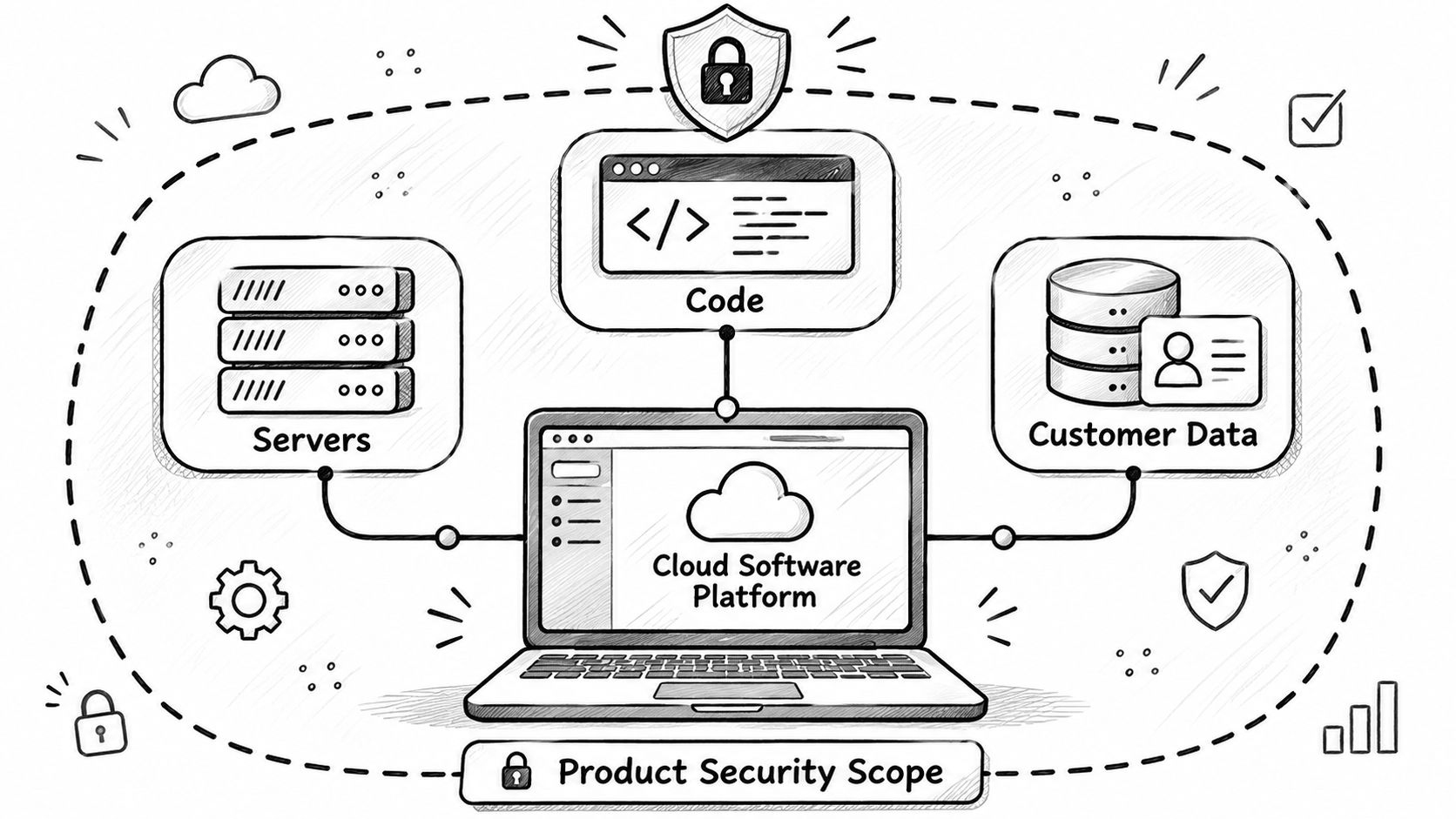
Describe components, environments and data flows, not marketing names. A defensible formulation reads close to this: "the design, development, hosting and support of the customer analytics platform, including cloud infrastructure, production data, corporate identities used for administration, relevant personnel and third-party providers."
The same guidance warns against implying enterprise-wide coverage when finance, sales or unrelated systems sit outside the boundary. A customer reading the certificate maps it onto their supplier-risk question, and wording that suggests more than the audit covered creates a misrepresentation risk that outlives the certificate.
- Name the environments: production, staging, the deployment pipeline and support tooling.
- Name the data: customer records, telemetry, backups and logs.
- Name the interfaces: cloud provider, payment processor, identity provider.
A managed IT service provider scoping its monitoring and helpdesk service for UK clients, with cloud hosting handled under supplier controls, is a common shape. Review the wording whenever a release or architecture change alters the boundary, not once a year by calendar.
4. Site or Geographic Scope
Geography is the boundary most organisations get half right. A site scope covers one location, a group of locations or a regional operation, and it works when one building holds most of the sensitive information: a head office, a data centre, a single UK trading entity inside an international group.
The scope statement has to list every address and say what happens at each one. Not "our London office" but the address, the functions performed there, and the systems and information that live there. Then extend it to the working arrangements people use.
- Remote working: home offices, mobile devices, and who supplies, patches and wipes them.
- Systems administered from a site: a system hosted in a third-party data centre is still in scope if your staff administer it from a named office.
- Site-level procedures: local access control, visitor management, physical security and equipment disposal.
- Shared buildings: server rooms, comms rooms, landlord maintenance and cleaning contracts.
Example: a UK insurance broker certifies its Suffolk head office and the systems it runs, then adds branch offices in a later cycle. A multi-site charity certifies the central donor database and the head office functions managing it, leaving regional fundraising offices to a later phase.
Run the ISO 27001 risk assessment against that site list, so each address produces its own physical and environmental risks rather than one generic entry. Then confirm with your certification body how many locations it will visit, because multi-site sampling rules change the audit plan and the evidence you'll need.
5. Scope with Justified Exclusions
Almost every scope statement carries at least one exclusion. The difference between a defensible one and a liability is whether the document explains why the exclusion is acceptable, in words a customer can read.
Derbyshire County Council's certified scope does this well. It covers the protection of all information and data assets used to deliver the council's functions, services and activities, and its published ISMS scope explicitly excludes schools. It also limits applicability to assets within the council's control and documents how assets are protected from influences outside the boundary. The omission is visible, the governed assets are named, and a reader can see exactly where the line falls.
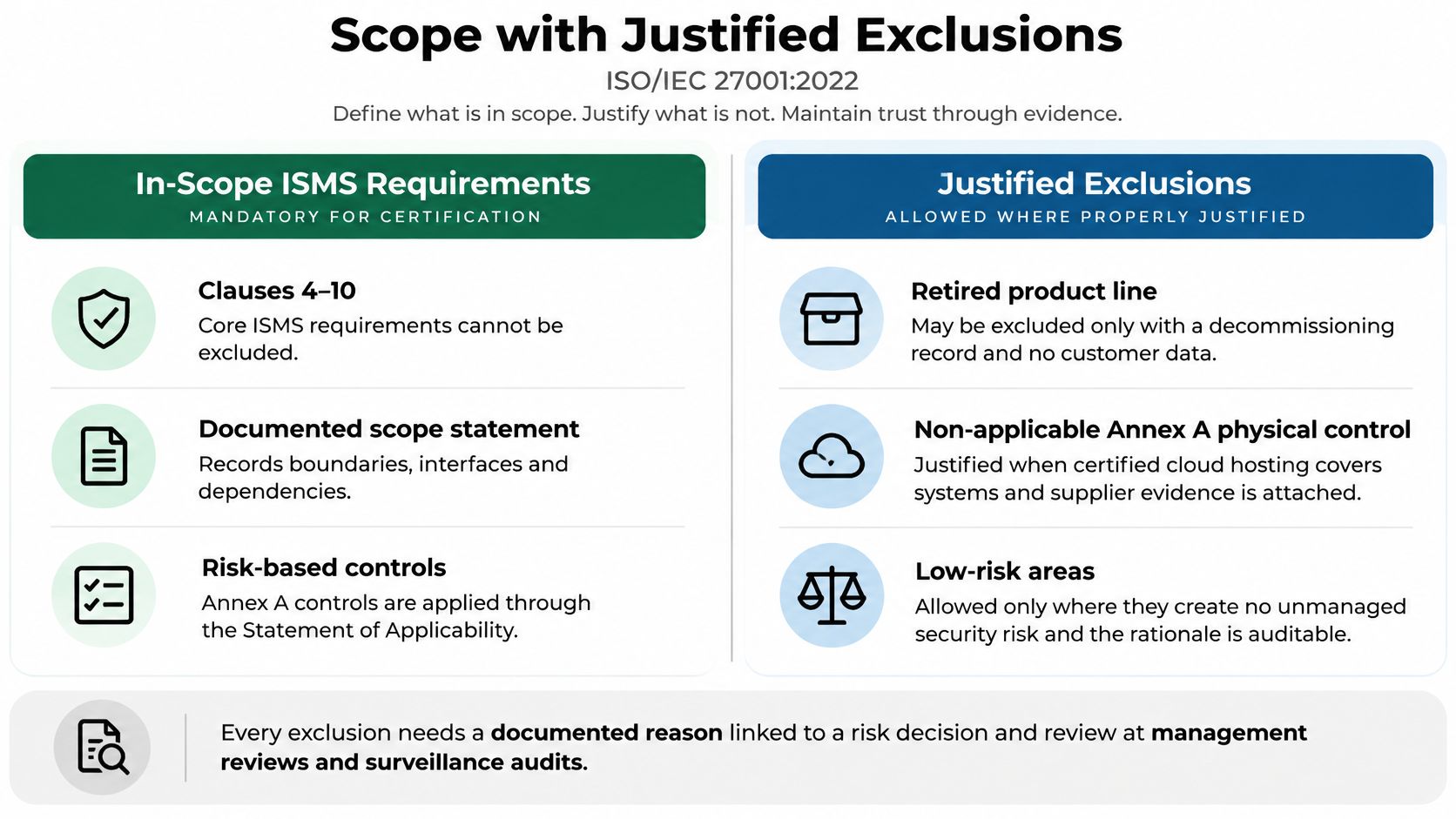
Under ISO/IEC 27001:2022, an exclusion is acceptable only where the excluded part doesn't affect your ability to meet the requirements of the ISMS. Clauses 4 to 10 can't be excluded at all. Annex A controls can be marked not applicable, but the Statement of Applicability must justify each decision, and the scope wording has to match it line for line.
Two Exclusions That Survive Audit
A consultancy retires a product line that never held customer data. The scope excludes it and points to a decommissioning record: data deleted, systems shut down, contracts closed, date recorded.
A financial services firm marks a physical security control not applicable because all systems run in a certified cloud region. The reasoning sits in the Statement of Applicability, backed by supplier evidence and a review date.
What fails is the exclusion nobody can explain. The sales division left out because the audit felt easier without it, or a legacy database excluded while still feeding the in-scope service. Keep the test simple: could you explain the exclusion to a customer's procurement team in one sentence, without wincing?
6. Outsourced or Cloud-Hosted Service Scope
Some organisations own a server room. Most UK mid-sized firms now own a configuration, a set of identities and a contract. This scope type covers a service where the infrastructure is largely third party: cloud hosting, managed platforms, outsourced development.
The scope statement sets out the division of responsibility. Your organisation controls user access, data classification, configuration of the service, supplier selection and monitoring, and the incident process. The supplier controls the physical estate, the hypervisor layer and platform availability. Write both halves, and name the specific provider for each major component rather than describing suppliers generically.
Badges don't travel. A supplier's ISO 27001 certificate covers that supplier's management system, not your tenant configuration, your access reviews or the data you load into it.
Example: a UK recruitment firm scopes its candidate management application hosted on a major cloud provider. Candidate personal data, consultant access, the finance system integration and the support tooling sit inside the boundary; the underlying platform sits with the provider under a monitored supplier relationship. A digital agency does the same for client project delivery across a managed development platform and hosted version control.
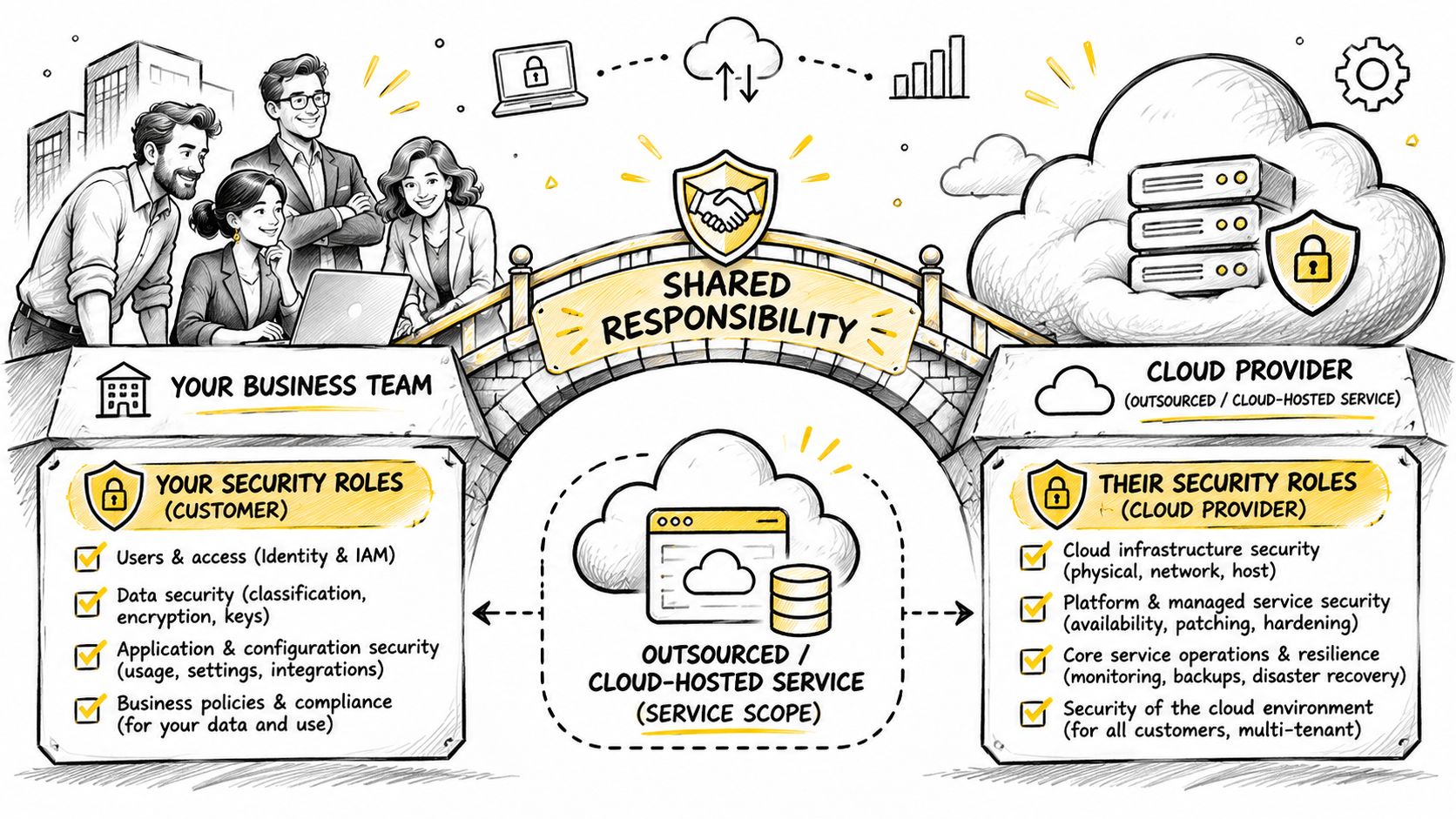
Keep supplier certificates and reports on file with the date you reviewed them, and record what you checked: the scope of their certificate, the services it covers, published assurance reports and any carve-outs in their terms. Reassess the boundary when a key provider changes ownership, retires a service or moves a region.
7. Regulated Data and Customer Assurance Scope
Some boundaries are drawn around data rather than around a building or a product. Insurers, charities and digital consultancies often need exactly this: a scope that names the information class, the systems and people that handle it, and the legal and contractual obligations attached to it.
The ICO guidance on data protection by design requires organisations to consider protection from the design stage throughout the processing lifecycle, and to manage third-party risk by choosing processors who offer sufficient guarantees. A scope statement that stops at the application and ignores the processor chain doesn't meet that test in practice.
Draw the Data Flow First
Map the information end to end before drawing the line: collection, storage, sharing, reporting, retention, deletion. Then decide what sits inside.
- Backups and archives: they hold the same regulated data and are routinely forgotten.
- Deletion and disposal: retention expiry, secure destruction, certificates of destruction.
- Interfaces: brokers, third-party administrators, payment providers, fundraising platforms.
- Reporting copies: management information and analytics extracts that leave the core system.
Example: a Lloyd's insurer scopes policyholder data and claims systems, including broker and third-party administrator interfaces. A UK charity scopes donor and beneficiary records, including the payment and fundraising systems that handle them.
Keep a register of customer security requirements and test it against the scope at every management review, which is what customer security questionnaire work usually exposes. If a tender asks for assurance over something outside the boundary, you need to know before you submit, not after you win it.
Seven ISO 27001 scope approaches at a glance
| Scope approach | Boundary defined by | Best suited to | Main trade-off |
|---|---|---|---|
| Whole-Organisation Scope | The full legal entity or operating footprint, including all functions, locations, systems and information assets | Small or straightforward organisations seeking clear, organisation-wide assurance | Easy to explain and reduces boundary gaps, but requires more effort and ongoing maintenance |
| Business Unit or Department Scope | A specific division, department or service line, including its processes, people, locations, systems and interfaces | Organisations seeking a phased certification focused on a high-risk or customer-critical unit | Faster and less costly, but shared services and exclusions can make the boundary harder to defend |
| Product or Service Scope | A named product or service, its environments, supporting teams, data flows and relevant dependencies | Technology companies and service providers needing assurance for a specific offering | Aligns assurance with customer needs, but may leave wider company systems outside scope |
| Site or Geographic Scope | Named addresses, buildings or regions, and the functions and systems operating there | Organisations with critical facilities or multi-site groups certifying by location or region | Clear for audits and physical controls, but remote staff and systems hosted elsewhere complicate the boundary |
| Scope with Justified Exclusions | Explicitly listed excluded activities, systems or locations, with documented reasons linked to risk | Organisations needing to focus certification while transparently excluding areas that do not create unmanaged risk | Can reduce unnecessary effort, but weak or outdated justifications risk audit findings and customer concerns |
| Outsourced or Cloud-Hosted Service Scope | The organisation's processes and systems, supplier services, and the division of security responsibilities | Organisations relying on cloud hosting, managed services or outsourced development | Reflects shared operations, but supplier visibility, evidence gathering and responsibility gaps are challenges |
| Regulated Data and Customer Assurance Scope | The data category or regulated process, including the people, systems and end-to-end data flows involved | Organisations handling sensitive or regulated data and responding to customer assurance requirements | Focuses effort on high-risk information, but data flows can make boundaries complex to map and maintain |
Choosing and Defending Your Scope Boundary
Pick the approach that matches how the organisation operates, not the one that looks cheapest on a proposal. A single-office firm with one set of systems should certify the whole thing, because a narrower boundary buys nothing and invites questions. A group with separable information flows should certify the unit or product that carries the assurance requirement, and say so plainly on the certificate.
Three questions settle most arguments. What information are we protecting, and for whom? Which activities create or change the risk to it? Who makes the security decisions when something crosses the line? If the answers point to people, systems or suppliers outside your draft boundary, the boundary is wrong, however tidy the wording looks.
Document interfaces and exclusions with reasons, not adjectives. Every exclusion needs a risk decision behind it, and every shared service needs a named owner. Get that right before Stage 1, because scope changes after a certification audit reopen the risk assessment, the Statement of Applicability and the internal audit programme.
Before you sign off: name the locations and activities, justify every exclusion in one sentence, and set a trigger for review when the business changes shape. Acquisitions, new cloud services and new offices are scope events, not housekeeping.
This is the stage where outside help earns its fee. ISO Security, the Ipswich consultancy led by Alan Hutson, defines ISMS scope during its discovery stage. For a UK charity, that meant limiting the scope to the services and information the certification requirement concerned, with trustees approving the scope and the ongoing commitment before any other work began. The charity then achieved independent certification for the agreed scope, with a management system a small team can run.
If you're deciding where to draw the line, ISO Security works through the scope with you before anything is written, then implements and maintains the management system behind it, from gap analysis and risk treatment through to surveillance audits. The team also handles the supplier oversight and questionnaire responses that usually expose a boundary problem in the first place. Visit ISO Security to start that conversation.