In 2022, 48% of UK businesses certified to ISO 27001 held all five categories of cyber-security documentation assessed by government researchers, against 29% of businesses whose cyber-security lead reported directly to the board (Cyber Security Longitudinal Study Wave Two). The 19-point gap has little to do with how many policies each group wrote. It reflects whether documentation sits inside a management system that assigns ownership, records decisions and gets reviewed.
That distinction decides how an auditor reads your files. A policy proves intent. A record proves the policy ran, and certification assesses the second. A folder of approved documents with no dates, no owners and no review history invites findings even when the prose is excellent.
ISO 27001 documentation requirements therefore come down to two things: a defined set of mandatory items, each tied to a clause, and the controlled evidence that shows the management system operating day to day. Get the set right, keep it current, and the audit turns into a walk through work you already do.
Table of Contents
- Mandatory Documented Information by Clause
- How Clause 7.5 Controls Every Document
- Scope, Policy and Objectives Documents
- Risk Records and the Statement of Applicability
- Operational Records That Prove the ISMS Runs
- Keeping Documents Current Between Audits
- Evidence Pack for Tenders and Customer Reviews
- Common Documentation Mistakes and Their Fixes
- Confirm Your Documentation Gaps Before Certification
Mandatory Documented Information by Clause
ISO/IEC 27001:2022 does not prescribe a fixed library of policies. Clause 7.5.1 requires documented information where the standard specifically asks for it, and anywhere the organisation decides it is necessary for the effectiveness of the management system. The first half is fixed and auditable. The second half is a judgement call you have to justify.
The table below is the mandatory core. Every certified organisation holds each of these, whatever its size or sector. The clause column tells you where the requirement sits in the standard; the third column tells you what an auditor expects to see when they ask for it.
| Documented item | Clause | What it must show |
|---|---|---|
| Scope of the ISMS | 4.3 | Boundaries, interfaces and any justified exclusions |
| Information security policy | 5.2 | Top management approval, communication and alignment with objectives |
| Risk assessment process | 6.1.2 | Criteria for likelihood, impact and risk acceptance |
| Risk treatment process | 6.1.3 | Treatment options, control selection and owners |
| Statement of Applicability | 6.1.3(d) | Each Annex A control with applicability, justification and status |
| Information security objectives | 6.2 | Measurable targets with owners, resources, dates and evaluation method |
| Evidence of competence | 7.2 | Records showing staff have the skills for their security roles |
| Operational planning evidence | 8.1 | Records that processes ran as planned |
| Risk assessment results | 8.2 | Recorded outcomes of each risk assessment |
| Risk treatment results | 8.3 | Recorded outcomes of treatment plans and their progress |
| Monitoring and measurement results | 9.1 | Metrics and evidence of ISMS performance over time |
| Internal audit programme and results | 9.2 | Audit plan, findings and reports |
| Management review results | 9.3 | Minutes showing decisions, resources and actions |
| Nonconformities and corrective actions | 10.2 | Cause analysis, action taken and proof the action worked |
Using the Table as a Pre-Audit Check
Run your current document set against this list before anything else. Mark each row present, partial or missing, and be honest about the partial ones, because that is where findings cluster. A risk assessment process described in a policy but never applied to a live register is partial, not present.
Two rows cause more trouble than the rest. The Statement of Applicability is a document in its own right, not a paragraph inside the risk policy, and it has to reconcile with the risk register line by line. Management review minutes are the other one: a signed agenda with no decisions recorded fails the test, because Clause 9.3 asks what top management did with the information, not that they met.
Every row in the table is also subject to the control requirements of Clause 7.5.3. Version, approval, access and retention apply to all fourteen items equally. A scope statement that nobody can find, or a risk register that exists in three near-identical versions, is a control failure before it is a content failure.
How Clause 7.5 Controls Every Document
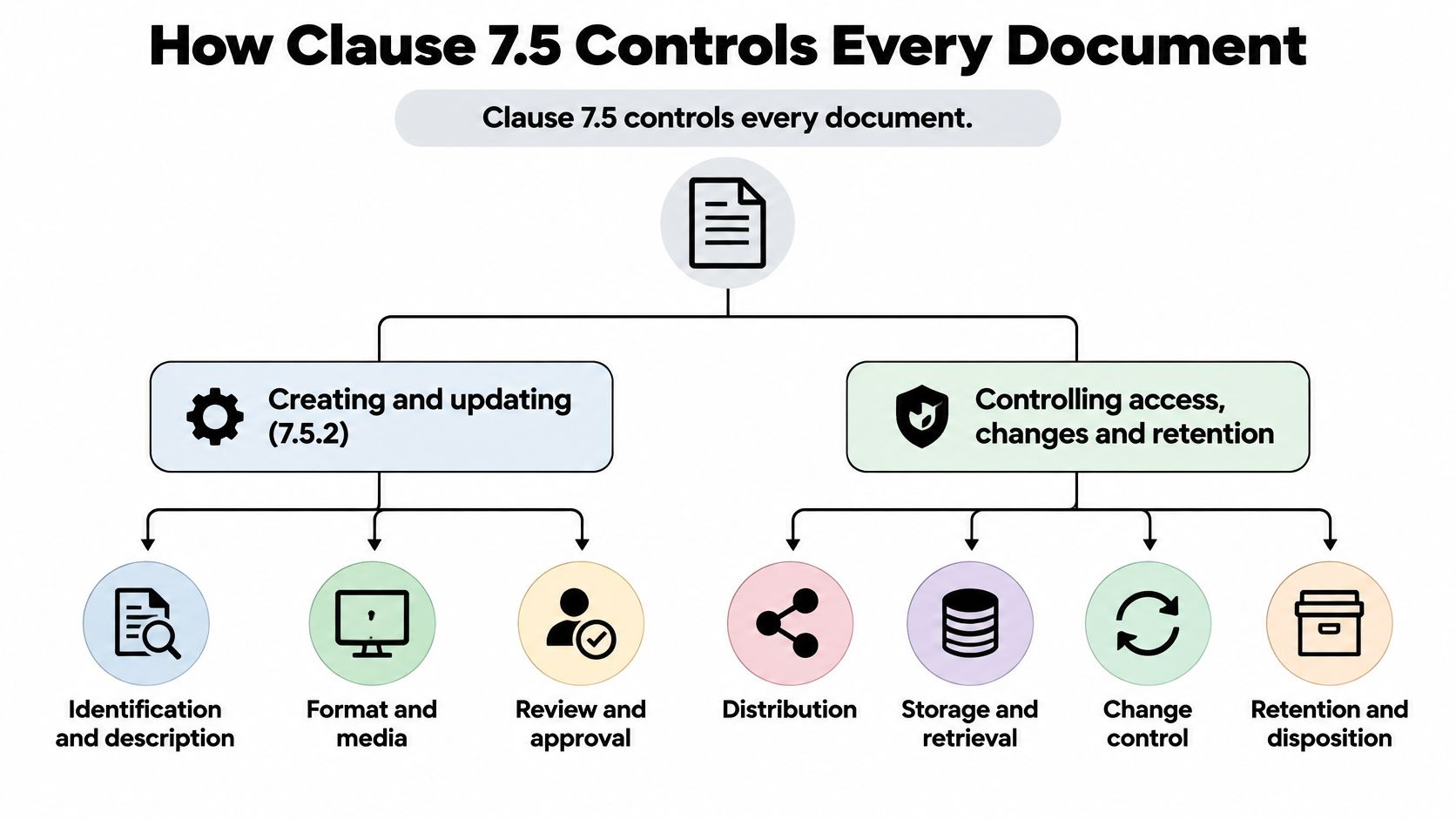
Clause 7.5 has two halves, and many teams only implement the first. Creating and updating governs how a document comes into existence. Control governs what happens to it afterwards, which is where audits usually find the gaps.
Creating and Updating
Clause 7.5.2 asks for three things from every document you produce. Identification and description means a title, an author, a date and a reference number, so the document can be named unambiguously in a conversation or an audit sample. Format and media means the document suits its purpose: a one-page access review spreadsheet is fine, a scanned whiteboard photo is not. Review and approval means someone with authority signed it off before release, with the date recorded.
Controlling Access, Versions and Retention
Clause 7.5.3 covers availability and suitability, protection through access, distribution, retrieval and use, storage and preservation including legibility, version and change control, retention and disposal, and identification of documents of external origin such as supplier terms and regulatory guidance.
A worked example illustrates the practical difference clearly. An approved incident management policy is stored on the shared drive as v2.3, with an approval date and a next review date in the footer. When v2.4 is approved, v2.3 is moved to an archive folder and its status is marked superseded. Users find only one live version. Auditors verify exactly this: whether the version staff read matches the version in use. Ask three people where they locate the incident policy. If the answers differ, control has failed regardless of how good the content is.
Practical rule: ISO 27001 sets no fixed retention periods. The organisation defines them in a documented retention schedule that reflects legal, contractual and audit needs, and states what happens to each record class at disposal.
External documents need the same treatment. A supplier's security schedule, a regulator's guidance note and a certification body's own requirements all belong in the register with an owner and a review trigger, because a change to any of them can invalidate your stated position.
Scope, Policy and Objectives Documents
Three documents sit above the operational detail and set the rules everything else follows. Get them wrong and the rest of the system inherits the error, often expensively, because scope decisions made at Stage 1 are difficult to revisit later.
The ISMS Scope
Clause 4.3 requires the scope to state the boundaries of the management system: which business units, locations, systems and services are inside it, what the interfaces with outside parties are, and any exclusions with a written justification. The justification is the part people skip.
Say a consultancy runs a legacy product line that holds no client data and runs on infrastructure it doesn't manage. Excluding it is defensible, provided the reason is recorded and the exclusion is reflected in the Statement of Applicability. Excluding it because the team hasn't got round to assessing it is not. Clear examples of how scope boundaries are written are worth studying before you draft yours; the ISO 27001 scope statement examples show the level of detail that survives scrutiny.
The Information Security Policy
Clause 5.2 asks for a policy approved by top management, communicated to staff, and aligned with the security objectives. Note what it doesn't ask for: a policy suite. Most organisations do better with one overarching policy plus topic policies (access control, acceptable use, supplier security, incident management) added only where risk justifies them.
A four-page policy your team can describe beats a forty-page document nobody opens. It also has to be deliverable. Every commitment in a policy is a claim an auditor can test against practice, so a statement that all laptops are encrypted means someone will ask to see the encryption report.
Objectives You Can Measure
Clause 6.2 requires objectives that are measurable, monitored, communicated and updated, with owners, resources, dates and a method of evaluation. "Improve security awareness" fails on every count. 95% of new starters completing security induction within 30 days passes, because it has a number, a population, a deadline and an obvious evidence source: the induction log.
Risk Records and the Statement of Applicability
A risk register that only lists risks is not evidence of risk management. What makes documentation defensible is a traceable chain of decisions, from business context through to operating evidence and review, which is the structure the NCSC's cyber security risk management guidance describes when it frames risk management as a structured process rather than a one-off list.
The Decision Chain Behind Every Risk
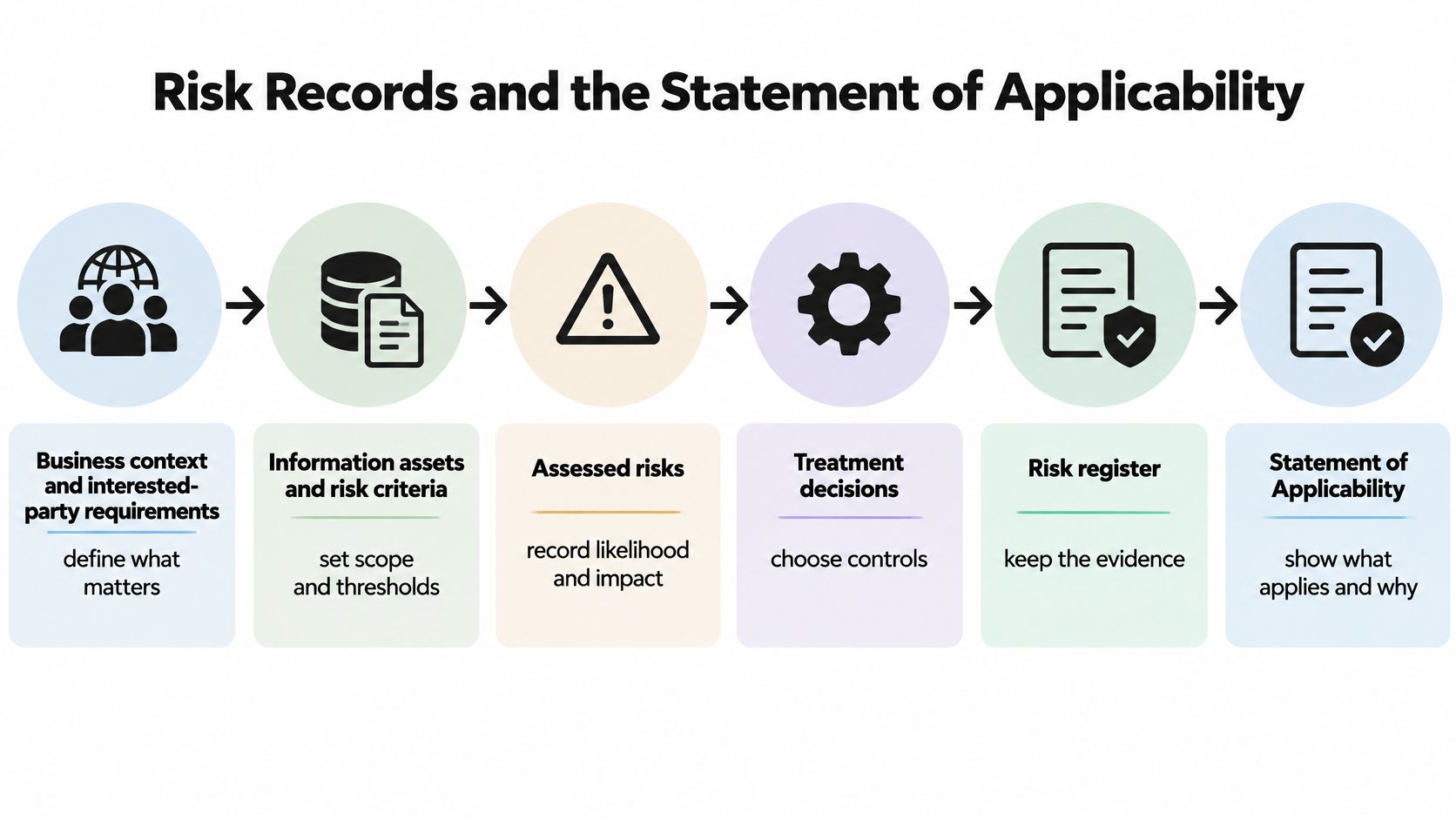
The chain runs in one direction: business context and interested-party requirements, then information assets and risk criteria, then assessed risks, then treatment decisions, then the applicability rationale in the Statement of Applicability, then control ownership, then operating evidence, then review and improvement. Break any link and the auditor has to take your word for something.
The register is the working record of each decision. It needs enough fields that a reviewer can follow the reasoning without interviewing you.
| Register field | What to record |
|---|---|
| Asset or process | The information asset or business process the risk affects |
| Threat and vulnerability | The source of harm and the weakness it exploits |
| Inherent likelihood and impact | The rating before existing controls are considered |
| Existing controls | Controls currently in place and their operating status |
| Residual rating | The rating after existing controls are applied |
| Treatment option | Modify, avoid, transfer or accept, with the reason |
| Accountable owner | The named person responsible for the treatment |
| Target date | The date by which the treatment must be complete |
| Acceptance authority | Who signs off any residual risk that is accepted |
What the Statement of Applicability Must Match
Clause 6.1.3(d) requires a Statement of Applicability covering every Annex A control in ISO/IEC 27001:2022, which lists 93 controls across four themes: organisational, people, physical and technological. For each control it records whether it applies, why it is included or excluded, and its implementation status. A blank is not a justification. If your organisation builds no software, excluding secure development controls is reasonable, provided the reason is written down.
The common failure is a mismatch between the SoA and the register. A control marked applicable with no linked risk suggests the SoA was copied from a template and never reconciled. SoA decisions also change over time, which is why the Statement of Applicability guidance and resources are worth revisiting at each review rather than once at implementation.
Pick five controls at random from your Statement of Applicability and trace each one back to a risk entry, a named owner and a piece of operating evidence. If any of the five breaks the chain, the rest probably do too.
Operational Records That Prove the ISMS Runs
An auditor who asks for last quarter's access review is not hunting for the access-control policy. They want the sheet that names the reviewer, the date, the accounts examined and the accounts removed. A policy works like the notice on a shop door. The record works like the till receipt: it shows the control ran.
That is the gap in many management systems. Writing policies and continuity plans has become more common. The file that proves a control operated on a named day, by a named person, with a recorded result is still thin. Certification sampling lives in that second file.
The Records Auditors Actually Sample
The records that surface in an assessment share three marks: a date, a person and an outcome. A write-up that only describes the process fails that test. These seven come up most often. Each one is tied to the clause that asks for it, with the sort of result a sample can follow.
| Record | Clause | A result that holds up |
|---|---|---|
| Training and competence log | 7.2 | The person, the training completed, the date, and how a manager confirmed they can do the role |
| Access review | A.5.18 | Reviewer, date, accounts checked, and leavers removed rather than noted for later |
| Supplier security assessment | A.5.19 | Questionnaire returned, risks noted, and the named person who accepted or rejected the supplier |
| Incident record and lessons learned | A.5.26 and A.5.27 | What happened, what was done, and the procedure that changed afterwards |
| Change assessment | A.8.32 | Security impact written down before a system, supplier or process went live |
| Backup and recovery test | A.8.13 | Test date, what was restored, and whether it met the recovery target |
| Corrective action | 10.2 | Cause identified, action taken, and a later check that the same failure did not recur |
Read a row across. If any cell is blank, the control may exist on paper and still have no evidence trail.
Scaling It to a Small Organisation
A charity of twelve staff does not need twelve documents. One risk register, one monthly review log and one incident log can carry the risk, competence and corrective-action trail, as long as each entry has an owner and a date. Combine two records when the trail still shows who did what and what resulted. Keep them apart when a combined log hides the outcome.
A template pack copied from the internet produces paperwork with no trail behind it. The first question about a named owner or a review date exposes the gap.
Where internal audit has to stay independent of the people who built the system, the ISO 27001 internal audit resources set out how to plan that cycle and record the findings.
Keeping Documents Current Between Audits
An ISMS rarely fails at the audit. It decays between audits, one outdated record at a time. UK survey results show how much ground there is to lose: only 25% of UK businesses had a formal incident-response plan and 36% had formal cyber-security policies in the latest available results (Cyber Security Breaches Survey 2025/2026), and many still have no business-continuity plan that covers cyber security.
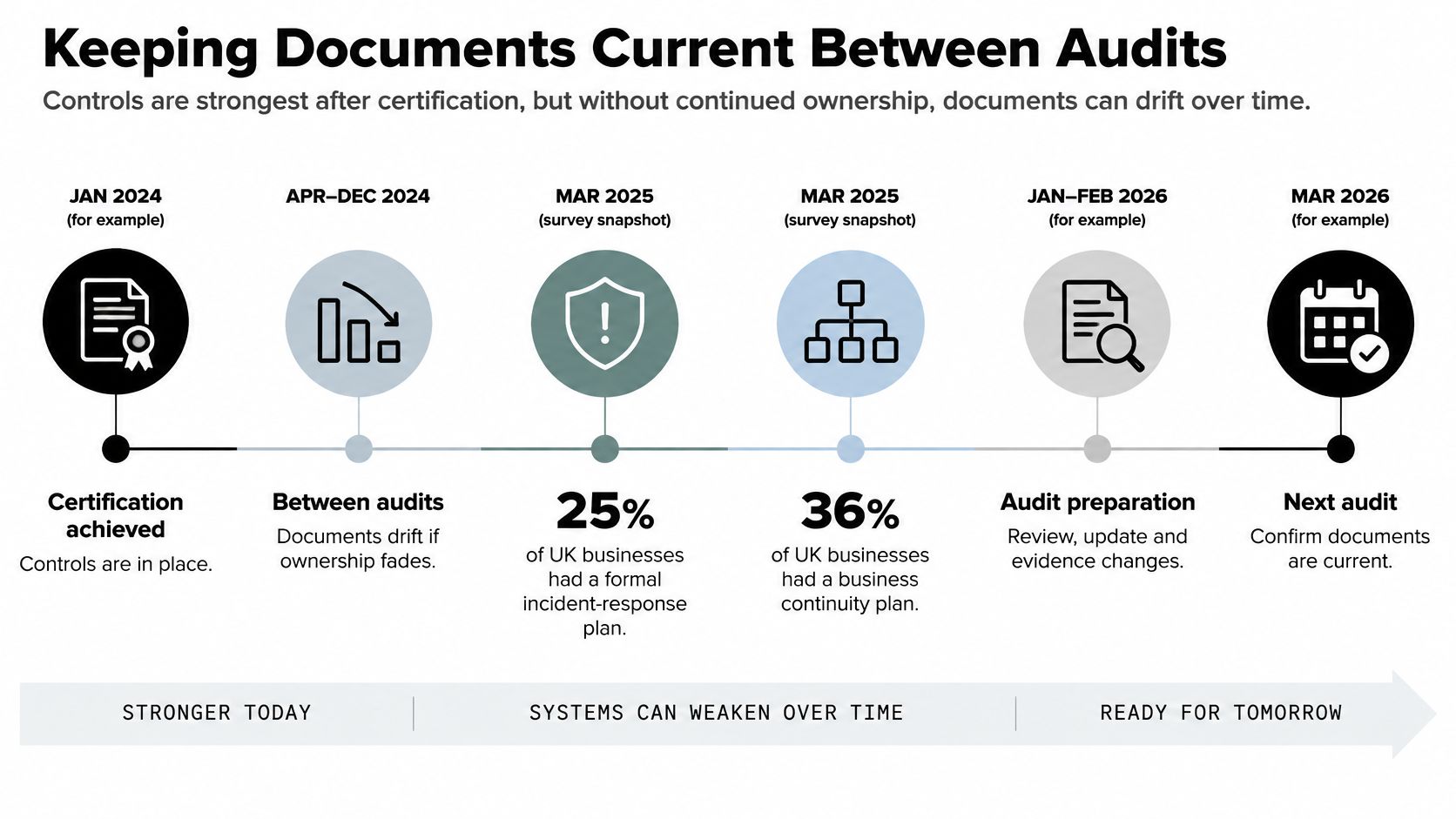
An organisation can hold a fully approved policy set and still lack current, tested records showing the system works during an incident, a supplier change or a cloud migration. The documents were true when they were signed. Nobody has checked whether they are true now. The evidence trail is only as strong as its last entry.
The Triggers That Force a Review
Scheduled annual review is a weak control on its own, because change doesn't wait for the calendar. Bind document review to events instead, and give each trigger a named owner who is responsible for acting on it.
- A significant incident: incident record closed, lessons learned logged, policy or control amended.
- A major technology change: asset register, risk register and control descriptions updated.
- A new or changed supplier: supplier assessment refreshed, SoA supplier controls reviewed.
- Restructuring: role ownership, competence records and access rights reassigned.
- A cloud migration: hosting locations, backup arrangements and supplier dependencies remapped.
- A material legal or contractual change: obligations reviewed against policy commitments.
- An approaching surveillance audit: evidence pulled together and gaps closed before the auditor arrives.
Change-driven review and operational testing tell you more about the health of your ISMS than a review calendar that gets met without anyone changing a decision.
Take one trigger in practice. A move to cloud hosting should update the asset register with the new environment, revise the supplier-control entries in the Statement of Applicability, and produce a fresh backup and recovery test record against the new platform. Three documents, three named owners, one event. The register owner updates what exists, the risk owner revisits whether the same controls still apply, and whoever runs recovery testing proves the backups restore. Do that as the change happens and the next audit is a formality; leave it and you rebuild the evidence months later from memory, which is exactly the kind of record an auditor discounts.
Certification decisions remain with the independent certification body throughout. Your job is to keep the evidence trail accurate, not to grade your own compliance.
Evidence Pack for Tenders and Customer Reviews
Buyers don't accept a general statement of compliance. Regulated and public-sector reviewers check specific facts against the certification body's register, and a missing expiry date can hold up a contract award.
| Evidence point | What the reviewer confirms |
|---|---|
| Certificate number | The certificate matches the certification body register |
| Registration date | Certification was granted on the stated date |
| Expiry date | The certificate is valid on the date of review |
| Organisation name and address | The certified entity is the supplier being assessed |
| Certification scope | The services, sites and systems covered are stated clearly |
| Statement of Applicability | The applicable controls and exclusions are visible |
| Processing locations | Each location handling the customer data is covered by the certificate |
| Copy of the certificate | The document presented is the issued certificate, not a summary |
The UK Health Security Agency's data security standards show the standard in practice. Their guidance, written around ISO 27001:2013 certification and worth checking against the current version before you rely on it, requires the certificate number, registration date and expiry date, the certified organisation's name and address, the certification scope, the Statement of Applicability, confirmation that each processing location is covered, and a copy of the certificate itself. An expired certificate is not accepted, and if validity lapses during the review, updated documentation is required.
Scope is where suppliers mislead themselves. Certification is scope-specific and time-bounded: it covers the activities, sites and systems named on the certificate and nothing else. A supplier whose certificate covers its London office but not the data centre hosting client data has to make that limitation explicit, because the reviewer will check. Keep controlled copies of the certificate, scope statement and Statement of Applicability in a dated folder, check expiry dates before every tender, and refresh the pack after each surveillance audit.
One point of principle: ISO Security is not a certification body and does not award, issue or guarantee ISO/IEC 27001 certification. The certificate comes from the accredited certification body, and the pack should reflect exactly what that body issued.
Common Documentation Mistakes and Their Fixes
The most common symptom is a policy everyone remembers approving and nobody can locate. That is rarely a filing problem. It usually means there's no controlled register with versions, owners and review dates, so documents live in inboxes, local drives and one person's memory.
| Symptom | Likely cause | Fix |
|---|---|---|
| Approved policies cannot be found | No central controlled register | Create one register with version, owner and review date for each document |
| Statement of Applicability justifications do not match practice | Justifications written once and never reviewed | Link each justification to a risk entry and review both at management review |
| Audit findings stay open for months | No owner or due date assigned | Assign an owner and date to each finding and track it to closure at management review |
| Evidence appears only before the audit | No recurring evidence capture schedule | Capture evidence per control monthly or quarterly with a named owner |
| Scope does not match the asset register | Scope not updated after change | Trigger a scope review whenever a site, supplier or system is added or removed |
Set realistic effort against each fix. A central register takes a day to build and an hour a month to maintain, and it removes an entire category of finding. Rebuilding a Statement of Applicability's justification set takes longer, often a few weeks, because each entry has to be traced back to a risk and checked against what the organisation does. Assign the register to whoever owns document control and the SoA rebuild to the person accountable for risk treatment.
Two mistakes deserve their own mention because they compound. Nonconformities that sit open without a named owner end up on the management review agenda as a list rather than a set of decisions, which turns a control into a ritual. Scope statements that were accurate at Stage 1 and haven't moved since a new site or system went live create a mismatch with the asset register that an auditor will spot in minutes.
A mistake you find yourself costs a day. The same mistake raised as a nonconformity by the certification body costs a corrective action cycle and, if it's serious enough, a delay to certification.
Each fix above is cheaper the earlier it lands, which is why the check that follows matters more than any single correction.
Confirm Your Documentation Gaps Before Certification
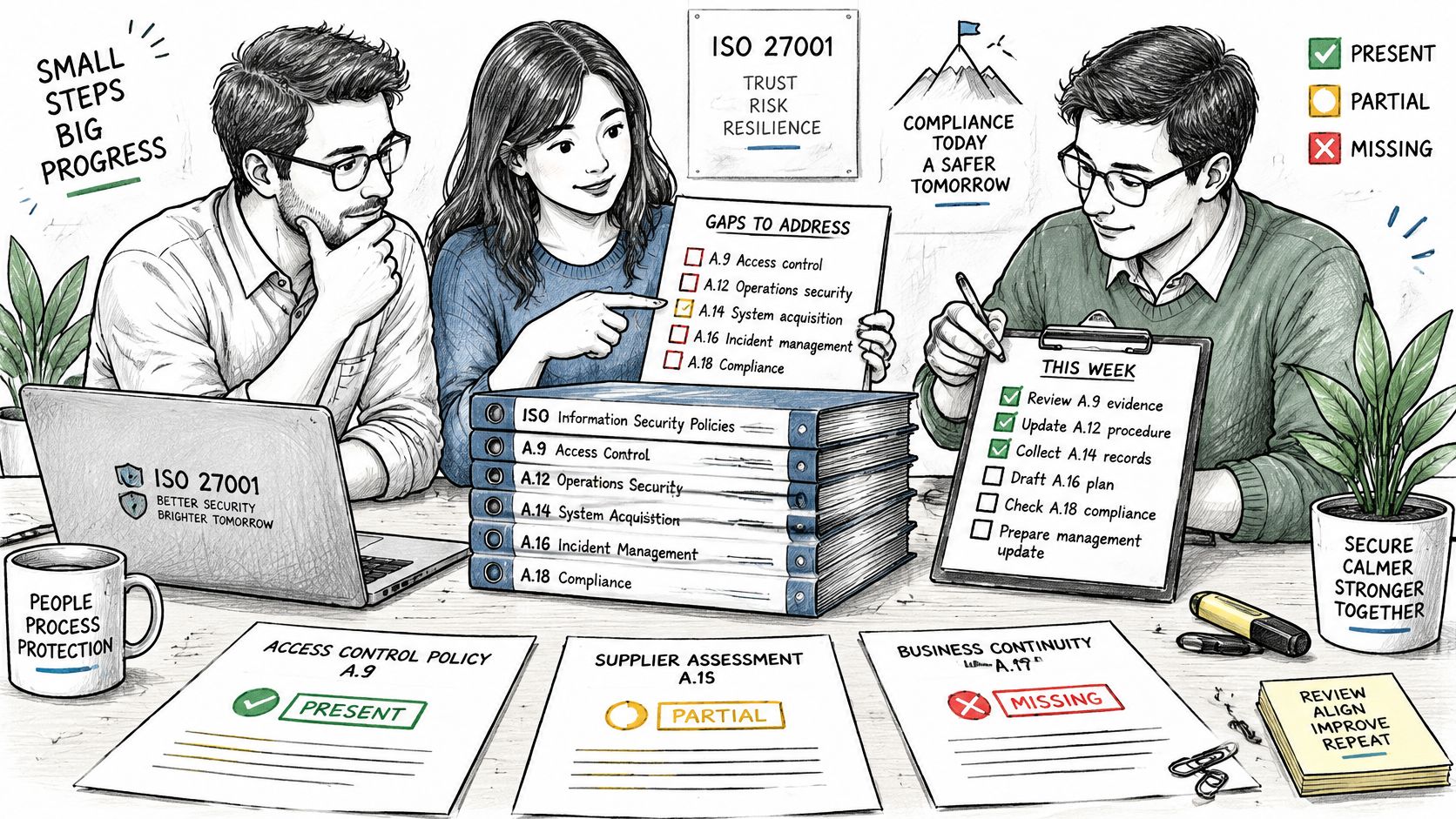
Work through this sequence once, this week, and you'll know where you stand before anyone books an assessment date.
- Compare against the mandatory table, clause by clause, and mark every item present, partial or missing.
- Check control metadata on each document you hold: owner, version number, approval date, next review date.
- Trace the Statement of Applicability entry by entry to a risk register entry and an accountable owner.
- Pull twelve months of evidence for each operational record type and note where the trail breaks.
- Commission a gap analysis that produces a prioritised action plan showing what must change before an auditor sees it.
A readiness discussion is the sensible starting point. We begin by explaining what ISO 27001 requires and asking about your objectives, likely certification scope, existing controls and timescale, because the right amount of documentation depends on your size, scope, complexity and current readiness. The gap analysis then turns that into a prioritised action plan. Certification decisions stay with the independent certification body.
The video below walks through the same ground from an auditor's perspective, which is useful when you're deciding how much evidence is enough.
If more than a few mandatory items come out partial or missing, book the gap analysis before you set a Stage 1 date. Moving the assessment is far easier than defending an incomplete management system in the room.
If you want the documentation set built around how your organisation works, ISO Security handles ISO 27001 implementation from scope and gap analysis through to independent certification support, then keeps the risk register, policies and audit evidence current through ongoing vISO oversight. We're a UK consultancy led by Alan Hutson, and we start by removing the mystique around what the standard requires before proposing anything new. Visit ISO Security to arrange a readiness discussion.