Fewer than a third of UK businesses conducted a cyber-security risk assessment in 2024, at 31%, and the figure for charities was 26%, according to the UK Government's Cyber Security Breaches Survey 2024. Sit that beside an organisation that holds client records in a cloud CRM, pays staff through a bureau and lets contractors log in from home, and you can see the size of what's been left unwritten.
An ISO 27001 risk assessment template XLS can carry that weight. Not because a spreadsheet is a good database, but because it's the file you can hand to an assessor, freeze the header row on and version properly. What fails is the downloaded template that turns out to be a scoring grid with no owners, no evidence column and no review date. An auditor spots that within the first few rows.
Table of Contents
- Why the Spreadsheet Has to Work as a Living Register
- Columns Your ISO 27001 Risk Register Needs
- Scoring Likelihood and Impact Without False Precision
- Rating Bands and Who Acts on Each
- Choosing a Treatment and Recording Who Accepts It
- Keeping the Register Current Between Audits
- Confirm Your Register Before the Certification Audit
Why the Spreadsheet Has to Work as a Living Register
In the previous 12 months, 75% of UK businesses reported carrying out activities to identify cyber-security risks, down from 86% a year earlier. Over the same period, only 21% reviewed the immediate cyber-security risks posed by suppliers, down from 36%, according to the Cyber Security Breaches Survey 2025. Activity held up. Documentation narrowed.
That gap is where templates fail. A file filled in once for the certification audit, then left alone until surveillance, records whatever was true on the day someone last opened it. Six months later it describes a supplier you've dropped, an office you've left and a system nobody uses any more.
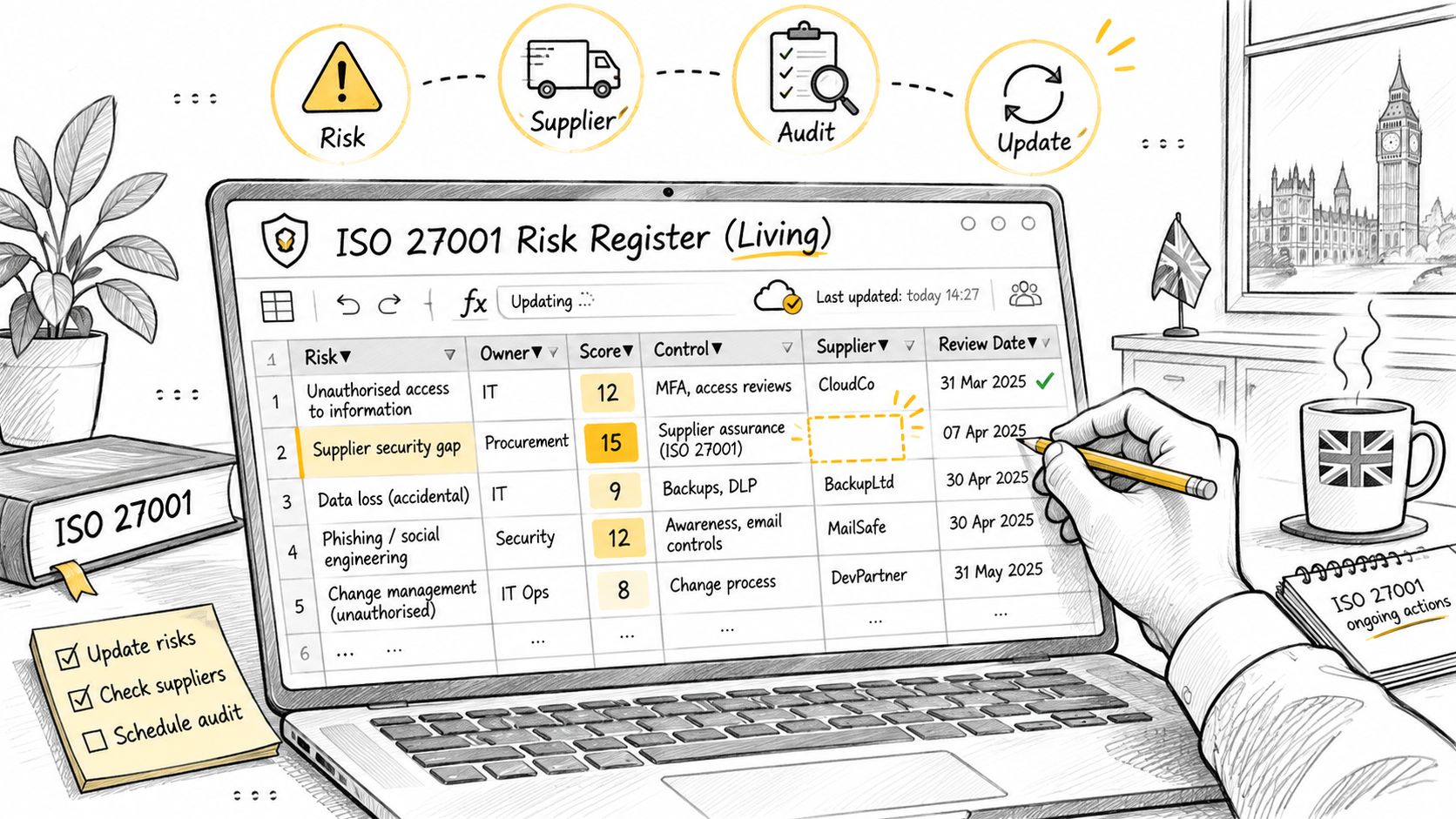
Every row has to answer three questions without anyone needing to ask. Who owns the risk, by name and job title? What was the score before controls and what is it after treatment? When was it last reviewed, and by whom? A register that answers those questions is a management record. One that doesn't is a document that happens to contain numbers.
Build the workbook in the order the risk travels: columns, then scoring, then bands, then treatment decisions, then the review routine, then a check you can run before the assessment team arrives.
Columns Your ISO 27001 Risk Register Needs
Structure the tabs in the order a risk is built, not the order that's convenient to fill in. Scope and context first, then assets, processes and suppliers, then threat and vulnerability statements, then inherent scoring, then existing controls, then residual scoring, then treatment, then ownership, then review history with evidence links. That sequence follows the NCSC cyber security risk management framework, which starts with organisational context and ends with monitoring and review.
| Column | What to enter | Example entry | Why it matters |
|---|---|---|---|
| Risk ID | Unique reference that never changes | R-014 | Lets actions and evidence link back to one risk |
| Scope and process | Business process or ISMS scope the risk sits in | Client billing, UK offices | Ties the risk to the certified scope |
| Asset or information | Information, system or supplier affected | Customer payment records in the cloud CRM | Shows what is actually at stake |
| Threat and vulnerability | Threat statement and the weakness it exploits | Phishing leads to credential theft; no MFA on the CRM | Makes the risk specific enough to test |
| Likelihood (inherent) | Score 1 to 5 before controls | 4 | Baseline for showing what controls change |
| Impact (inherent) | Score 1 to 5 before controls | 5 | Sets priority together with likelihood |
| Existing controls | Controls in place now, with an evidence reference | MFA on admin accounts, policy ISP-04 rev 3 | Records what already reduces the risk |
| Residual likelihood and impact | Scores after existing controls | 2 and 4 | Shows the risk left for a decision |
| Treatment decision | Modify, retain, avoid or share | Modify | Documents the choice the standard requires |
| Risk owner and action owner | Named person accountable for the risk and for each action | Finance director; IT manager | Makes sure someone can act |
| Due date and next review | Action deadline and reassessment date | 30 June 2026; six-month review | Shows the register stays current |
| Status and evidence link | Open, in progress or closed, with the path to proof | Open; ISMS/Evidence/2026/pentest-report.pdf | Gives auditors traceable proof |
The Risk ID is the spine. Actions, audit findings and evidence files reference it, so nothing gets lost when a title is reworded. Keep inherent and residual scores in separate columns. The inherent score shows what the business was carrying, the residual score is the one that drives the treatment decision.
Where Risk Statements Go Vague
"Hacker attack" cannot be tested, treated or evidenced. "Phishing leads to credential theft; no MFA on the customer CRM" names the weakness and points straight at the fix. Write every threat that way, with the vulnerability attached, and the control selection almost writes itself.
The same discipline applies to controls. A cell that says "access control in place" proves nothing. Reference the policy version, the system configuration or the test report that shows it working.
Test for a usable column: if you can't point to a file, a scan or a signed contract that proves the cell's claim, the column is decoration.
Set-up Choices That Save Time Later
- Freeze the header row and the Risk ID column. Anyone scrolling should never lose the column names.
- Add data validation dropdowns for every likelihood, impact, treatment and status field. Free text in a score column is how a register ends up with "high" next to a number.
- One named owner per row. Not a team, not a department. A person.
- Put risk appetite and escalation thresholds in the header block, so every score has a stated line that triggers action.
Scoring Likelihood and Impact Without False Precision
Write both scales in words before anyone scores a risk. A 1 to 5 range only works if two people assessing the same risk land on the same number, and that happens when the words say what the number means.
| Score | Likelihood (time frame) | Impact (measurable consequence) |
|---|---|---|
| 1 | Rare, once in ten years or less | Minor: no client data exposed, hours of disruption |
| 2 | Unlikely, once every few years | Moderate: limited data exposure, up to one day of disruption |
| 3 | Possible, about once a year | Significant: client data exposure or a day or more of service loss |
| 4 | Likely, several times a year | Major: client data exposure with contract penalties or regulator reporting |
| 5 | Almost certain, monthly or more | Severe: large-scale client data exposure, prolonged outage and reputational harm |
Multiply likelihood by impact and keep the result a whole number. Attach one sentence of reasoning to each score, so a reader can argue with the judgement rather than guess at it. Decimals and long formulas suggest a precision the team doesn't have, and they invite an argument nobody wins.
Threat events aren't abstract. 43% of UK businesses and 30% of UK charities reported experiencing a cyber-security breach or attack in the previous 12 months, according to Crowe UK's analysis of the government survey. Set your likelihood scale knowing that attacks land regularly, and reserve the low scores for genuinely rare events.
Calibrating With the People Who Run the Service
Scores agreed in a room full of risk managers are guesses. Run the calibration workshop with the people who operate the process, in their language, about the information they hold. Take the finance team's shared mailbox that holds supplier bank details and remittance advices. The team confirms it's targeted several times a year, so likelihood is 4. A successful compromise means a fraudulent payment and a client notification, so impact is 4. The product is 16, which lands in the critical band and gets escalated. Nobody needed a decimal point to reach that.
A score of 16 isn't more accurate than a score of 15. It means you've agreed what 16 looks like.
Run one check at the next review. If no score anywhere in the workbook has moved, the scales aren't being used. Someone is copying last quarter's numbers forward.
Rating Bands and Who Acts on Each
Bands turn a number into a decision, and the decision belongs to somebody. Map each inherent and residual score once the scales are settled, then publish the mapping so nobody has to interpret it at the point of pressure.
| Rating | Score range (L x I) | Escalation level |
|---|---|---|
| Low | 1-4 | Owner monitors; reviewed at the scheduled review |
| Medium | 5-9 | Action owner assigned; treatment planned within the review cycle |
| High | 10-15 | Treatment agreed before the next review; reported to senior management |
| Critical | 16-25 | Escalated immediately; treatment agreed with the board |
The bands are products of two scales. A 3 x 4 gives 12, which is High. A 4 x 4 gives 16, which is Critical and escalates. That's the whole logic, and it's why inconsistent scoring upstream wrecks escalation downstream.
Write the thresholds into the header block of the workbook alongside risk appetite. An auditor should be able to read the escalation rule off the first screen without asking for it. Moving a band boundary later is a governance decision with a date and an approver attached, not a quiet edit to a formula.
Choosing a Treatment and Recording Who Accepts It
The scores exist to force a decision, and the decision has four shapes. What matters is that the choice is written down with a rationale, a date and a signature, because an undocumented choice is indistinguishable from no choice at all.
| Option | Use when | Evidence to record | Who signs off |
|---|---|---|---|
| Modify | Controls can cut the risk to an acceptable level | Control reference, implementation date, test result | Risk owner |
| Retain | Residual risk is within appetite and treatment costs more than the risk | Acceptance rationale and review date | Senior management |
| Avoid | The activity creates risk that cannot be controlled | Decision to stop or change the process, with date | Senior management |
| Share | A supplier or insurer can carry part of the risk | Contract clause, insurance policy or supplier assurance report | Risk owner and contracts lead |
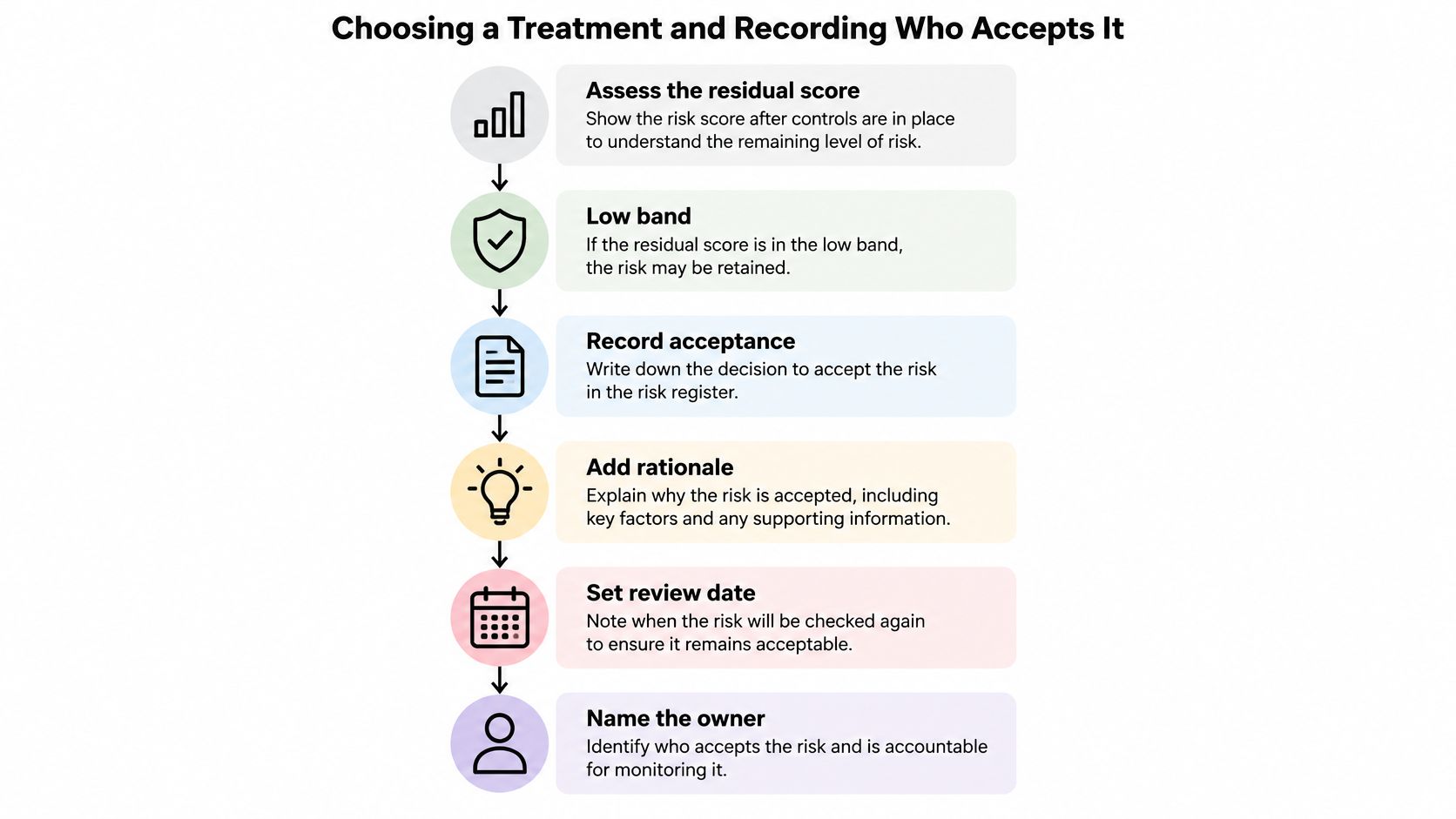
Work through the options in a fixed order rather than picking the cheapest. Start with the residual score against appetite. If it sits inside, retention is legitimate, provided the rationale and a review date are recorded. If it doesn't, ask whether a control can bring it down inside a time frame the business will tolerate. If it can't, decide whether the activity should change or stop. Sharing and formal acceptance come last, because they move risk rather than remove it.
Here's how the treatment process runs, in a format worth watching.
A supplier that stores customer data shows the sequence in practice. Suppose the residual score is High and appetite says that's too much. The control is a contract clause requiring breach notification within 24 hours plus encryption at rest, paired with a supplier assurance report obtained annually. The treatment is recorded as share, the evidence is the signed clause and the assurance report, and the action stays open with the procurement lead as action owner until both documents exist. Each treatment then maps to the Annex A controls you've applied and to the justification held in your Statement of Applicability, so the decision can be traced from score to control to evidence.
Rule of thumb: a risk accepted in a meeting and not written down hasn't been accepted. It's been forgotten.
Keeping the Register Current Between Audits
Set the review triggers before the first review, not after the first incident. The NCSC cyber security toolkit for boards expects organisations to choose a risk-management method suited to their business and technology, assess changes to risk at least twice a year, and maintain a cyber-risk register covering ownership and escalation across business units, subsidiaries, suppliers and partners.
Material change always prompts reassessment. Treat these as automatic triggers rather than judgement calls:
- New system or major upgrade that touches client or personal data.
- Office move or new site, which resets physical and network assumptions.
- New supplier holding client data, or a change in what an existing one can access.
- Security incident or a near miss that got logged.
- Audit finding from an internal audit, a customer audit or the certification body.
- Contract or regulatory change that alters notification duties.
Housekeeping That Keeps the File Credible
Lock formula cells so scores can't be overwritten by accident. Put a version number and date on the cover sheet. Keep an approvals tab showing who signed off each release, and a change log listing what moved and why. None of this stops a determined editor, which isn't the point.
Locked cells don't stop a determined editor. They stop an accidental one. That's the failure mode you'll actually meet.
A Routine Small Teams Can Hold
Smaller organisations don't need a committee, they need a calendar. A monthly sweep of open actions, a quarterly access review and a supplier check, each with one named owner, keeps the workbook honest without consuming anyone's week. For charities we keep controls to fewer, better controls owned by named people, on a calendar of risk review, access review, supplier checks and an incident log. The same rhythm works for an owner-managed business.
Keep closed actions in the register with their evidence link rather than deleting them. Deleted rows are the first thing an assessor asks about, and the history is the proof that the treatment happened. A short guide to how to maintain ISO 27001 certification between surveillance visits covers the wider cycle this routine feeds.
Confirm Your Register Before the Certification Audit
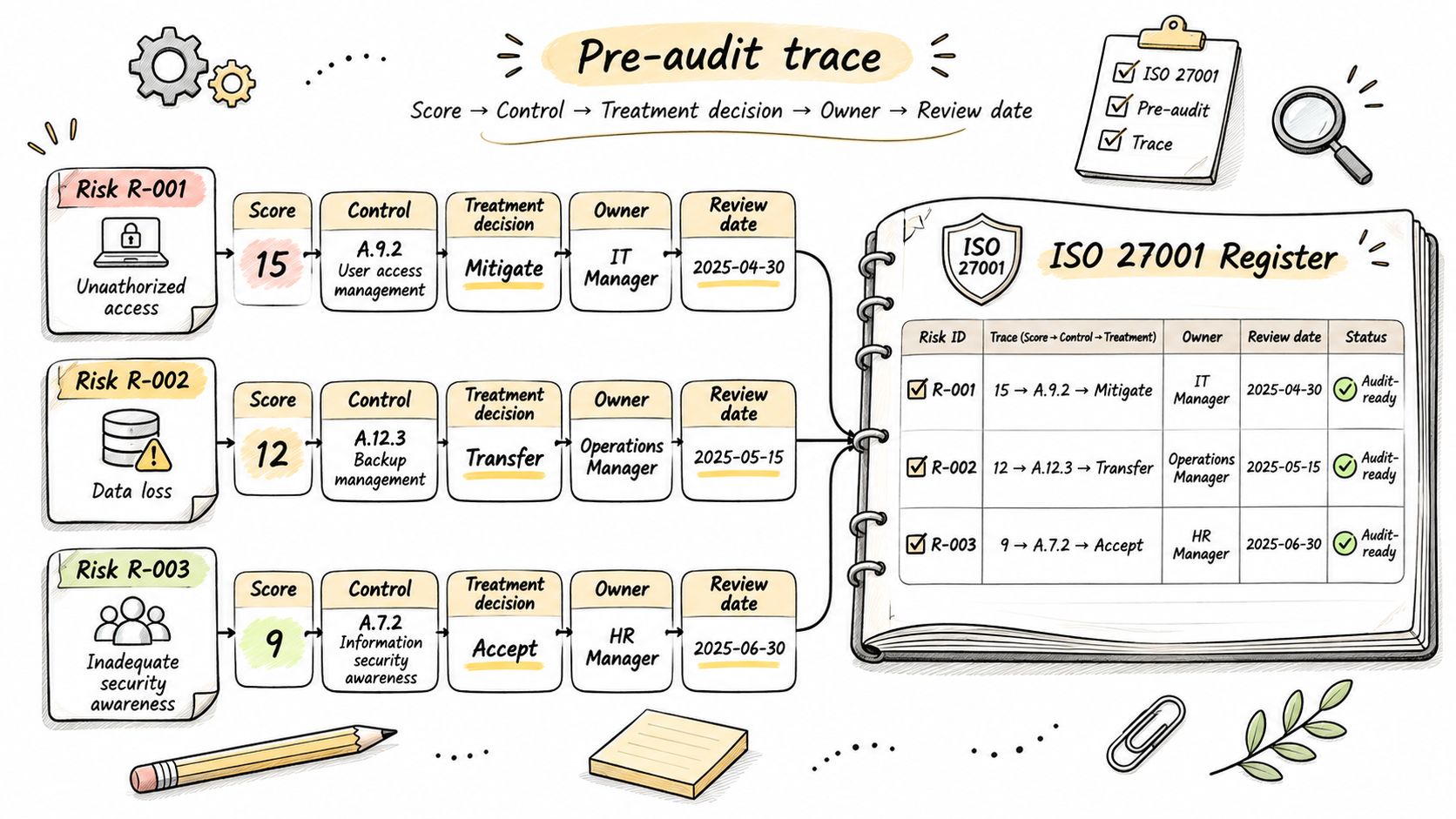
Run a three-risk trace before anyone external opens the file. Pick three rows at random and follow each one from the score, to the control, to the treatment decision, to a named owner, to an evidence file that opens. If any link is missing, fix that row rather than tidying the formatting.
The trace runs in one direction only.
Then run the checks that catch drift. Every row needs a named owner, a due date for open actions and a next review date that hasn't already passed. Scores that never changed across two review cycles, risks with no treatment decision and links pointing at folders that no longer exist are the three failures that come up most often. Ask the opening question one more time: could a new starter tell you who owns the top three risks and when each was last reviewed?
If the answer is no, decide whether to fix it internally or bring in help. External support tends to pay when a customer or tender deadline is close, when nobody internally owns information security, or when the workbook has drifted behind the ISMS it's supposed to describe. The first step in that case is a readiness discussion, where we explain what ISO 27001 requires and ask about your objectives, likely certification scope, existing controls and timescale. Mobilisation then reviews your existing ISMS documents, risks, controls, audits, management reviews and certification dates, using one day of the annual allocation. Where the documentation set as a whole needs work, these ISO 27001 documentation requirements set out what an assessor will expect alongside the register.
Set a date this month to run the three-risk trace. Diarise it, name who's doing it, and treat the findings as a work list.
If your register has rows with no owner, scores nobody can justify or evidence links into folders that have moved, ISO Security can help. We work with UK organisations on ISO 27001 implementation and ongoing vISO support, including the risk assessment workshops, methodology and treatment plan that sit behind a workbook an auditor can trace. Visit ISO Security to start with a readiness discussion about where your existing register and controls stand.