You have two-factor authentication on the finance system, a firewall logging every connection, and backups that run at two in the morning without fail. Then a customer's procurement team sends over a security questionnaire, 130 questions long, and asks for your last internal audit report, your risk register and your Statement of Applicability. You have the tools. You can't produce the paperwork.
That gap is where plenty of UK organisations sit, and it's why a certification project can feel far heavier than it should. The work isn't installing security. It's proving security, repeatedly, to people who weren't in the room when the decisions were made.
Table of Contents
- What Information Security Compliance Really Means
- Frameworks That Set the Rules in the UK
- Assigning Ownership and Documenting the System
- The Evidence Auditors Ask For and How Often
- How to Prepare for an Audit, Step by Step
- Common Compliance Failures and How to Fix Them
- Choose Your First Compliance Step This Quarter
What Information Security Compliance Really Means
Walk past a restaurant in any UK town and you'll see a food hygiene rating stuck to the window. That sticker proves an inspection happened on one particular day. It doesn't prove the kitchen was clean on the Tuesday three weeks later, and it certainly doesn't prove anyone washed their hands this morning.
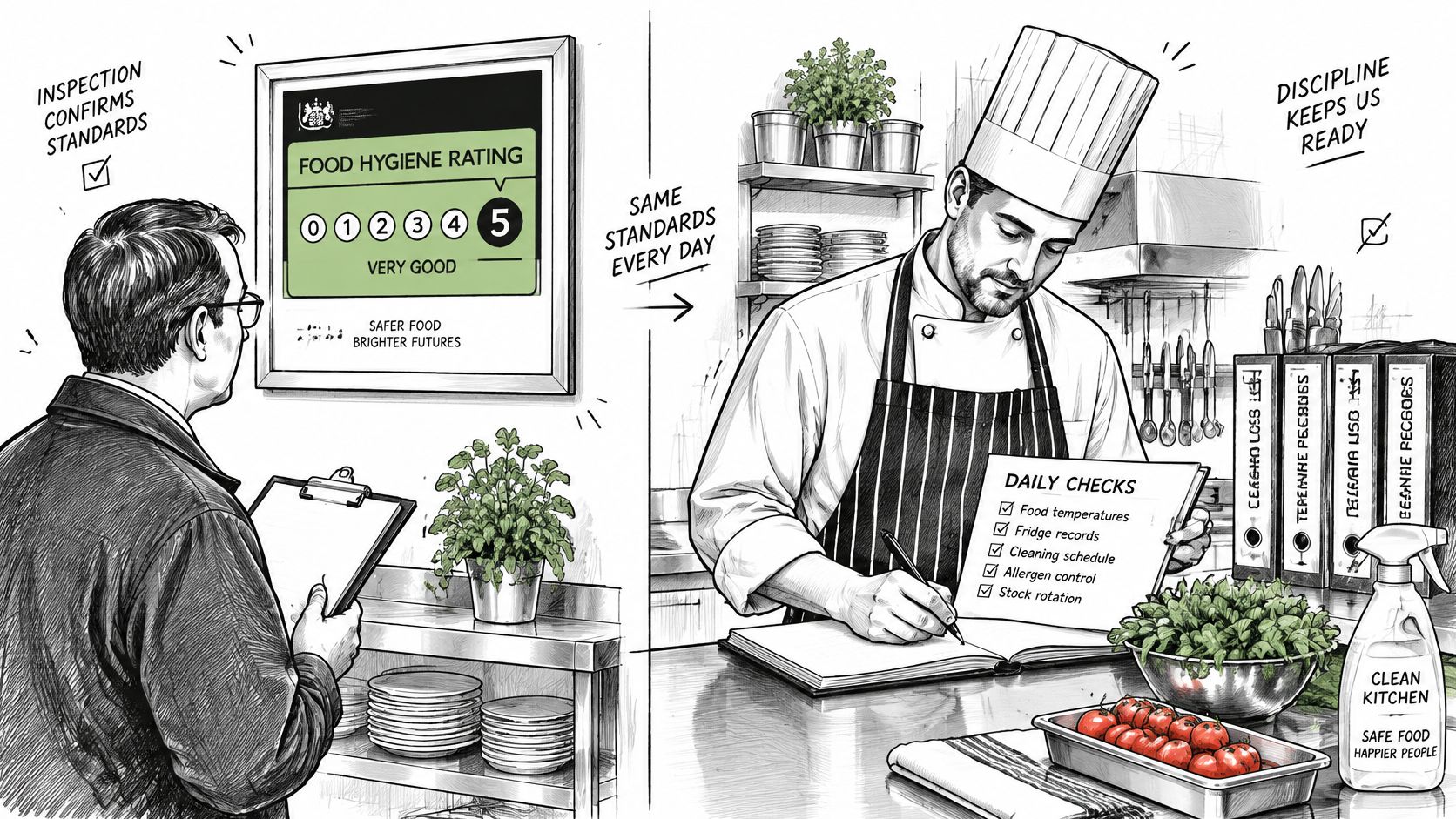
Information security compliance works the same way. It's the state where an organisation meets the security requirements it has signed up to, whether those come from law, a contract or a standard, and can show evidence that it keeps meeting them. The sticker is the certificate. The kitchen is the system.
The three parts of compliance
Every compliance question, however it's phrased, breaks into three parts.
- Requirements. What you've signed up to. UK GDPR, a customer contract with a security schedule, a tender that demands ISO 27001, or a regulator's rules for your sector.
- Controls. The measures that meet each requirement. Access control, supplier checks, backups, incident handling, patching, training.
- Evidence. The records showing those controls ran, when they were supposed to run, and who was responsible.
Most organisations are strong on the middle one and thin on the third. The UK Government's own figures show exactly that pattern.
Why tools don't add up to compliance
The Cyber Security Breaches Survey 2025 found that 43% of UK businesses and 30% of charities reported a cyber security breach or attack in the preceding 12 months. Yet only 39% of businesses had a formal cyber security strategy, down from 47% in 2024, and only 31% undertook a formal cyber security risk assessment.
Among large organisations the basic controls were close to universal. 98% had password policies, 96% maintained data backups and 92% required two-factor authentication. All that kit, and fewer than two in five businesses overall could point to a written strategy for using it.
The lesson: a firewall, a backup job and an MFA prompt are things you own. Compliance is the documented decision about why you own them, who checks they still work, and what you did when they didn't.
So run the check on your own organisation today. You have the controls, probably. Do you have a documented risk assessment naming the risks those controls address? Do you have records, dated and attributable to a role, showing the controls operated last quarter? And could you hand both to a stranger within a working day?
Frameworks That Set the Rules in the UK
Frameworks get discussed as if choosing one meant rejecting the others. In practice they overlap heavily, and what separates them is who they apply to and what an assessor will ask you to hand over.
| Framework | Who it applies to | What it asks for | Evidence auditors look for |
|---|---|---|---|
| ISO/IEC 27001:2022 | Any organisation choosing to certify its management system | Risk-based information security management system with Annex A controls | Statement of Applicability, risk treatment plan, internal audit reports |
| UK GDPR and Data Protection Act 2018 | Any organisation processing personal data | Appropriate technical and organisational security for personal data | Records of processing, data protection risk assessments, breach logs |
| NIS Regulations 2018 | Operators of essential services and relevant digital service providers | Proportionate security measures and incident reporting | Documented security measures, incident notification records |
| Cyber Essentials | Organisations wanting a baseline certification, often for government contracts | Five technical control areas, covering firewalls, secure configuration, security update management, user access control and malware protection | Completed self-assessment questionnaire and certificate |
| Cyber Essentials Plus | Organisations needing independent verification of technical controls | The same control areas, tested by an assessor | Technical test results and assessor report |
Why ISO 27001 sits above the rest
ISO/IEC 27001 is a management system standard. It doesn't tell you to buy a particular firewall. It tells you to identify your risks, choose controls that address them, run those controls, check they work, and improve. Annex A supplies the catalogue of controls to choose from, and the Statement of Applicability records which ones you selected and why.
That structure is what makes certification possible, and it's why one system can answer the others. UK GDPR asks for appropriate technical and organisational measures, and a documented risk assessment plus evidence of operation is one credible way to demonstrate them. NIS obligations on security measures and incident reporting map onto incident controls you'd already be running.
Cyber Essentials is narrower by design: a technical baseline confirmed through a self-assessment questionnaire, with Plus adding independent testing by an assessor. Larger customers and some public sector buyers push for the Plus version because it verifies rather than asserts. A side-by-side comparison of ISO 27001 and Cyber Essentials is worth reading before committing to either, because the two answer different questions.
Practical rule: build one management system, then map each framework's requirements into it. A control mapped once can satisfy a contract clause, a regulator and an auditor without a second set of paperwork.
Start by listing what binds you: your contracts, your biggest customers, your sector regulator and any tender you intend to bid for. That list, not a preference for one standard, decides your route.
One caution. This is a general comparison, so confirm your specific obligations with a qualified adviser for your sector before you plan any spend.
Assigning Ownership and Documenting the System
The most common reason a compliance programme stalls isn't technical. It's that nobody owns it. Controls get installed by whoever had the budget, then age.
Accountability is where the UK gap is widest. The UK Government's 2025 cyber security breaches survey found that only 25% of UK businesses had a formal cyber incident response plan, while just 15% formally reviewed cyber risks posed by immediate suppliers and only 6% reviewed risks across their wider supply chain. Board-level responsibility for cyber security sat with only 27% of businesses and 30% of charities, rising to 66% among large businesses. Training had reached just 19% of businesses and 21% of charities in the previous 12 months.
Read those numbers as a list of unowned jobs. No plan means nobody rehearsed. No supplier review means nobody asked. The fix is organisational before it's technical.
Who signs, who runs, who checks
Three levels of ownership work for almost any organisation.
A senior owner. One director or partner who signs off security decisions and accepts risk. Not a committee. A person whose name appears on the risk acceptance.
Control owners. Named individuals for each area: access reviews, supplier checks, incident handling, backups, training. Each one owns the schedule and the evidence for their patch.
A coordinator. Someone who keeps the register current, chases overdue items and prepares the management report. In a small firm this is a few hours a month, not a full-time post.
Say a 40-person professional services firm. The operations director owns supplier checks because procurement already sits with them. The finance lead owns access reviews because joiners and leavers hit payroll first. Both bring a one-page status update to a 30-minute monthly security meeting chaired by the managing director. That's the whole governance layer, and it's enough to answer a customer questionnaire without a scramble.
The documents that have to exist
Four documents do most of the work, and each one is short.
- An information security policy approved by management, dated, with a review date attached.
- A risk register listing each risk, its owner and the decision to treat, transfer or accept it.
- A Statement of Applicability naming which Annex A controls apply, which don't, and why.
- Written roles describing who is accountable for what, in plain language.
Put those responsibilities into job descriptions as well as into the policy. When someone leaves, accountability then stays with the post rather than walking out of the door with them. For a closer look at who should own your ISMS, the split between senior sign-off and day-to-day operation is usually the first thing to settle.
Outside help is useful here, but judge it on what it leaves behind. We work alongside the client's team rather than around it, because the ISMS has to be operated by the organisation long after the project ends.
The Evidence Auditors Ask For and How Often
A policy tells an auditor what you intended to do. A dated record tells them what happened. Most failed audits aren't failures of security. They're failures to produce the second thing.
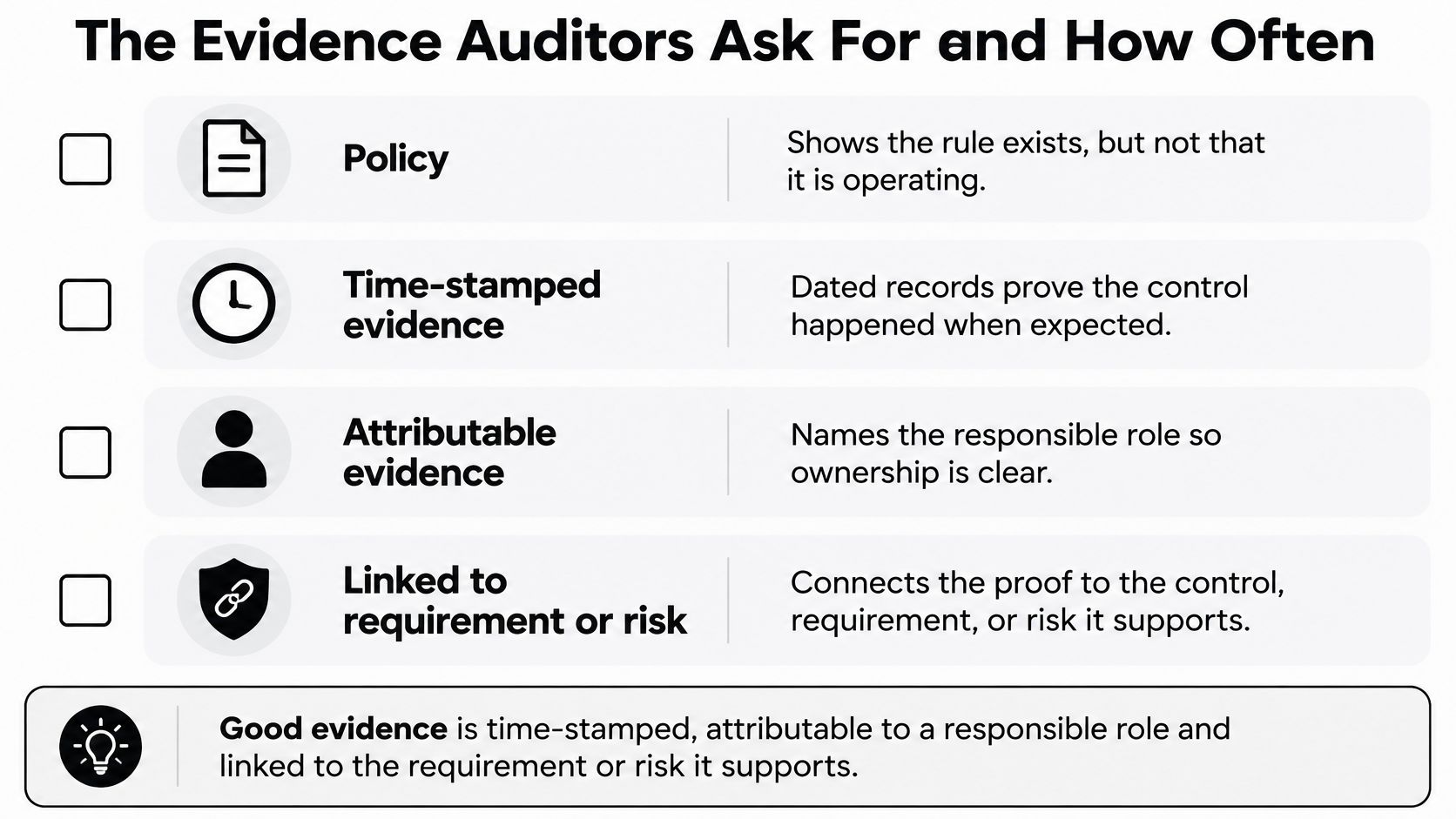
Good evidence passes three tests. It's time-stamped, so it shows when the control ran. It's attributable, so a name or a role sits behind it. And it's linked, so you can point from the record to the clause or the risk it satisfies. A screenshot of a settings page fails all three, because it shows a configuration at a moment rather than operation over a period.
Reported adherence and certified compliance aren't the same thing
The UK Government longitudinal research on cyber security behaviour found that 17% of businesses and 10% of charities reported adhering to ISO 27001, while 37% of businesses and 41% of charities reported adhering to neither ISO 27001 nor Cyber Essentials. Reported adherence is a self-description, not an independent certificate. The distinction matters because the evidence you maintain between audits is what an assessor samples.
What to keep and how often to refresh it
| Evidence | What it proves | Typical refresh |
|---|---|---|
| Risk register with treatment decisions | Risks are identified and accepted, transferred or treated | Reviewed at least annually and after any material change |
| Statement of Applicability | Which Annex A controls apply and why | Updated whenever controls or scope change |
| Internal audit report | Controls operate as written across all clauses | At least annually |
| Management review minutes | Leadership reviews performance and makes decisions | At least annually |
| Access review records | Only the right people hold the right access | Quarterly is common practice |
| Supplier security assessments | Third parties meet the organisation's requirements | At least annually, scaled to data access |
| Incident log and corrective actions | Incidents are handled and root causes fixed | Continuous, with closed actions verified |
| Policy approval records | Policies are approved, current and communicated | At least annually |
Those intervals reflect ordinary practice. Your own schedule should follow your risk profile and what your contracts promise. If a contract promises quarterly supplier reviews, quarterly is the answer regardless of what any table says.
If a walkthrough helps, this video covers the same ground from the auditor's side of the table.
Build the register once and stop rebuilding it
The practical habit is a single control-and-evidence register. One row per control, carrying an owner, a due date, where the evidence is stored, and a status. When something goes overdue it escalates to management with a decision attached: accept the risk, transfer it, or treat it by a set date. An unresolved item then becomes a recorded decision rather than a silent finding.
Keep a standing evidence pack that answers the standard security questionnaire: the current policy set, the Statement of Applicability, the latest internal audit summary and the outcomes of supplier assessments. Answer each new request from that pack instead of starting again. The ISO 27001 documentation requirements set out what has to exist and what's optional, which stops a small team drowning in paperwork it never needed.
How to Prepare for an Audit, Step by Step
Preparation has a sequence, and running the steps out of order is how teams end up rewriting the same policy twice. Here's the order that works.
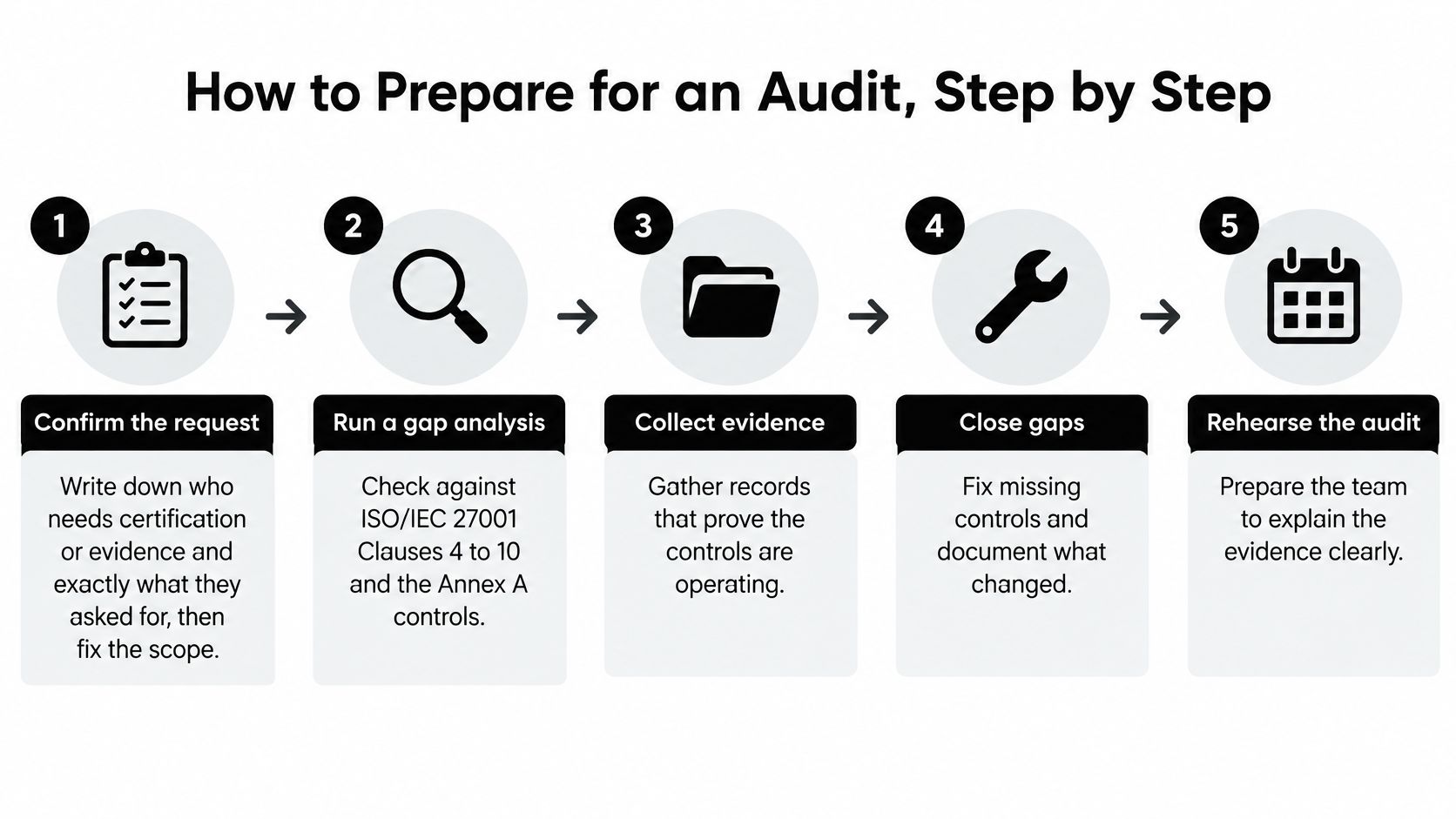
Confirm the request. Write down who needs certification or evidence and exactly what they asked for, then fix the scope. A customer asking whether you're "ISO 27001 compliant" and a procurement team demanding a certificate against a defined scope are different problems. The common slip is opening a policy template before reading the question.
Run a gap analysis. Check what exists against ISO/IEC 27001 Clauses 4 to 10 and the Annex A controls. The gap list becomes the work plan and keeps the project out of areas that don't affect certification. The slip here is a review carried out by the person who built the system, with nobody challenging it.
Complete risk assessment and treatment. Produce the risk register and the Statement of Applicability from that work. Do it with the people who run the services, in the language they use, covering the information they hold. A register written by an outsider and never opened again fails its purpose within weeks.
Write policies, implement controls, assign owners. Every control gets a name against it and a stated frequency. Two pages that people follow beat sixty that they don't. The slip is assigning an area to a team rather than to a person.
Run an internal audit and a management review. Close corrective actions with evidence attached to each closure. The system demonstrates that it can identify its own problems, which is exactly what a certification body wants to see.
Choose an accredited certification body and prepare for two stages. Stage 1 checks whether documentation and scope are ready for operation. Stage 2 samples operating evidence across a period and tests whether controls work as written. Our implementation route runs in six stages, from discovery and scope through gap analysis, risk assessment and treatment, ISMS design and implementation, internal review and audit preparation, to independent certification support. We attend the external audit and coordinate evidence and corrective actions.
Keep the evidence register live. After certification, surveillance audits sample exactly that register, so it's the object under examination rather than a by-product. Recertification is the same exercise at a larger scale, with a longer sampling period.
What a ready team looks like
Ask for evidence of any control and a prepared team produces it inside a working day: the record, the date, and the name behind it. That's the practical test, and it's the one that separates an organisation which passed an audit from one that is actively running a system.
The tell: if producing evidence takes a week of searching, the control isn't being managed. It's being reconstructed.
Common Compliance Failures and How to Fix Them
Almost every struggling compliance programme has adequate tools and no routine. The failures below repeat across sectors, and each fix costs time rather than money.
| Failure | Why it happens | Fix |
|---|---|---|
| Policies exist but nobody follows them | Written for auditors rather than daily operations | Map each policy to a named owner and a recurring review task |
| Supplier risk ignored beyond tier one | Only the main suppliers are considered | Tier suppliers by data access and review high-risk ones yearly |
| Corrective actions stay open | No due dates or escalation route | Set due dates and escalate overdue items to management |
| Controls bought but not operated | Tools deployed without an accountable owner | Name an owner and a measure for each control |
| Scope too broad or too narrow | Scope drawn without mapping services and data | Define scope around the services and data that matter |
A policy set nobody had opened
Say a firm holds a 60-page policy set, approved two years ago and untouched since. At its surveillance audit the assessor asks for last year's access reviews. There are none, because no review was ever scheduled. The policies promised reviews; nothing in the calendar made them happen.
The fix wasn't a rewrite. It was a quarterly access review of named systems, with the result filed in the register and signed by the reviewer. Two hours a quarter, and the policy became true.
Fix in the order that makes the rest easier
Start with ownership, then the evidence routine. Those two changes make every other fix provable, because from that point on the work leaves a record behind it. The reverse order, buying tools first, produces the situation most organisations are already in: strong defences, no story.
Put a name and a date on the work, and the audit becomes a review of records rather than an investigation of intentions.
Choose Your First Compliance Step This Quarter
One decision rule clears most of the confusion. Choose the route from what triggered the need, not from which standard sounds most impressive. If a customer, tender or regulator requires evidence, set the deadline and the scope first, because those two determine everything else. If nobody inside the organisation owns information security, appoint that person before spending a penny on tools. A control with no owner decays.
The first action this quarter is small enough to finish in a week. Draft a one-page gap view against the requirement you face, name an owner for each control area, and put a monthly evidence review in the calendar. That's the foundation everything else sits on.
Where the organisation needs outside help, we implement a practical Information Security Management System, prepare teams for independent ISO 27001 certification and keep them audit-ready through ongoing vISO support. That support suits certified organisations without an internal ISMS owner, growing businesses whose security responsibilities have outgrown informal processes, and leadership teams that need clearer reporting on security performance.
This article is general information about information security management and ISO/IEC 27001, not professional, legal or regulatory advice.
If you'd rather build the evidence routine once than rebuild it before every audit, we can help. ISO Security works alongside your team to scope the ISMS, run risk assessment and treatment, and keep the register current through surveillance and recertification. Visit ISO Security to start with a readiness discussion about who is asking for certification and exactly what they've requested.