Most UK boardrooms contain a quiet misunderstanding, and both sides of it are polite. Directors believe they have delegated cyber risk to the IT team. The IT team believes the directors have accepted it. In 2024, 30% of UK businesses had board members or trustees with explicit responsibility for cyber security, according to the Cyber Security Breaches Survey 2024.
The remaining seven in ten did not lack antivirus or a firewall. They lacked a decision-rights map: a written answer to who may accept a risk, who funds the fix, and who signs the exception when the fix slips a quarter.
That map, the monthly cycle that keeps it current, and the indicators a board can read without a technical translator are what make accountability provable. Frameworks describe what good looks like. Decision rights decide whether it happens.
Table of Contents
- What IT in Governance Really Means
- Who Is Accountable for Each Decision
- The Governance Cycle That Keeps Decisions Current
- Turning IT Risk into a Board-Level Risk
- Linking Technology Spend to Business Objectives
- What Good Governance Looks Like in Practice
- Your First 90 Days of IT Governance
What IT in Governance Really Means
IT in governance is not the IT department's job, and treating it as one is the fastest route to controls nobody owns. The department operates systems. The board governs the decisions about them, and those decisions are what auditors and customers test when they ask how security is directed.
The three duties a board cannot delegate
Accountability. Every critical service and every category of sensitive information needs a named owner. Decisions get written down, and something happens when an action slips past its date. An owner in name only is worse than no owner, because it looks like coverage.
Risk oversight. The board agrees an appetite before it needs one, keeps a live risk register, and escalates by business impact rather than scanner severity. A high-scoring vulnerability on a system holding no customer data can matter less than a moderate access gap on the finance ledger.
Alignment. Technology spend, change and supplier choices tie back to stated business objectives, and somebody measures the result after delivery. Without that link, governance becomes a compliance ritual running parallel to how the organisation makes money.
Governance, defined: IT in governance is the set of decision rights, accountability and assurance that determines how technology, information and suppliers are directed, funded and held to account. Management drives. Governance decides who may authorise the route.
That driving analogy survives contact with real board packs. Governance sets the destination, the rules of the road and who can approve a detour. Management holds the wheel. A board that starts choosing the route has stopped governing and started managing, and a board that never asks where the car is going has abdicated.
The map below shows where responsibility for decision rights, accountability and assurance sits.
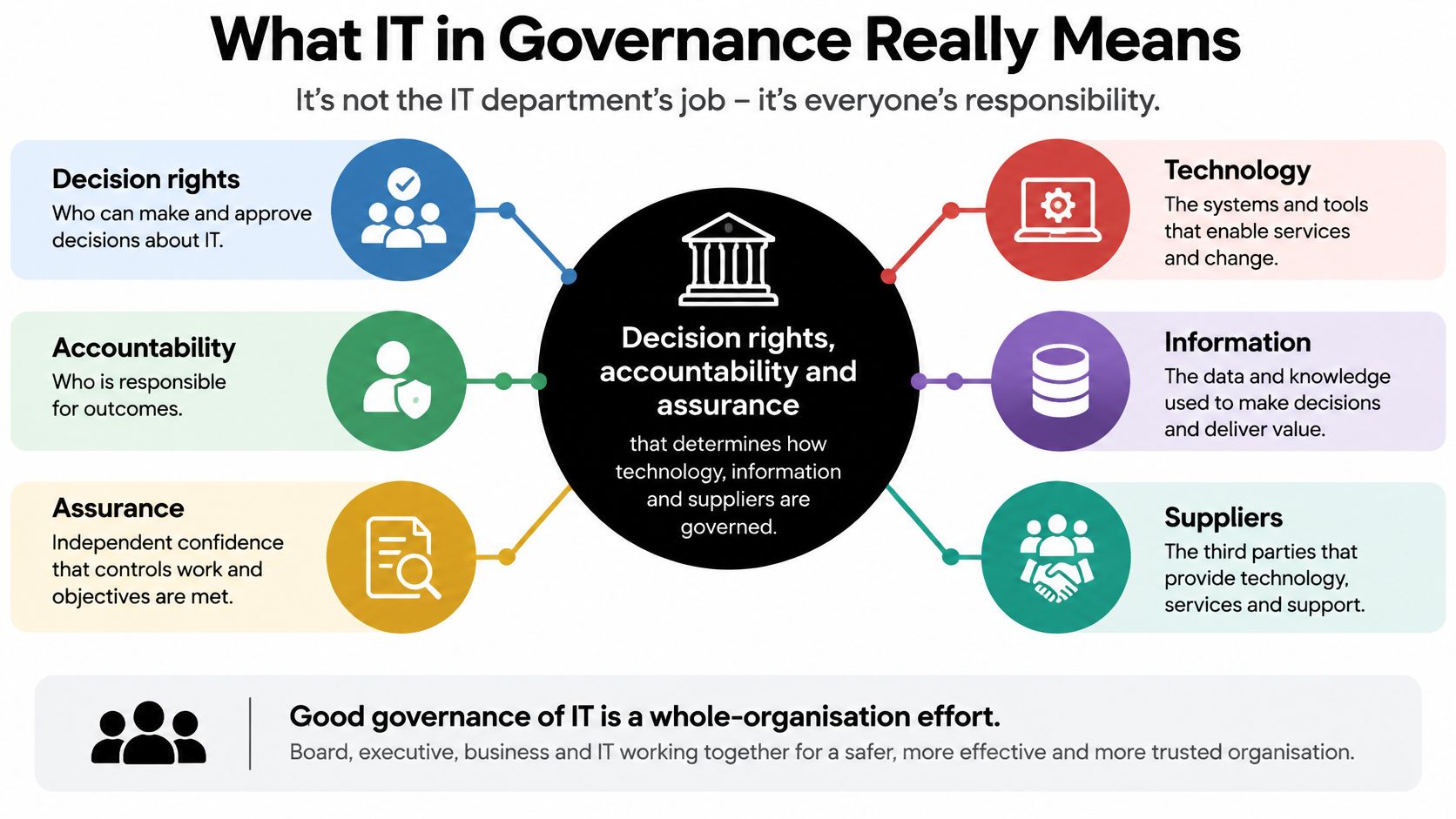
Oversight is spreading. In 2024, 55% of UK businesses reported having at least one board member whose role included oversight of cyber security risks, according to the UK government's Cyber Security Longitudinal Survey, Wave Three. That is progress, and it is not accountability. A director who receives a security report has oversight. A director who signs an appetite statement and accepts a named residual risk above it has accountability.
Ambiguity is the reason most management systems stall between audits. People wait for a decision that nobody realises they were entitled to make, and the cycle loses a quarter every time. Remove the ambiguity and the system runs on its own evidence.
Who Is Accountable for Each Decision
Six layers of accountability run through any organisation that has to answer for its technology. Most mid-sized UK firms operate four of them and assume the other two are covered. They usually aren't, and the gap stays invisible until a tender asks who approved a risk exception in February.
The table below is the artefact I would take into the next board meeting. It separates the layer that is accountable from the layer that operates, and it names the evidence before anyone starts arguing about budget.
Accountability map for IT in governance
| Layer | Accountable for | Decisions they own | Evidence they must show |
|---|---|---|---|
| Board or trustees | Scope, risk appetite, resources and residual risk | Accept, reduce or reject risk above appetite; approve scope and budget; approve major change | Signed scope, risk appetite statement, board minutes, accepted risk decisions |
| Executive team (CEO, CFO or audit committee) | Cross-functional prioritisation and funding | Fund or stop technology investment; assign executive owners; resolve competing priorities | Investment decisions, benefit reviews, performance reporting, action escalation |
| CIO or Head of IT | Operation of technology and controls | Service changes, access model, patching and resilience standards, incident response | Service and control reports, incident records, change logs, remediation plans |
| Information security lead or vISO | The management system and assurance | Risk register updates, control testing, policy exceptions, audit coordination | Risk register, control evidence, audit findings, management review pack |
| System and control owners | Operation and evidence for named controls | Local access, backup, supplier and change decisions within policy | Access reviews, backup tests, supplier checks, training and incident records |
| Internal audit and certification body | Independent assurance | Audit scope and opinion; certification decision | Audit report, findings and closure evidence, certificate and surveillance report |
Read it from the top. The board keeps the decisions that cannot be outsourced: what is in scope, how much risk is tolerable, which resources are approved, and who formally accepts whatever remains. That position holds when every technical control sits with a managed service provider. Your organisation retains accountability for the ISMS, control operation, technical implementation, risk acceptance, management decisions and remediation, and no contract transfers it.
The board-versus-IT misunderstanding
The failure is symmetrical and quiet. A board assumes the operations director owns cyber risk, because she presents on it every month. The operations director assumes the board has accepted the risk, because nobody has ever challenged the slide. Both positions sound reasonable. Neither survives a customer questionnaire asking who last approved an exception, or an auditor asking for the minute in which appetite was set.
Smaller organisations are not just short of technical controls. They are short of an operating model that produces decisions. The UK Cyber Security Breaches Survey 2025/26 found that only 31% of businesses had explicit board-level responsibility for cyber security, against 68% of large businesses, with the figure at 30% for charities.
Outsourcing the technical work doesn't move the accountability, and it shouldn't. Judge a virtual security lead on the quality of decisions, evidence and escalation the arrangement produces, not on how much technical work it absorbs. Getting that division wrong is common enough that who should own your ISMS is worth reading before anyone redraws the org chart.
The Governance Cycle That Keeps Decisions Current
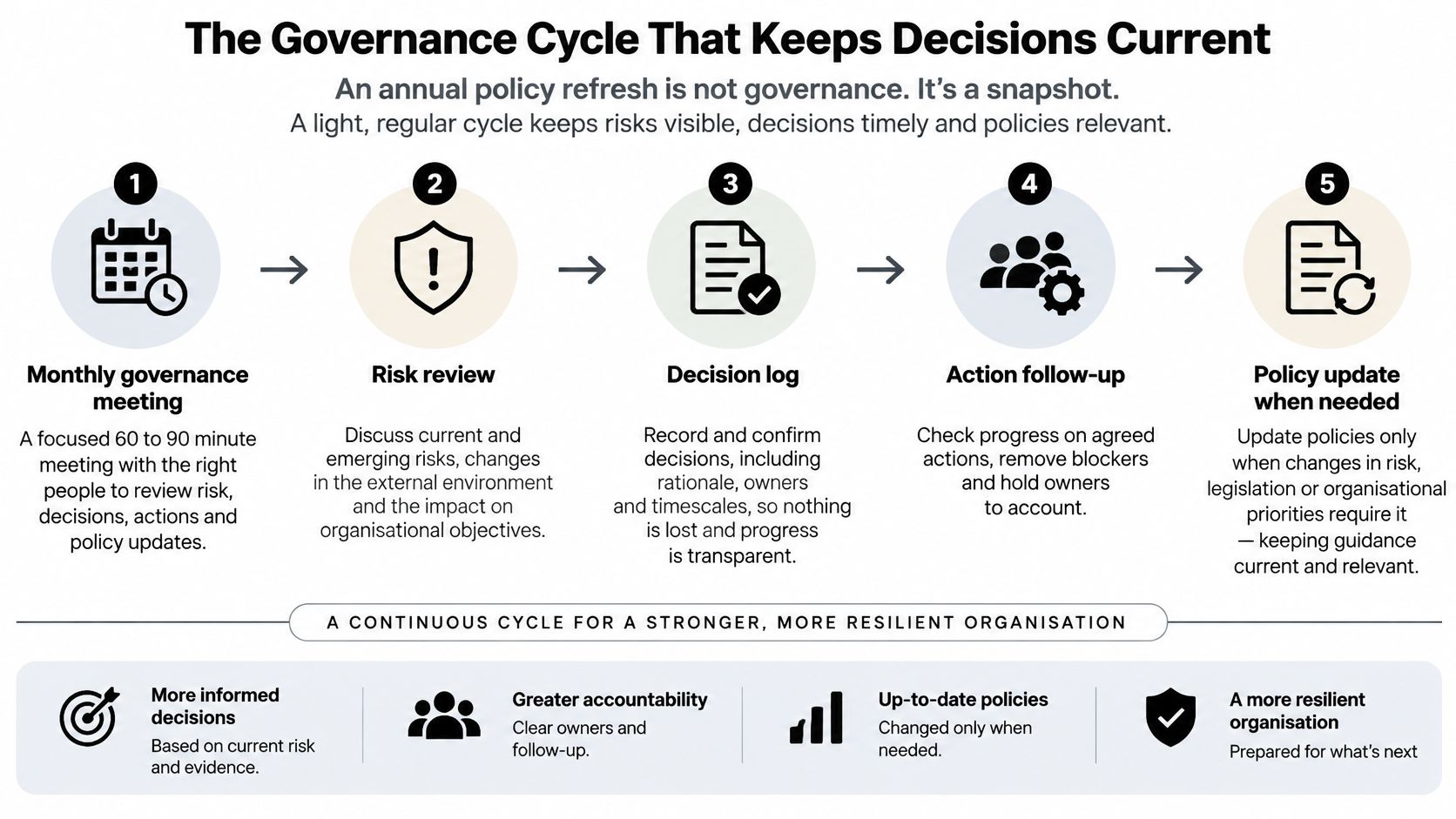
An annual policy refresh gives you a filing date. It does not show whether a decision was made in March, challenged in June and recorded in November. Governance needs a cycle that carries decisions forward, with named owners, fixed review points and evidence that survives between audits.
NCSC's cyber governance guidance for boards sets out why board-level oversight matters, but guidance alone does not create oversight. Assigning a responsible person closes part of the gap. The harder part is making that person report into a rhythm that produces decisions, escalations and records while there is no external assessment due. A named individual without a fixed cycle produces sporadic oversight, and sporadic oversight produces evidence assembled in a panic the week before assessment.
The cadence that keeps oversight real
Five rhythms are enough for many organisations. A small team can run them without turning security into a separate management system that sits beside the business.
| Cadence | Forum | Who attends | Decisions | Evidence produced |
|---|---|---|---|---|
| Quarterly | Risk and assurance review | Executive owner, security lead, control owners, finance, internal audit observer | Confirm residual risk against appetite, approve treatment plans, review supplier tiers, sign off board report | Board report, exception register, supplier review record, treatment plan |
| Biannual | Management review | CEO or trustees, executive team, security lead, control owners | Agree objectives, resources, improvement actions and audit follow-up | Management review minutes, improvement plan, resource decisions |
| Annual | Strategy, scope and audit planning | Board or trustees, executive team, security lead, internal audit | Reconfirm scope and appetite, approve audit plan and budget, set surveillance and recertification dates | Scope statement, risk appetite, audit plan, budget approval |
| Triggered | Change or incident review | Relevant service owner, security lead, executive sponsor, supplier manager | Decide on material change, incident escalation, supplier or architecture approval | Change record, impact assessment, incident report, decision note |
The monthly slot is the engine. It needs no committee paper and no new title. Give it sixty to ninety minutes, a standing agenda and a chair who can force a decision. The agenda stays narrow: changes to the risk register, actions past their target date, incidents since the last meeting, supplier or contract triggers, and change requests awaiting approval.
The cycle is deliberately predictable: risk reviews, policy reviews, action tracking, internal audit activity and management reporting, at a cadence that suits the organisation. Once responsibilities and priorities are agreed, the year can be planned. That matters because the trade-off is real. A regulated firm can overload an ISO 27001 management system with governance, and a system nobody can operate between audits is worth very little. Fewer meetings with clear outputs beat a full calendar nobody can sustain.
If you'd rather hear the cycle described than read it, the walkthrough below covers the same ground.
The quarterly review is where the ISO 27001 management review earns its keep, because it forces three questions onto paper: what changed, what did we decide, and what evidence exists that the decision was carried out. Keep the monthly meeting to 45 minutes with a dashboard and one rule.
Practical rule: a risk that hasn't changed, an action that hasn't slipped and a supplier that hasn't triggered anything gets one line, not a discussion.
Turning IT Risk into a Board-Level Risk
Technical severity and business consequence are different scales, and organisations that confuse them fund the wrong fixes while the board reads a list it can't act on.
The fields every risk entry needs
A register that can be governed has the same ten fields in every row. Risk ID. The business service or objective affected. Threat and vulnerability. Inherent likelihood and impact. Existing controls. Residual rating. Accountable risk owner. Treatment decision, whether accept, mitigate, transfer or avoid. Target date and evidence of closure. Review date.
Nothing goes on the register without a named owner senior enough to accept the consequence. If the owner can't fund the treatment or escalate beyond their own budget, they aren't the owner.
Appetite written as decisions
Write appetite by category rather than as one number: customer data, service availability, regulatory obligations, supplier concentration, and safety where it applies. Each statement carries a threshold that forces escalation. "No customer data outside the approved platform without board approval" is an appetite. "We take security seriously" isn't.
The UK government's 2025 Cyber Security Breaches Survey found that only 27% of businesses had a board member with explicit responsibility for cyber security, rising to 66% among large businesses. Without a named executive owner, cyber risk stays an IT concern rather than an enterprise risk requiring appetite, funding and formal assurance. The governance expectations that follow are straightforward: identify the technology, information and services critical to objectives, assign senior ownership, integrate cyber risk into enterprise risk management and internal controls, define appetite, and require regular assessment.
The board page and its triggers
| Indicator | What it tells the board | Escalation trigger |
|---|---|---|
| Top risks by business impact | Whether the largest exposures match the stated appetite | Any residual risk above appetite or without an owner |
| Overdue treatment actions | Whether agreed risk reduction is actually happening | Any action past its target date, or more than two actions overdue in one area |
| Incidents and repeat incidents | Operational resilience and control failure patterns | A reportable incident, repeated cause, or contractual or regulatory impact |
| Supplier assurance gaps | Concentration and third-party dependency risk | A critical supplier without current assurance or incident-notification terms |
| Audit findings | Independent view of control effectiveness | A major finding, repeat finding, or unresolved finding past its deadline |
| Policy exceptions | Where practice has drifted from policy | An exception nearing expiry or repeated renewal without treatment |
Supplier assurance is where the register usually goes quiet. The latest NCSC board-governance data, published with the Cyber Governance Code of Practice, reports that only 48% of large organisations review cyber risks from immediate suppliers and only 24% assess wider supply-chain risks.
A regulated firm can overload an ISO 27001 management system with governance, and a system nobody can operate between audits is worth very little. Ten live risks with owners beat sixty rows nobody reads. Start from the risk assessment and prune hard. The test of the whole arrangement is simple: can a director explain the top three risks, and what happens if each one lands, without a single piece of technical jargon?
Linking Technology Spend to Business Objectives
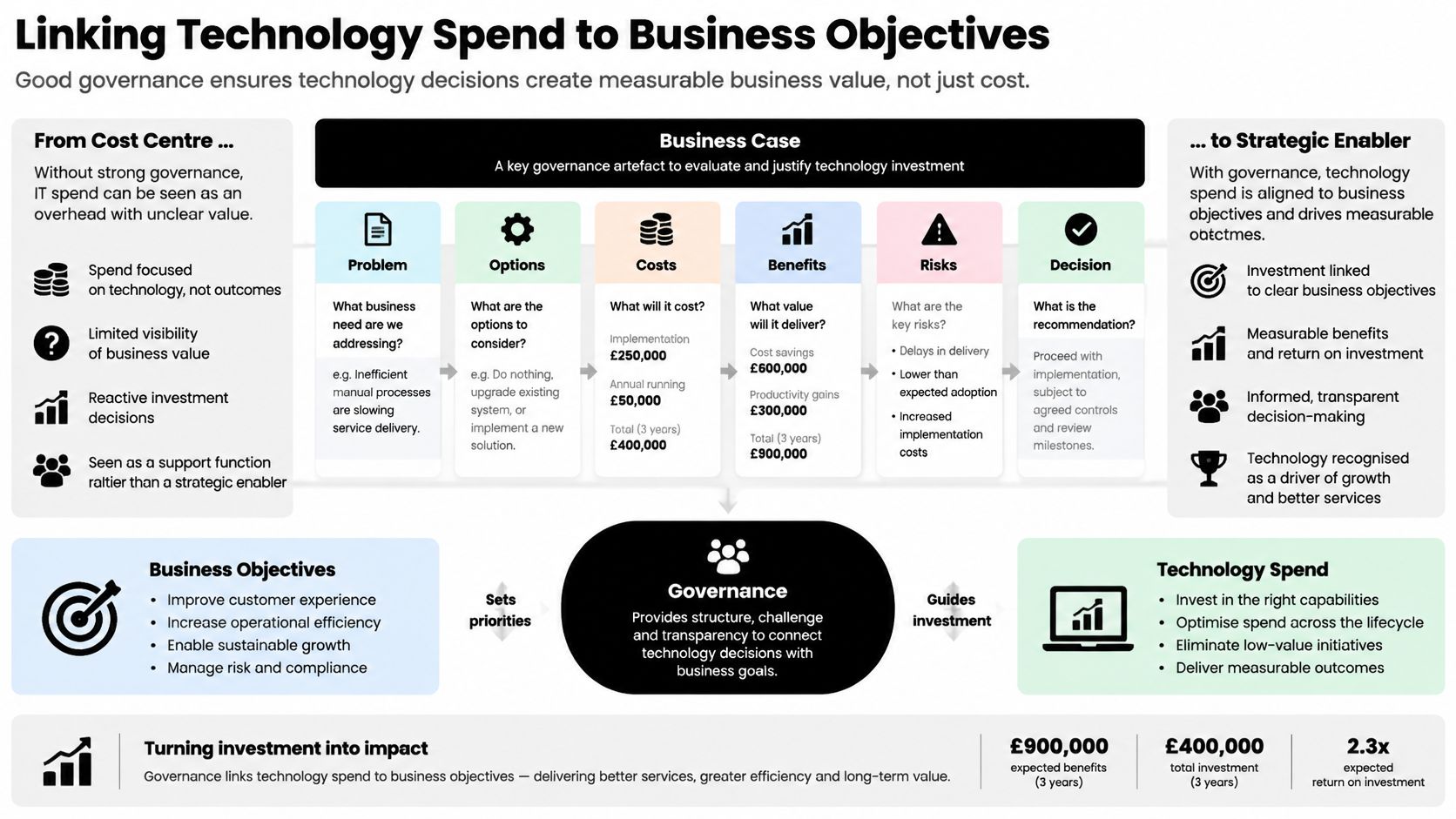
A business case is a governance artefact, not a funding ritual. It records the decision the board made, and it's the only document that lets you check later whether the promise held.
The scale of that promise is why it matters. In 2009, UK public-sector IT expenditure totalled £17.9 billion, and only 8% of it went on software, according to the UK government's blueprint for modern digital government. The same analysis estimated unrealised savings and productivity benefits of £45–87 billion a year, equivalent to 4–7% of public-sector spending, and noted that digital expenditure ran 30% below benchmarks in industry and other governments. Large budgets don't produce value on their own. Prioritisation, appraisal and outcome tracking do.
What a business case has to contain
- The problem, stated in operational or commercial terms, with a baseline measurement.
- The options considered, including doing nothing and the cheapest partial fix.
- Total cost, with run costs, licences and internal effort for three years, not just the build.
- Benefits with named owners, each with a measure and a date.
- Risk, dependencies and the exit route, including what happens if the supplier fails or the contract ends.
A portfolio view does the sorting. Split the estate into run, grow and transform, then force explicit decisions on legacy systems, duplicated tools, contracts and skills. Run work rarely gets scrutiny because it looks inevitable, and that's exactly where overlapping licences and forgotten renewals live.
Benefits tracking is where most governance fails. Every approved initiative gets a baseline, a target, a measurement date and an owner. Any initiative whose benefit isn't evidenced at the review point gets rescoped or stopped. For a regulated firm, scope the whole conversation around the regulated activities and data, confirmed with leadership, so the technology discussion keeps its commercial anchor.
The hard rule: an initiative with no measured benefit at its review date gets rescoped or cancelled, and the decision goes in the minutes either way.
The board sees four measures: service availability against target, incident cost and repeat rate, audit findings and their closure, and benefit realisation against the business case. Everything else is operational detail.
What Good Governance Looks Like in Practice
Three implementations at three scales show the same pattern, which is why I don't treat them as separate success stories.
At Chaucer, the Lloyd's insurer, existing policies, risk processes and governance forums were mapped against ISO 27001 so the business did not have to build what it already had. The work was led from inside as GRC Lead, with accountability staying with the firm rather than migrating to a consultant's template.
At Lean Tree, an employee-owned digital transformation consultancy, consultants handle client information every day. Scope and controls had to fit how people worked, because a generic control set would have been ignored within a month.
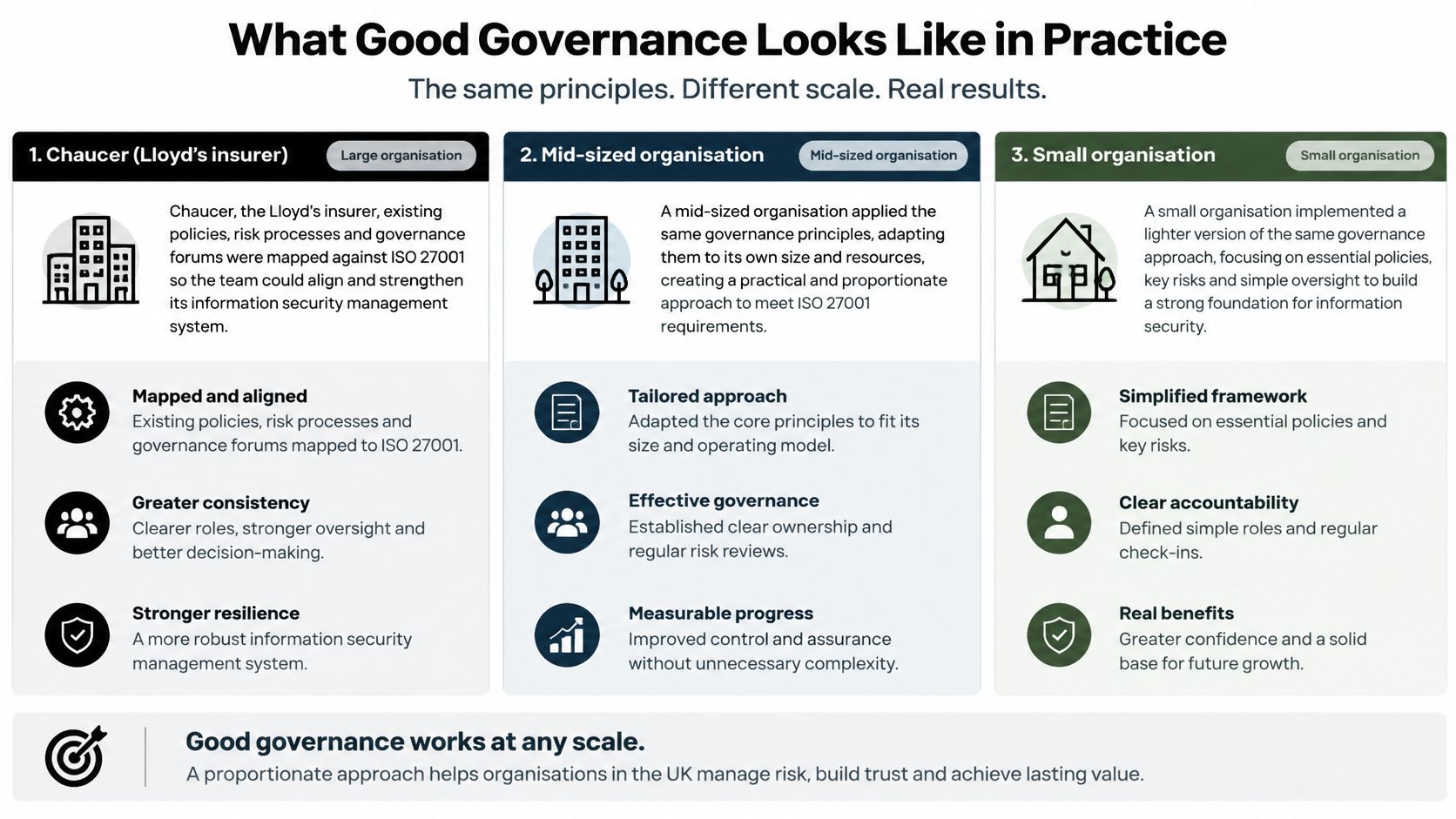
For a UK charity, scope was limited to the services and information the requirement concerned, and trustees approved that scope and the ongoing commitment before any other work began. One named person owned the management system, with a few protected hours a month to run it. The policy set stayed slim, evidence came from systems the organisation already had, and controls were kept to fewer, better ones owned by named people on a calendar of risk review, access review, supplier checks and an incident log.
The shared pattern is unglamorous. A named owner. A right-sized scope. Reuse of forums and records that already exist. Evidence taken from live systems rather than assembled for auditors. Senior approval of scope and commitment before the work starts, so nobody discovers in month four that the trustees never agreed to it.
The transferable test: could a new joiner explain who owns each top risk, where the evidence lives, and what happens when an action slips?
If the answer needs a meeting, the governance is documentation, not control.
Your First 90 Days of IT Governance
Start with the decisions, not the policies. A policy set written before anyone agrees who decides what becomes shelfware with a version number.
Days 1 to 30. Run a 90-minute accountability workshop. List the five technology and information services the organisation cannot operate without, then name the board owner, executive owner and control owner for each, and record which decisions the board retains. Follow it with a one-page appetite for customer data, availability, regulatory obligations and supplier risk. Circulate both before the next board meeting.
Days 31 to 60. Start the monthly 45-minute governance meeting with the fixed agenda: risk changes, overdue actions, incidents, supplier triggers, change requests. Produce the first one-page board report. Expect the first two meetings to be slow while people learn that silence counts as an overdue action.
Days 61 to 90. Test three evidence items end to end: a risk review, an access review and a supplier tier review. If any of them can't produce a decision and a date, the process is decorative. Then schedule internal audit or a management review so an independent opinion exists before a customer asks for one.
Where there's no internal ISMS owner, the year still has a shape. A standard 12-day annual maintenance plan runs roughly as follows: governance, documentation and policies 1.5 days; risk assessment and treatment 1.5 days; operational governance and control monitoring 1 day; Annex A internal audits and reporting 2.5 days; management review preparation and reporting 1 day; external audit preparation and attendance 1.5 days; Clauses 4 to 10 audit coordination and actions 1 day; ongoing advice, meetings and improvement coordination 2 days.
That structure suits certified organisations without an internal owner, growing businesses whose security responsibilities have outgrown informal arrangements, teams preparing for surveillance or recertification, and leadership groups that want clearer reporting than a folder of screenshots.
ISO Security works with owner-managed and mid-sized UK organisations on exactly this split of accountability, from the accountability workshop and risk appetite through to the monthly cycle, board reporting and audit evidence, with Alan Hutson leading each engagement personally. If your board can't currently name its top three technology risks and who owns each one, that's the place to start, and it takes a single meeting to fix. Visit ISO Security to see how the implementation and ongoing vISO support fit together.