Your payroll provider emails to say it's investigating a breach. You open the supplier file and find a completed questionnaire, a signed contract and a security certificate. Then comes the awkward detail: the affected records were held by a subcontractor your organisation never assessed. You need to establish what's exposed, who can act and whether payroll can still run.
Table of Contents
- What Third-Party Risk Management Covers and Why It Matters
- The Six Stages of the Third-Party Lifecycle
- Mapping Suppliers and Their Hidden Dependencies
- Tiering Suppliers and Matching the Evidence
- Scoring Supplier Risk and Aligning With ISO 27001
- Contract Terms That Make Oversight Enforceable
- Monitoring Suppliers Between Reviews
- Testing Supplier Recovery and Incident Response
- Start With Your Most Critical Suppliers This Quarter
What Third-Party Risk Management Covers and Why It Matters
Third-party risk management is the process of identifying, assessing, treating and monitoring information security risks introduced by suppliers, partners, contractors and other external organisations with access to your systems or data. In the payroll scenario, the assessment must cover the service you depend on, not just the company you pay.
The illustration captures that difference between a direct relationship and the dependencies beneath it.
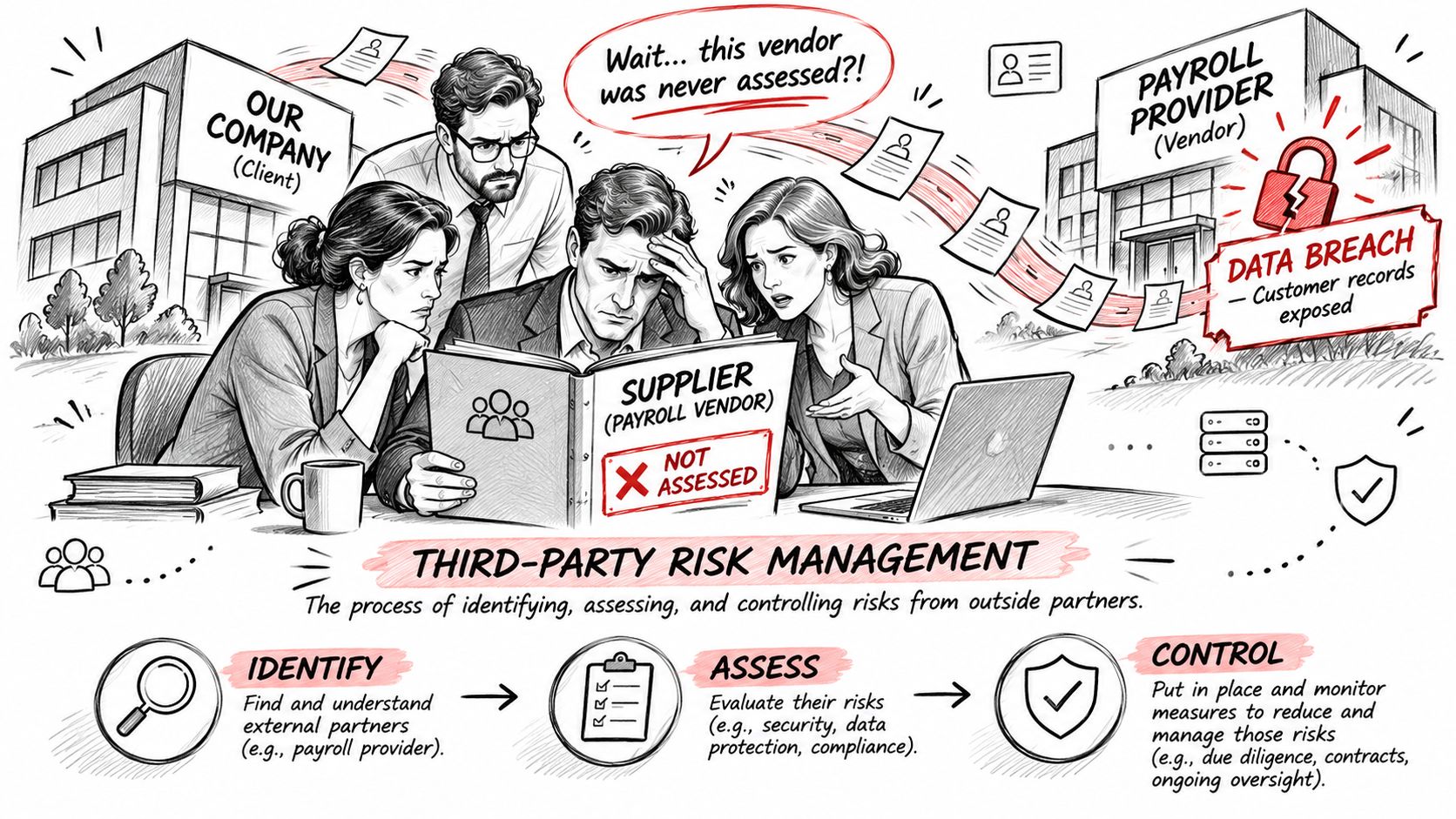
Think of a landlord who carefully vets tenants but never checks who they let into the building. Your supplier might be trustworthy, yet its subcontractor could still introduce an unexamined route to sensitive information.
External organisations create exposure through system access, custody of data and routes for attacks, including phishing or malware. Outsourcing the work doesn't remove your need to understand those connections.
Look beyond the signed agreement
In the UK Government's Cyber Security Breaches Survey 2022, only 13% of UK businesses reported reviewing the cyber-security risks posed by immediate suppliers, while 7% reviewed risks across their wider supply chain. Those are historical benchmarks, but the distinction remains useful: assessing a payroll company doesn't automatically assess its hosting platform or subcontractors.
Treat every supplier that touches sensitive data as part of your security boundary, including the dependencies you don't contract with directly.
Supplier oversight belongs within information security compliance, rather than sitting solely with procurement. It needs an inventory, proportionate evidence, enforceable obligations and people authorised to respond when something changes.
Use this video alongside the practical lifecycle below.
The Six Stages of the Third-Party Lifecycle
| Stage | Core question | Typical output | Usual owner |
|---|---|---|---|
| Identify | Who has access to our systems or data? | Complete supplier inventory | Procurement with IT |
| Classify | How much harm would a failure cause? | Risk tier for each supplier | Information security lead |
| Assess | Is the supplier's security adequate for its tier? | Evidence review and risk rating | Information security team |
| Contract | Which security obligations are enforceable? | Security schedule and clauses | Legal with procurement |
| Monitor | Has anything changed since the last review? | Triggered reassessments and action log | Supplier owner |
| Exit | How is access removed and data returned or deleted? | Closure record and confirmed data disposal | Supplier owner with IT |
The lifecycle provides a handover structure. Each owner should know what evidence they receive, what decision they make and what they pass to the next person.
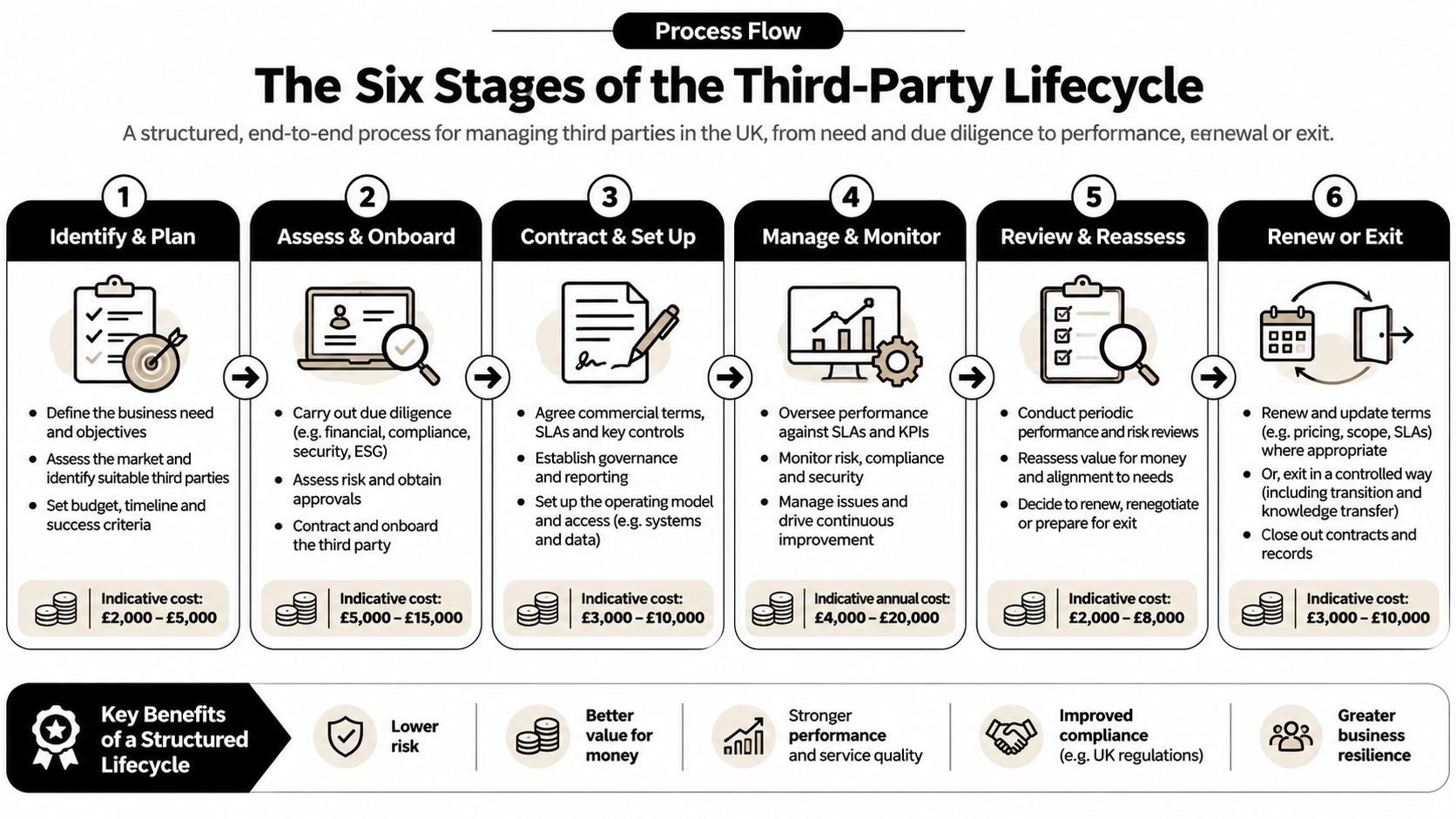
Establish the relationship before approving it
Identify the organisations involved before approving access or sending data. The common failure is treating the procurement database as complete when business teams have bought additional services themselves.
Classify the service by the harm its failure could cause. Don't classify by spending alone: an inexpensive file-sharing application could hold confidential acquisition documents.
During assessment, check whether the evidence supports the proposed use. A supplier saying it encrypts data doesn't answer who can decrypt it, how access is approved or whether the assurance covers your particular service.
Carry decisions into operation and closure
At the contract stage, turn assessment requirements into obligations. A common failure is signing standard terms while leaving unresolved security requirements in an email thread that nobody revisits.
Monitoring gives the supplier owner responsibility for changes after approval. The failure to avoid is an untouched supplier file whose evidence no longer describes the service being delivered.
At exit, IT removes accounts, integrations, tokens and remote access while the supplier owner confirms data return or disposal. Cancelling invoices isn't proof that the relationship has ended securely.
Practical check: Compare each lifecycle stage with your current programme. Where there's no recorded output, there's no dependable evidence that anyone completed the work.
Use a shared register or controlled workflow to connect these outputs. A spreadsheet can work for a manageable supplier population, provided owners update it and link supporting evidence rather than keeping separate, contradictory copies.
Mapping Suppliers and Their Hidden Dependencies
Start where supplier relationships leave traces. Reconcile accounts payable and procurement records with the IT asset list, identity and access records, and corporate card purchases. Ask department managers about browser-based tools, external consultants and shared workspaces that might never have reached IT.
A contract-only list misses services staff adopted without approval. An access-only list misses providers that hold exported data without connecting to your network.
The UK Government's announcement on critical supply-chain cyber resilience reported that only 12% of organisations reviewed cybersecurity risks from immediate suppliers, while 5% addressed vulnerabilities in their wider supply chain. These are separate findings from the survey benchmark above, not a like-for-like trend comparison.
Record the service, not just the supplier
Create a record for each supplier and service pair. The same company might provide a public website and a confidential document repository, with different access arrangements and consequences of failure.
| Register field | What to record |
|---|---|
| Supplier name | Legal entity contracted for the service |
| Service | The specific service or system the supplier provides |
| Data types | Categories of personal or confidential data the supplier handles |
| Access level | Whether the supplier has no access, standard access or privileged access |
| Hosting location | Country or region where data is stored and processed |
| Subcontractors | Named fourth parties with a role in the service |
| Owner | Named internal manager accountable for the relationship |
| Contract end date | Renewal or termination date that triggers reassessment |
For an important service, draw a simple dependency map showing information flows, administrative connections, hosting locations, subcontractors and recovery responsibilities. Mark any platform whose failure would interrupt several services simultaneously.
Say your payroll provider and HR platform use the same hosting dependency. Separate supplier assessments might look satisfactory, but the map exposes a shared point of failure. That's a reason to examine the combined business impact.
Give each critical service a named internal owner who can explain its dependencies and make decisions about gaps. Track the proportion of critical service dependencies that are mapped, assessed and linked to accountable owners. Record unknown hosting arrangements or undisclosed subcontractors as risks, not blank cells that imply everything's acceptable.
Tiering Suppliers and Matching the Evidence
The UK Government's Cyber Security Longitudinal Survey found that 51% of UK businesses requested cybersecurity information about their suppliers' own supply chains, while 47% had carried out a formal assessment of supplier cybersecurity. Collecting answers and evaluating security are different activities.
A questionnaire gathers statements. An assessment checks control effectiveness, access paths, processing locations, subcontractor dependencies, incident history and the risk that remains. Ask what each answer means for your intended use, rather than marking the form complete.
Match scrutiny to exposure
Use privilege, data sensitivity, connectivity, service criticality and concentration risk to set tiers. The relevant exposure might be access to your systems, storage of client personal data or intellectual property, or an attack originating from the supplier.
The following is an illustrative review policy, not a universal timetable or a prescribed certification requirement.
| Tier | Typical suppliers | Evidence expected | Reassessment cycle |
|---|---|---|---|
| Tier 1 critical | Hosting, managed security, payroll and anyone with privileged access or customer data | Independent certification or audit report plus targeted technical validation | Annually and after any material change |
| Tier 2 significant | Software that handles customer data without privileged access | Current certificate or questionnaire checked against documented evidence | Every two years and after incidents |
| Tier 3 low | Office supplies and tools holding no data or access | Basic due diligence and terms check | At renewal |
Treat the examples as starting points. Classify customer-data services as significant only where the documented sensitivity, scale and business impact justify that decision; sensitive or business-critical processing should remain critical.
Check what the evidence actually covers
For a critical hosting service, inspect the certification scope and audit findings, then request targeted evidence about privileged access, vulnerability remediation, customer-data segregation and backup restoration. A certificate covering a different entity or service doesn't settle those questions.
If a large supplier won't complete your questionnaire, use its published assurance pack and identify the remaining unanswered risks. Don't confuse inability to obtain a bespoke response with proof of weak controls.
Where evidence remains incomplete, record the gap, compensating safeguards and explicit risk acceptance by a named manager. In our risk assessment and treatment process, the client's team agrees a repeatable methodology, with decisions recorded in a risk treatment plan and Statement of Applicability. Keep these records aligned with your ISO 27001 documentation, and measure critical-supplier coverage by current, independently verifiable assurance rather than questionnaire totals.
Scoring Supplier Risk and Aligning With ISO 27001
A tier needs a documented reason. Otherwise, assessors can classify the same supplier differently because one worries about outages and another focuses on confidentiality.
Separate inherent risk, before considering safeguards, from residual risk, after evaluating them. Record the evidence and assumptions behind both judgements so that a low rating doesn't conceal an untested supplier promise.
Use a repeatable example method
For a hypothetical scoring model:
- Likelihood: Use a scale from one to five, considering the access model, hosting arrangements, subcontractor complexity, incident history and demonstrated controls.
- Impact: Use the same scale for consequences, considering data exposure, service interruption and recovery time against business tolerance.
- Rating: Multiply likelihood by impact. In this example, scores of fifteen or more indicate critical suppliers, eight to fourteen indicate significant suppliers, and seven or below indicate low-risk suppliers.
- Override: Put privileged suppliers in the critical tier regardless of their calculated score, and document other overrides for sensitive data or essential services.
For example, a managed security provider with firewall administrator access might receive likelihood four and impact five, producing twenty and a critical rating. A survey tool containing no personal or confidential data might receive two for each, producing four, provided its loss wouldn't disrupt an important process.
These are illustrative decisions, not probabilities or mandatory thresholds. Calibrate the method with the people who operate the services, using an ISO 27001 risk assessment template as a recording aid rather than a substitute for judgement.
A calculated score helps people compare decisions. It doesn't justify accepting a risk that nobody understands.
Within the ISMS, connect supplier identification and assessment to supplier-relationship controls, contractual obligations to supplier agreements, dependency mapping to ICT supply-chain security, and ongoing oversight to monitoring and change management. Keep the method, evidence, treatment decisions and applicable control selections traceable for audit.
Contract Terms That Make Oversight Enforceable
A security expectation is difficult to enforce when the agreement gives you no way to obtain evidence or challenge a change. Resolve important requirements before signature, while procurement still has room to negotiate.
Write clauses around the actual service and business consequences. A generic promise to maintain appropriate security won't tell an incident manager which notification route to use or what information the supplier must provide.
Connect each obligation to a risk
- Breach notification: Agree a notification deadline and contact route for incidents affecting your data or service. Require an initial notice without making the supplier wait for a completed investigation.
- Audit and assurance rights: Specify the reports you can receive and how further validation will work for critical services. This addresses the risk of relying indefinitely on unsupported statements.
- Subcontractor disclosure: Require a current list of relevant subcontractors, notice of material changes and appropriate approval or objection arrangements. Include security obligations that flow down to them.
- Data location and handling: Record where information may be stored and processed, how customer data is segregated and how changes are controlled.
- Recovery objectives: Agree restoration expectations and backup responsibilities for critical services. Make clear which activities your organisation must perform during recovery.
- Investigation cooperation: Define access to relevant logs, findings and knowledgeable staff, subject to legitimate confidentiality and security constraints.
- Secure exit: Specify data return or deletion, treatment of retained backups and confirmation that supplier access has been revoked.
Keep accountability inside the organisation
Use legal review for enforceability and relevant data-protection obligations. Security staff should explain the operational requirement; they shouldn't assume a technically detailed clause is legally sufficient.
The client's organisation retains accountability for the ISMS, control operation, technical implementation, risk acceptance, management decisions and remediation. A contract helps you hold suppliers to account, but it doesn't operate your controls or approve your residual risk.
Test each obligation with a practical question: what evidence would reveal a breach, and what evidence must the supplier provide afterwards? An incident timeline, access log, recovery-test record or deletion confirmation is more useful than an obligation nobody knows how to verify.
Monitoring Suppliers Between Reviews
More supplier data doesn't automatically produce better decisions. A dashboard full of ratings won't help if nobody knows which change matters or who can act on it.
Concentrate ongoing attention on suppliers whose failure could stop an essential service, expose sensitive information or exploit privileged access. Keep scheduled reviews as a backstop, but don't wait for renewal when the service changes.
Continuous attention doesn't mean asking someone to read every supplier document every day. It means maintaining dependable alert routes, watching relevant service and access changes, and assigning someone to decide whether new information requires action.
Use events to reopen assessments
| Trigger | What to reassess | Evidence to request |
|---|---|---|
| Change in privileged access | Access model and approval routes | Updated access review and approval record |
| Supplier acquisition or merger | Ownership, data location and control changes | Revised assurance report and renewed risk acceptance |
| New subcontractor | Fourth-party dependencies for the service | Subcontractor list and flow-down terms |
| Security incident at supplier | Impact on your data and services | Incident report and evidence of remediation |
| Material service change | Scope, data handling and tier | Updated contract schedule and new assessment |
An acquisition should open a review, not automatically close one with renewed acceptance. Confirm what has changed, obtain evidence and decide whether the previous treatment remains adequate.
Similarly, a supplier incident doesn't always justify immediate disconnection. The supplier owner and incident lead should consider actual exposure, available safeguards and the operational consequences of suspending the service.
Connect alerts to decisions
Route supplier notifications into a shared mailbox or ticket queue, not an individual's inbox alone. Link each material event to the supplier record, relevant risk-register entry and change-management ticket.
The action record should identify the decision-maker, immediate containment, evidence requested, interim safeguards and closure conditions. Where the change increases exposure, pause the affected rollout or access request until an authorised person makes the risk decision.
Attention rule: If an alert can't change an access decision, treatment action or escalation, reconsider why you're collecting it.
For lower-risk suppliers, a renewal-based review may be sufficient unless their use changes. Agree in advance who receives urgent alerts, who provides cover during absence and who has authority to suspend access. Monitoring fails operationally when everyone receives a notification but nobody owns the response.
Testing Supplier Recovery and Incident Response
A critical supplier goes offline on Monday morning. Your operations manager wants a workaround, customer support needs a message, and IT can't confirm whether the outage involves a security incident. A tabletop exercise lets those people practise the decisions before they face a live interruption.
An assurance report describes controls within its scope. It doesn't establish whether your organisation can recover using that supplier's arrangements.
The FCA's cross-sector Technology and Cyber Resilience Questionnaire report, covering regulated firms surveyed during 2017 and 2018, identified third-party issues as the cause of 15% of operational incidents reported to the FCA. This is historical financial-services evidence, not a current estimate for all UK organisations.
Exercise the shared response
- Inspect the recovery commitment. Compare the supplier's restoration expectations with how long your business can tolerate interruption. Clarify whether the commitment covers infrastructure availability or a usable, restored service.
- Walk through operational decisions. Ask who authorises manual processing, which information staff need and how they reconcile work afterwards. Test whether the workaround depends on the unavailable supplier.
- Include the supplier's role. Invite critical suppliers into relevant exercises where practical. If they can't participate, validate assumptions against their response plan and obtain written clarification.
- Test communication and escalation. Confirm named contacts on both sides, incident notification routes, escalation thresholds and who approves customer messages.
- Agree post-incident evidence. Establish how you'll obtain the timeline, affected-service assessment, recovery validation and corrective-action updates.
Record the agreed recovery time, last test date, gaps found and owner responsible for closing them. Don't mark the exercise successful merely because participants discussed the scenario; check whether they could obtain the information and authority needed to continue operating.
Start With Your Most Critical Suppliers This Quarter
Use an initial month to establish a workable programme, rather than waiting for a perfect inventory. The following is an illustrative four-week sequence, with a concrete output at each stage.
- Week one, build the baseline. Reconcile finance, procurement, IT, access and corporate card records. Output: a supplier-and-service inventory with provisional owners.
- Week two, prioritise exposure. Apply the agreed methodology and select an initial group of critical suppliers. Output: a prioritised assessment queue with recorded reasons.
- Week three, examine evidence. Request current assurance and record unanswered questions, treatment owners and closure dates. Output: an evidence-backed action log.
- Week four, establish operating rules. Check contractual gaps, configure reassessment triggers and assign alert recipients and access-suspension authority. Output: approved monitoring and escalation arrangements.
Make the next cycle manageable
Focus the first quarter on critical relationships, then extend the method to significant suppliers in the following quarter. Address urgent contractual or access weaknesses immediately rather than deferring everything until renewal.
Leadership keeps accountability for the ISMS, risk acceptance and remediation. Certification decisions remain with an independent certification body; an organised supplier programme provides evidence for assessment, not a guarantee of certification.
We provide supplier and third-party information security oversight, alongside Statement of Applicability and Annex A control selection, internal audit and management review. Visit ISO Security to arrange a readiness discussion, and tell us which clients or frameworks are asking for assurance so we can set out the smallest credible scope for your firm.