If your organisation has an information security policy, a risk register and a certificate, can you show what happened when a supplier changed, an access review was missed or a new service went live? That's the gap conventional explanations of ISO 27001 clauses often leave open. Documents describe the system, but decisions, operating records and follow-through show whether people are running it.
An Information Security Management System, or ISMS, connects business requirements to security responsibilities, risk decisions and evidence. Treat its clauses as a repeating cycle, rather than separate folders to complete before an audit, and it becomes easier to understand both what auditors examine and where organisations go wrong.
Table of Contents
- ISO 27001 Clauses 4 to 10 at a Glance
- Scope, Context and Leadership in Clauses 4 and 5
- Risk Assessment, Treatment and Operation in Clauses 6 and 8
- Support, Evaluation and Improvement in Clauses 7, 9 and 10
- Annex A Controls and the Statement of Applicability
- How the Clauses Work as One ISMS Cycle
- Proving the ISMS Works Between Audits
- Supplier Risk as Part of the ISMS
- Check the Certificate Scope Before You Rely on It
ISO 27001 Clauses 4 to 10 at a Glance
| Clause | Title | What it requires | Evidence auditors ask for |
|---|---|---|---|
| 4 | Context of the organisation | Interested parties, legal and contractual requirements and the ISMS scope | Scope statement and context record |
| 5 | Leadership | Management commitment, information security policy and assigned roles | Approved policy, role descriptions and commitment records |
| 6 | Planning | Risk assessment, risk treatment, objectives and the Statement of Applicability | Risk methodology, risk register, treatment plan and SoA |
| 7 | Support | Resources, competence, awareness, communication and documented information | Training and competence records, document control |
| 8 | Operation | Risk assessment and treatment carried out, planned processes controlled | Operating records and risk assessment results |
| 9 | Performance evaluation | Monitoring, measurement, internal audit and management review | Monitoring data, internal audit reports and management review minutes |
| 10 | Improvement | Nonconformity handling, corrective action and continual improvement | Corrective-action log with closure and effectiveness evidence |
Clauses 1 to 3 cover scope, normative references and terms, rather than the auditable management-system requirements. The distinction matters: introductory material helps you interpret the standard, while the requirements above describe what your organisation must establish and maintain.
Sub-clause lookup
- Context, 4.1 to 4.4: Internal and external issues, interested parties, ISMS scope and the ISMS itself.
- Leadership, 5.1 to 5.3: Management commitment, the information security policy and assigned responsibilities.
- Planning, 6.1.2 and 6.1.3: Risk assessment and treatment. 6.2 covers objectives; 6.3 covers planning changes.
- Support, 7.1 to 7.5: Resources, competence, awareness, communication and documented information.
- Operation, 8.1 to 8.3: Operational control, risk reassessment and treatment execution.
- Evaluation, 9.1 to 9.3: Monitoring, internal audit and management review.
- Improvement, 10.1 and 10.2: Continual improvement, then nonconformity and corrective action.
Use the table as a lookup, not as a document shopping list. An auditor may start with a policy, then ask who follows it, inspect a recent record and check what management did when the process failed. Read the matching clause detail whenever a row needs translating into practical work.
Scope, Context and Leadership in Clauses 4 and 5
Clause 4 establishes what the ISMS must protect and why. Start with the business, not a template scope statement.
Under 4.1, identify internal and external issues affecting information security. Internal issues might include limited specialist capacity, rapid recruitment or dependence on a legacy application. External issues could include customer assurance demands, contractual commitments and changes in how services are delivered.
Under 4.2, identify interested parties and their relevant requirements. Don't stop at naming customers, regulators and employees. Record what they expect, where that requirement comes from and which requirements the ISMS will address.
Define a boundary you can defend
4.3 requires a defined scope. Describe the services, locations, information and interfaces covered, including dependencies on other teams and suppliers.
Say a software business excludes its hosted product from certification but presents the certificate as assurance for that product. The problem isn't just awkward wording. Customers may reasonably believe the certified system covers delivery activities that haven't been assessed within that boundary.
Use our ISO 27001 scope statement examples to distinguish a clear service boundary from a broad claim that the organisation can't support.
4.4 then requires the organisation to establish, implement, maintain and continually improve the ISMS. A scope statement alone doesn't fulfil that obligation. People need to operate the processes within it and manage their interactions.
Scope test: Could a customer identify whether the service they buy sits inside your certification boundary without asking you to reinterpret it?
Make leadership visible
5.1 concerns top management's commitment. Auditors look beyond an executive signature to decisions about priorities, resources and accountability.
Under 5.2, management establishes an information security policy suited to the organisation's purpose and ensures it's communicated. Under 5.3, responsibilities and authorities must be assigned and communicated. Give a risk a named accountable owner, such as the operations director, rather than assigning it vaguely to a committee.
For a UK charity, we limited the ISO 27001 scope to the services and information the requirement concerned. Its trustees approved that scope and the ongoing commitment behind it before any other work began.
Finish your scoping exercise with a concise working sheet:
- Services and sites: Mark what's covered and explain exclusions.
- Information: Identify the data and records used to deliver those services.
- Suppliers and interfaces: Show external dependencies and responsibility boundaries.
- Approval: Record who agreed the scope and who reviews changes.
Risk Assessment, Treatment and Operation in Clauses 6 and 8
A risk register becomes useful when someone can follow a risk from identification to a decision, an implemented treatment and evidence of the result. Clause 6 plans that work; Clause 8 puts it into operation.
Establish a repeatable risk method
Under 6.1.2, define how you assess information security risks. Set criteria for likelihood, impact and acceptance so different assessors can reach reasonably consistent results.
Consider confidentiality, integrity and availability separately. For a customer portal, unauthorised disclosure, incorrect account information and prolonged unavailability create different consequences and may need different treatments.
A practical assessment record should capture:
- Risk scenario: What could happen, to which information or service, and why?
- Existing safeguards: What already reduces the likelihood or consequences?
- Assessment and ownership: How significant is the risk, and who can authorise the response?
- Acceptance criteria: What makes the remaining exposure acceptable?
Our ISO 27001 risk assessment template guidance can help organise those fields. The important part is the decision process, not the spreadsheet format.
Choose treatment deliberately
6.1.3 covers risk treatment. You might modify a risk through controls, avoid the activity, share some consequences through contractual arrangements or insurance, or retain the risk with informed approval.
For example, suppose a consultancy identifies excessive administrator access to customer files as unacceptable under its criteria. Its treatment plan could require named administrative accounts, restricted permissions and a review of privileged access. Record the responsible owner, completion date, expected outcome and acceptance of the residual risk.
Compare the controls you determine are necessary with Annex A to check that nothing necessary has been overlooked. Record the resulting control decisions in the Statement of Applicability, or SoA.
6.2 requires information security objectives that can be monitored and are measurable where practicable. Replace “improve access security” with an objective that defines the intended outcome, assessment method, owner and timescale.
Under 6.3, plan changes to the ISMS. A new business unit or outsourced service may alter responsibilities, evidence sources and the risk method itself.
Retain proof of execution
8.1 requires operational planning and control, including relevant externally provided processes, products and services. Define what acceptable performance looks like and how exceptions are handled.
8.2 requires risk assessments at planned intervals and when significant changes are proposed or occur. 8.3 requires implementation of the treatment plan and retention of the results.
For the administrator-access example, an auditor should be able to inspect:
| Operational element | Concrete example |
|---|---|
| Process | Approved procedure for granting and reviewing privileged access |
| Owner | Named service manager |
| Operating record | Completed access review with removal decisions |
| Verification | Dated check that removals were completed |
A risk register without operating records leaves the treatment unproven. Recording an intention to restrict access isn't evidence that permissions changed.
Support, Evaluation and Improvement in Clauses 7, 9 and 10
These clauses answer related but different questions: can people operate the ISMS, does management know whether it works, and does the organisation correct weaknesses?
Give people the means to perform
7.1 requires the resources needed for the ISMS. That includes staff time and authority, not just security software.
Under 7.2, determine the competence needed by people whose work affects information security and retain appropriate evidence. A training attendance record can help, but it doesn't necessarily demonstrate that someone can configure a service securely or investigate an incident.
The remaining support requirements cover:
- Awareness, 7.3: People understand the policy, their contribution and the implications of failing to meet requirements.
- Communication, 7.4: Determine what needs communicating, when, to whom and how.
- Documented information, 7.5: Control creation, updates, access, storage and retention so people can find the right version.
A practical document-control arrangement might use SharePoint with approval permissions and version history. The tool matters less than whether staff can distinguish current instructions from obsolete copies.
Evaluate performance and management decisions
Under 9.1, define what you'll monitor, how you'll measure it, when measurement happens and when results are analysed. Collect information that supports decisions, rather than filling a dashboard with figures nobody uses.
9.2 requires internal audits at planned intervals against the standard and your own ISMS requirements. Plan coverage according to process importance and previous findings, and protect the audit's objectivity.
9.3 requires management review. Relevant inputs include audit results, risk status, feedback and improvement opportunities. Useful outputs identify decisions, changes and resource needs, with accountable owners.
Management-review minutes should show what leaders decided, not merely that somebody presented a slide deck.
Correct causes, not just symptoms
10.1 addresses continual improvement. 10.2 addresses nonconformities, their causes, corrective action and checks on effectiveness.
Suppose an organisation misses a scheduled access review. Completing the overdue review is the immediate correction. If the cause was an unassigned recurring task, the corrective action should assign accountability and establish a dependable scheduling arrangement.
Checking that the next scheduled review happened provides stronger effectiveness evidence than marking the action complete when the calendar invitation is sent.
Use this closure test:
- Cause: Have you explained why the failure occurred?
- Action: Does the response address that cause?
- Evidence: Can you show what changed?
- Effectiveness: Have you checked whether the change prevented recurrence?
Annex A Controls and the Statement of Applicability
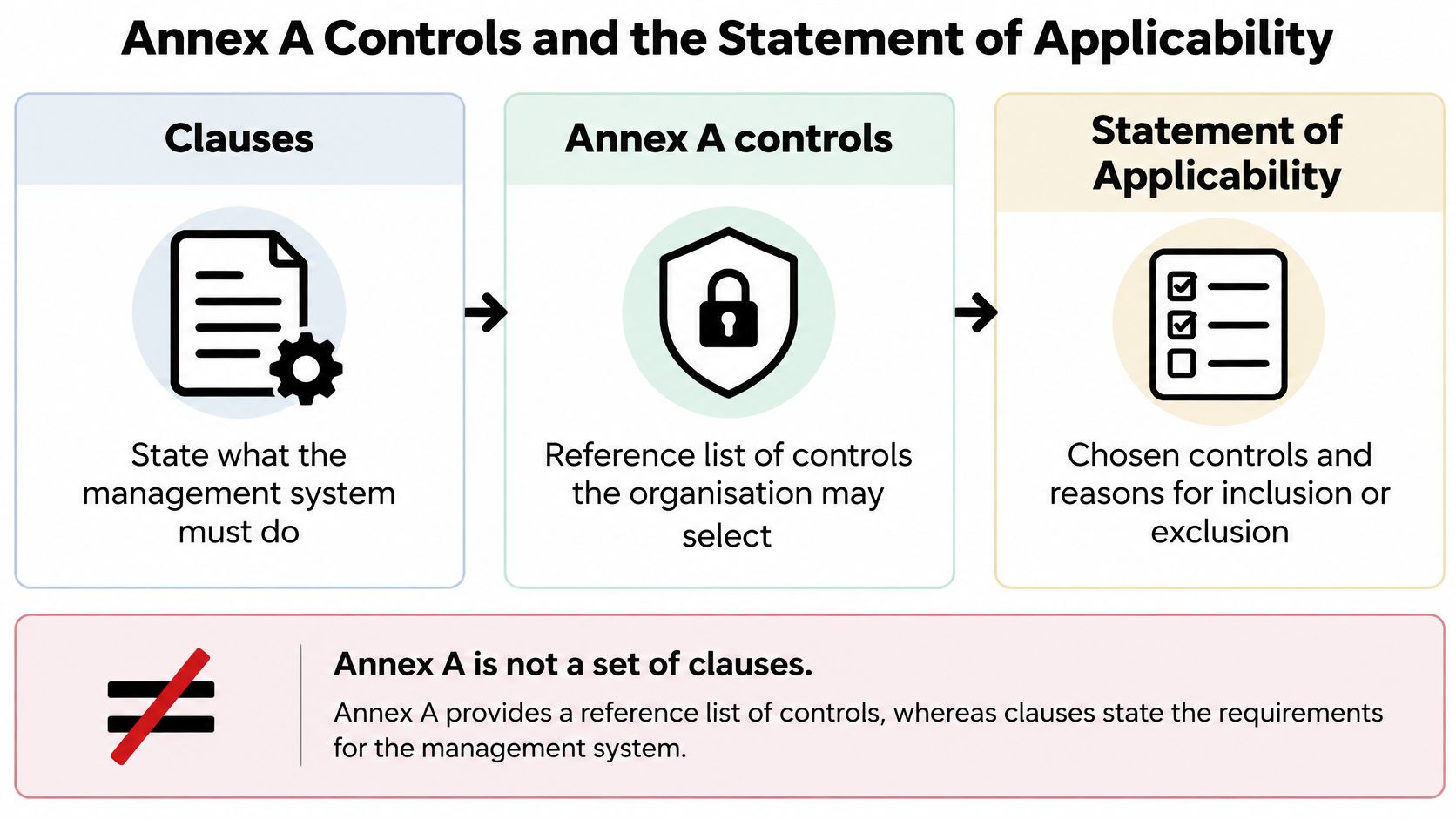
Annex A is a reference list of controls, not another set of management-system clauses. The clauses establish how the organisation governs security. Annex A helps it check the safeguards needed to address its risks and requirements.
The UK standards information page from ISO 27001 Partners describes 93 controls, divided into 37 organisational, 8 people, 14 physical and 34 technological controls.
| Annex A group | Controls | Typical focus |
|---|---|---|
| Organisational | 37 | Policies, roles, supplier relationships, incident management and compliance |
| People | 8 | Screening, awareness, disciplinary process and remote working |
| Physical | 14 | Premises, secure areas, equipment and utilities |
| Technological | 34 | Access rights, configuration, logging, cryptography and secure development |
| Total | 93 | All four Annex A groups |
The relationship is easier to understand when the requirements and control decisions are kept distinct.
Explain each applicability decision
The Statement of Applicability connects necessary controls to the management system. It records the controls required, reasons for inclusion, whether they're implemented and justification for excluding Annex A controls.
Say a cloud-based consultancy doesn't operate a data centre. It may justify excluding controls relating specifically to premises it doesn't operate, but it shouldn't dismiss physical security wholesale. Staff devices, home working and the cloud provider's responsibilities still need consideration.
An exclusion must explain the actual circumstances. “We use the cloud” doesn't establish who protects equipment, how provider assurance is obtained or which responsibilities remain with the consultancy.
Keep the SoA traceable
A copied template with every control marked applicable can be just as misleading as one containing unjustified exclusions. Auditors can compare those statements with the risk register, treatment plan and actual operations.
Use a row structure that makes the reasoning easy to follow:
- Control and applicability: Identify the control and whether it's necessary.
- Justification: Explain the relevant risk, business requirement or exclusion.
- Implementation status: Distinguish implemented controls from planned work.
- Owner: Name the person accountable for maintaining it.
- Evidence location and review date: Point to retrievable records and show when the decision was checked.
Evidence references are a practical enhancement, not a reason to duplicate every operating record inside the SoA. Link to controlled records so updates don't create conflicting copies.
How the Clauses Work as One ISMS Cycle
The ISO 27001 clauses make more sense when you follow the decisions passing between them. A change in business context should affect risk planning; a failed control should affect improvement work; management should oversee both.
The UK government's Cyber Governance Code mapping explicitly links governance practices to ISO/IEC 27001 requirements, including context, assigned responsibilities, risk planning, operational risk assessment and monitoring. That supports a practical approach: connect governance decisions to evidence of risk and performance.
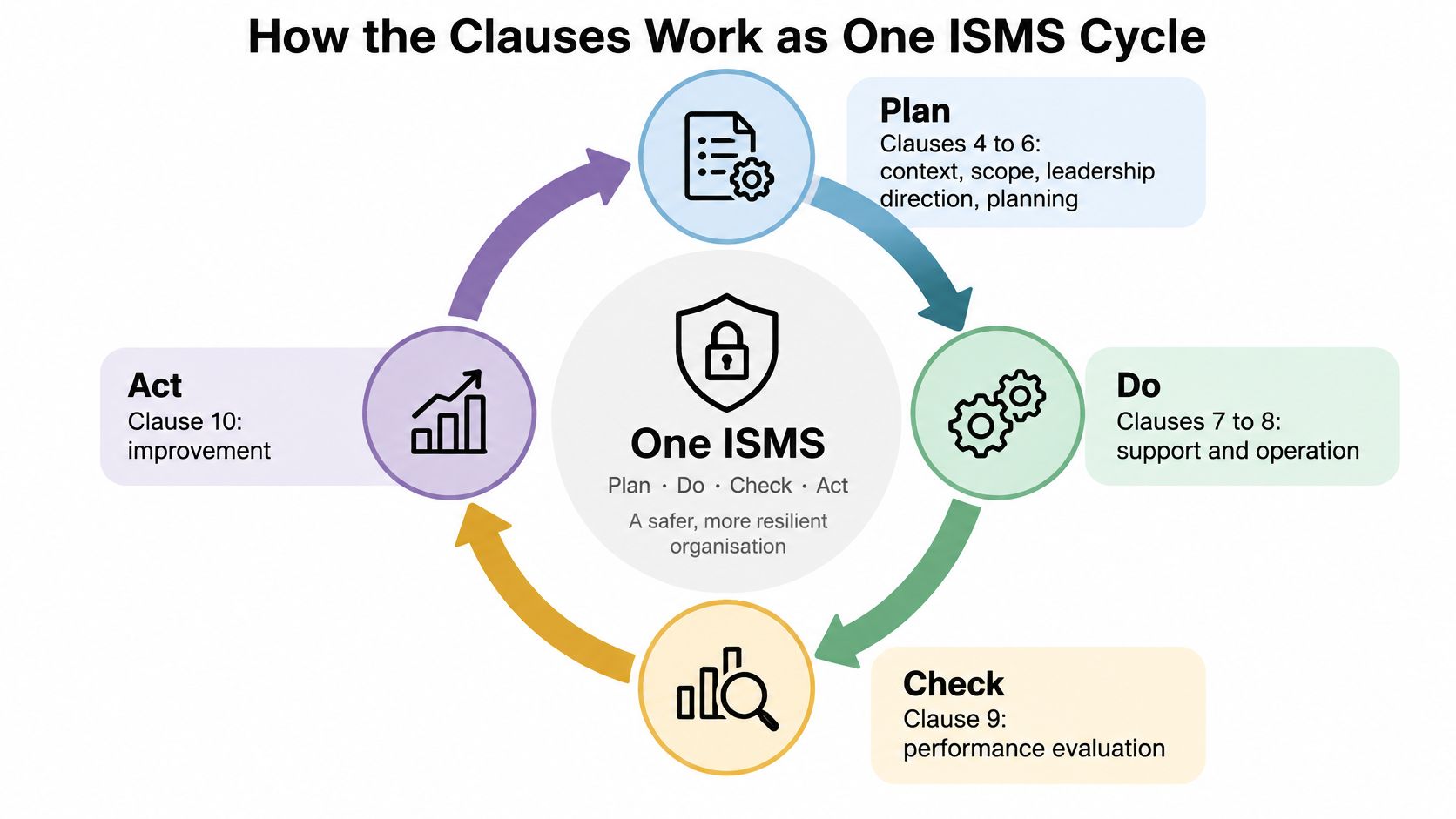
Use Plan, Do, Check, Act as a working model
- Plan: Establish context and scope, secure leadership direction and decide how to address risks.
- Do: Provide resources and competence, then operate the planned processes.
- Check: Analyse monitoring results, conduct internal audits and review the ISMS with management.
- Act: Correct failures and make improvements that inform the next planning decisions.
Leadership belongs across the cycle. Managers can't delegate the work and then disappear until the certification assessment.
Check the handoffs
Planning to operation: The SoA and treatment plan should inform control owners' activities. If a necessary control is omitted from planning, nobody may receive the responsibility or resources to operate it.
Evaluation to improvement: An internal audit finding should lead to a proportionate response. If the finding changes your understanding of exposure, update the risk assessment rather than leaving the new information only in the audit report.
Scope to supplier assurance: An omitted service dependency can cause supplier oversight to be missed. The supplier itself needn't become part of your organisation's certification scope, but relevant interfaces and externally delivered activities still need managing.
These aren't automatic outcomes of completing documents. Someone must own each handoff.
Connect control themes to governance
The table shows practical dependencies alongside the government's mapping. It isn't a claim that Annex A controls have a simple one-to-one relationship with clauses.
| Clause | Annex A themes that depend on it | Cyber Governance Code mapping |
|---|---|---|
| Clause 4 | Supplier relationships, information assets and compliance requirements | Mapped to Clause 4 |
| Clause 5.3 | Policies and roles, including Annex A 5.1 and 5.2 | Mapped to Clause 5.3 |
| Clause 6 | Risk treatment and Statement of Applicability | Mapped to Clause 6 |
| Clause 8.2 | Risk assessment in operation | Mapped to Clause 8.2 |
| Clause 9.1 | Logging, monitoring and control-performance evaluation | Mapped to Clause 9.1 |
For example, policy and role arrangements can be considered during management review, while a significant technology change should trigger reassessment of relevant treatment decisions.
At Chaucer, we mapped existing policies, risk processes and governance forums against ISO 27001 so the business didn't have to build what it already had.
Create a cross-reference sheet with a row for each clause, relevant control themes and the records that demonstrate implementation. For every stage, name the owner, the record and the review date. Where you can't, investigate the missing connection before producing another document.
Proving the ISMS Works Between Audits
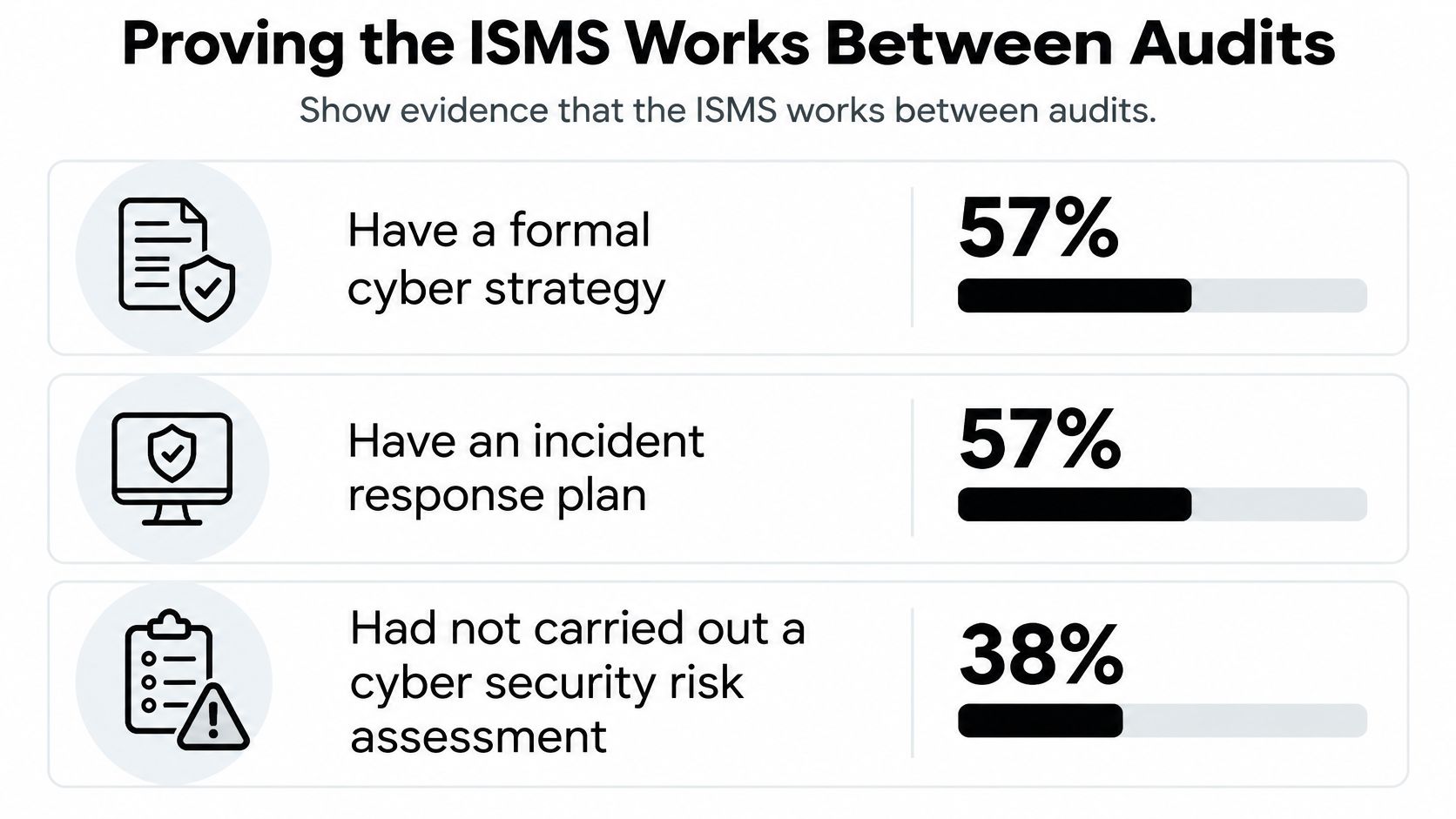
The National Cyber Security Centre's board guidance reports that only 57% of medium-sized organisations have a formal cyber strategy, only 57% have an incident response plan, and 38% hadn't undertaken a cyber-security risk assessment in the preceding year. These are measures of different practices, not a certification failure rate.
A complete document library can still conceal inconsistent delivery. The useful question is whether people perform their assigned work and leave evidence that allows someone else to verify it.
Establish a proportionate evidence rhythm
The following is an example operating rhythm, not a frequency prescribed for every organisation. Adjust it to your risks, contractual obligations and process stability.
| Cadence | Suggested activity | Evidence to retain |
|---|---|---|
| Monthly | Review incidents, significant changes and open corrective actions; confirm control-owner activity | Reviewed logs, updated actions and exception decisions |
| Quarterly | Review access rights, supplier status and objective performance; schedule an incident exercise where appropriate | Dated sign-off, supplier decisions, exercise findings and performance analysis |
| Annually | Complete planned audit coverage, hold management review and review policies, the SoA and risks | Audit results, management decisions and approved updates |
| After material change | Reassess affected risks and controls | Change assessment, risk decisions and implementation checks |
Don't postpone a necessary reassessment because the annual review is approaching. A new cloud platform or acquisition can alter exposure immediately.
Use existing work rather than parallel paperwork
Attach evidence collection to operational tasks already in the calendar. If managers review access in an established service meeting, retain the attendee list, decisions and completion evidence there, with a controlled reference from the ISMS.
When a documented control is performed inconsistently, prioritise the response according to potential harm, frequency and underlying cause. Repeated omissions may indicate a systemic ownership or resource problem rather than isolated forgetfulness.
An auditor should be able to follow the record without relying on the memory of the person who performed the task.
We arrange and coordinate a separate independent audit of Clauses 4 to 10, included in the plan, and track findings and corrective actions from both audits to closure. That process depends on retrievable evidence, not retrospective explanations.
Which three records would you show an auditor from the last quarter, and what would each prove?
Supplier Risk as Part of the ISMS
A supplier's certificate isn't a substitute for managing your dependency on it. Certification can provide assurance about its ISMS without establishing whether your particular service, data flows, subcontractors and contract terms are adequately controlled.
The UK government's Cyber Security Breaches Survey 2025/26 found that only 15% of businesses formally reviewed risks from immediate suppliers, while only 6% reviewed wider supply-chain risks. The practical response is to make supplier assessment part of normal risk management, rather than a certificate-collection exercise.
Decide what assurance the relationship needs
Which suppliers need consideration within the ISMS? Include dependencies that store, process or access relevant information, host systems or deliver critical services. Describe the interface and your responsibilities without implying the supplier's whole business falls within your certification boundary.
When is an assessment proportionate? Scale it to information sensitivity, access and service criticality. A low-risk scheduling tool needs a different review from a provider holding customer records or administering production infrastructure.
What if the supplier has no certificate? Examine a completed security questionnaire, independent assurance reports where available, relevant policies and evidence supporting important answers. Check incident-notification terms, audit rights and subcontractor arrangements, rather than treating a signed questionnaire as conclusive proof.
How do findings enter the ISMS? Record the relevant risk, assign an owner and decide the treatment. Reflect necessary supplier controls in the SoA, track unresolved actions and bring significant exposure to management review.
Monitor changes after onboarding
- Service changes: Reassess new hosting locations, access arrangements or subprocessors.
- Assurance changes: Investigate expired evidence, material findings or altered certification scope.
- Exit readiness: Check how information will be returned or deleted and how service continuity will be maintained.
Our third-party risk management guidance provides a practical basis for organising that oversight.
List the five suppliers whose failure would hurt most. For each, identify what evidence you hold, who reviewed it and which unanswered questions could change your risk decision.
Check the Certificate Scope Before You Rely on It
Check the assurance behind the certificate before using it to support a procurement or customer decision.
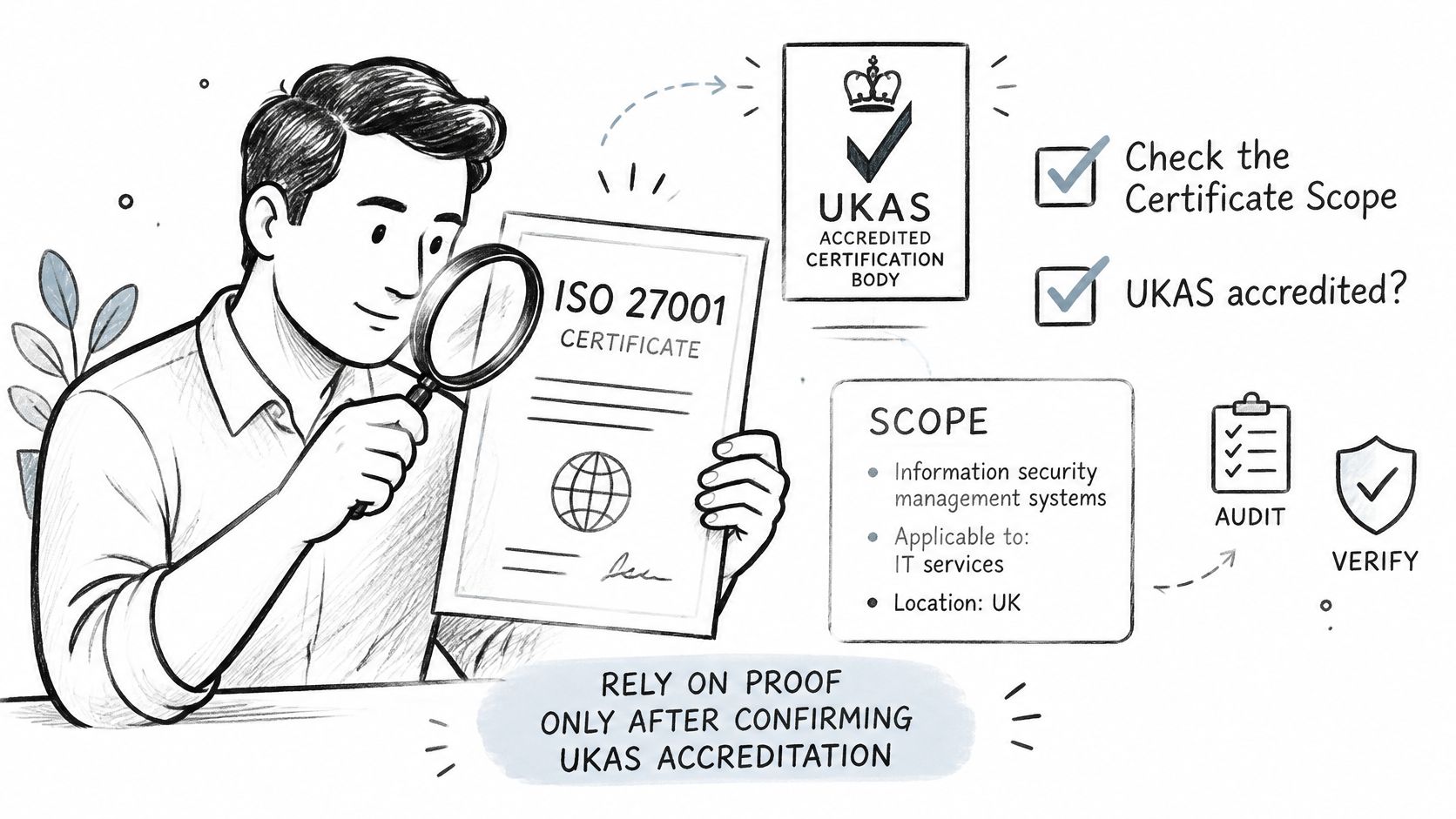
- Verify accreditation. Confirm that the certification body has relevant UKAS accreditation, rather than relying on a logo alone.
- Compare the scope. Match the named services, entities and sites to what you're buying.
- Check the edition. Look for ISO/IEC 27001:2022. UKAS transition arrangements gave existing certified organisations until 31 October 2025 to transition.
- Request supporting assurance. Ask for appropriate access to the SoA, treatment information and service-specific security arrangements, subject to confidentiality.
- Inspect recent evidence. Seek dated operational and evaluation records relevant to the service, not unrestricted access to sensitive internal material.
UK public-sector security schedules illustrate why this matters: contractual assurance can require a defined service scope, risk assessment, SoA, treatment plan and incident-management plan beyond the certificate itself.
Use the following video alongside those checks when considering your next step.
Our first step is a readiness discussion: we explain the requirements and understand your objectives, likely scope, existing controls and timescale. We're not a certification body and don't award, issue or guarantee certification; the independent certification body decides.
ISO Security offers practical ISO 27001 implementation and ongoing vISO support to connect clause requirements with named responsibilities, risk decisions and audit evidence. Visit ISO Security to arrange a readiness discussion, bringing your draft scope, supplier list and most recent risk register.