Only 15% of UK businesses had undertaken a cyber security vulnerability audit in the 12 months before the Cyber Security Breaches Survey 2025 reported, and of those that did, 41% used external auditors only, 32% used both internal and external teams and 23% kept the work in-house. Most managers who commission an audit have therefore never watched one take place, which is why the conversation afterwards tends to drift to the wrong things: the scanner the auditor ran, the clean penetration test from last year, the thickness of the report.
Audits usually fail on ownership and follow-through rather than on missing technology. A modern small business already has multi-factor authentication, a cloud backup and an endpoint tool. What it often lacks is the trail: nobody can show who accepted a risk, nobody can prove a fix landed, and the action log still lists items raised two years ago.
An audit doesn't come with a guarantee that nothing will go wrong. It comes with something narrower and more useful: evidence that your security is managed the way you say it is, and a documented list of the places where that claim breaks down.
Table of Contents
- What a Cyber Security Audit Is and What It Is For
- How a Cyber Security Audit Differs From Other Assessments
- Drawing the Scope Boundary Before Fieldwork Starts
- Evidence Auditors Collect and How They Test It
- Testing Governance and Named Accountability
- Testing Suppliers and Outsourced Services
- How Findings Become Corrective Action
- What the Audit Report Contains and How Often to Repeat It
- Confirm Your Audit Scope and Start Mobilisation
What a Cyber Security Audit Is and What It Is For
A cyber security audit is an independent or internally controlled evaluation of whether security risks, governance arrangements and protective measures are being systematically managed. That definition is wider than a scan with a report attached, and it explains why two organisations with near-identical technology can get very different results. One has records showing decisions being made and checks being run. The other has a policy library nobody has opened since the day it was signed.
The Financial Audit Analogy and Where It Holds
A financial auditor doesn't recount every penny in the business. They check the books against a set of rules, sample transactions, and ask whether the paperwork matches what happened. A cyber security auditor works the same way. The criteria are your published policy and a standard such as ISO 27001, the transactions are your access reviews, change records, incident tickets and supplier checks, and the question is whether what's written down is what your people do on an ordinary Tuesday.
The analogy holds in one further respect. A financial audit doesn't prove the business will never lose money, and a security audit doesn't prove you'll never be breached. Both prove that a defined set of controls operated over a defined period, and both leave a trail a third party can inspect without taking your word for anything.
The Three Questions Every Audit Answers
Every audit, whether it runs for three days or three months, reduces to the same sequence.
- What should be in place? This comes from your own policy set, a contractual requirement, or a control list such as ISO 27001 Annex A. Without agreed criteria there's nothing to audit against, only opinions.
- Is it in place? The auditor inspects records: the signed policy, the risk register, the configuration export, the access review. This stage catches documentation gaps, which are the easiest findings to fix.
- Does it work in practice? The auditor samples real activity and looks for exceptions. A quarterly access review that happened in January and never again fails this test, even though the procedure exists and the template is filed.
What the Work Is Actually For
An audit serves four practical purposes. It confirms that controls match the policy you publish, which is the claim customers, insurers and tender panels rely on. It shows who is accountable for each risk, because a named owner is the difference between a fix and an intention. It produces evidence a buyer, an insurer or an accredited certification body can accept without a follow-up meeting. And it finds the gap before an attacker or an external assessor finds it for you.
An audit answers one question: can we prove that our security is being managed the way we say it is?
How a Cyber Security Audit Differs From Other Assessments
A clean penetration test doesn't mean an audit passed, and a vulnerability scan says nothing about whether anyone owns a risk. The terms get used interchangeably in tender documents and board papers, and the confusion is expensive. Teams buy a test when the customer wanted assurance that security is managed, then discover the mismatch months later when the questionnaire comes back.
| Assessment | Core question | Typical method | Main output | Usually run by |
|---|---|---|---|---|
| Cyber security audit | Are risks, governance and controls managed as stated? | Document review, interviews and sampled testing against criteria | Rated findings and a corrective-action plan | Internal team or independent auditor |
| Vulnerability scan | Which known weaknesses exist in systems? | Automated scanning of hosts, networks and applications | List of vulnerabilities with severity scores | Security or IT team, usually with a tool |
| Penetration test | Can an attacker exploit weaknesses to reach a defined goal? | Authorised, time-boxed attack simulation under agreed rules | Exploited attack paths, proof of impact and retest results | Specialist testers working to a defined rules of engagement |
| Risk assessment | Which risks matter most, and how should each be treated? | Workshops, risk register and likelihood and impact scoring | Risk register and treatment decisions | Risk owners with a facilitator |
| Gap analysis or readiness assessment | How far are we from a standard such as ISO 27001? | Clause and control comparison against the standard | Gap list and implementation plan | Consultant or internal project lead |
| Certification audit | Does the management system meet the standard for certification? | Stage 1 document review and Stage 2 on-site assessment | Certification decision | Independent accredited certification body |
Why the Question Matters More Than the Tool
An audit samples records, interviews the people who own a control, and rates what it finds against criteria agreed in advance. A penetration test proves whether an attacker can reach a specific goal within agreed rules of engagement, and its value depends entirely on how tightly that goal was defined.
A risk assessment decides which risks matter and how each will be treated, but it never tests whether the treatment happened. A readiness assessment measures the distance between where you are and a standard, and it produces a plan rather than a verdict.
The certification audit is the one people misread most often. It produces a decision, and that decision belongs to an accredited certification body. We can prepare you for it, attend it with you and help you close what it raises, but we can't guarantee the outcome, because the decision isn't ours to make.
Choosing the Right One
- A customer questionnaire or a board question about assurance: commission an audit, because someone needs evidence that controls are managed, not proof that a particular server can be attacked.
- A new application, a migration or a major change: commission a penetration test scoped to that system, with the goal written down before testing starts.
- A standard you're heading towards: start with a readiness assessment, which turns an intimidating standard into a prioritised plan you can fund.
- An annual insurer renewal: an audit with rated findings and a tracked action log usually answers the questions a renewal form asks.
Drawing the Scope Boundary Before Fieldwork Starts
Scope is the written boundary of the audit: which systems, locations, teams, data, suppliers and processes it covers, and which period of time it examines. Get it wrong and the fieldwork either never ends or carefully examines everything except the thing that matters.
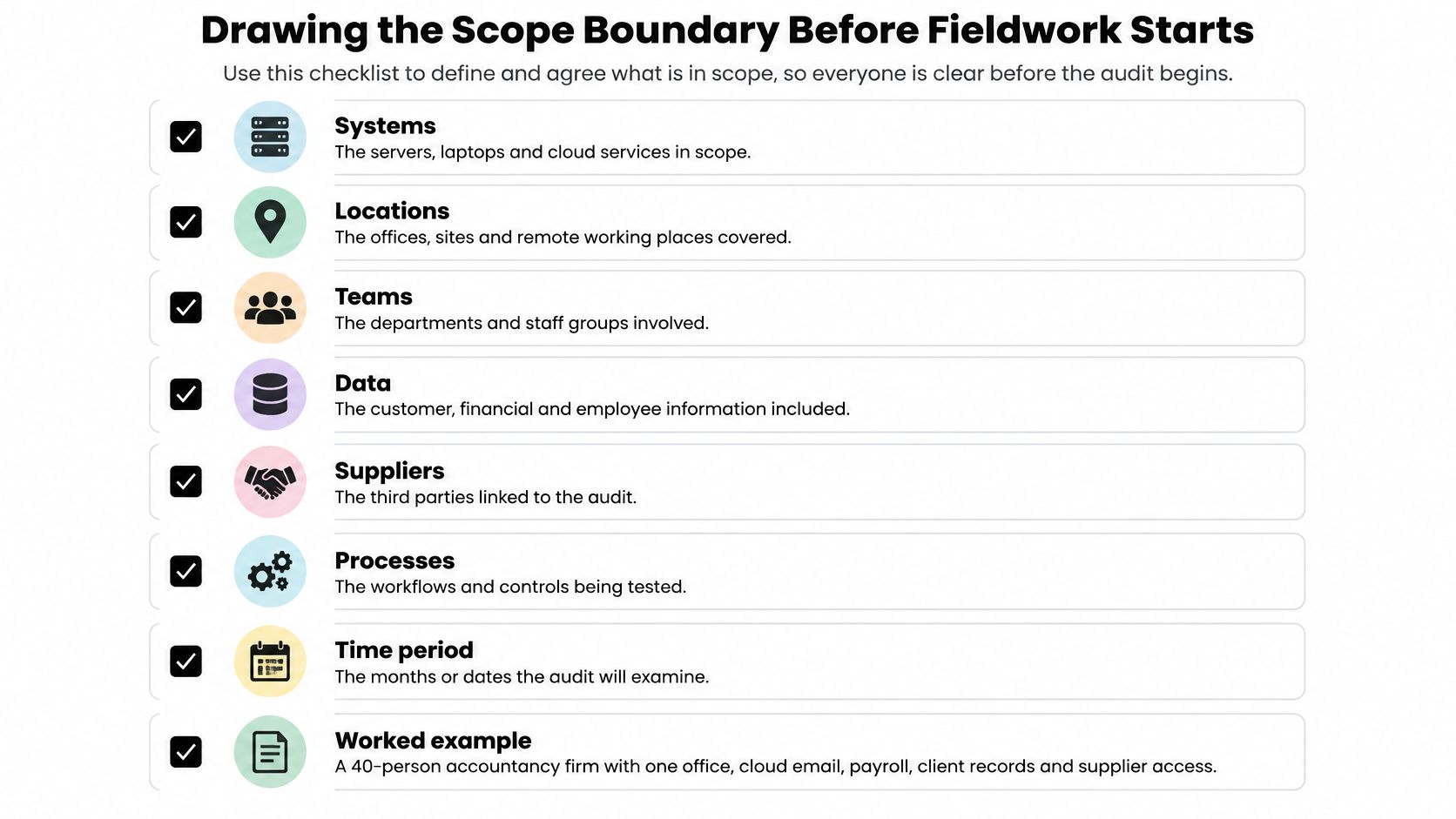
Say a 40-person accountancy firm commissions an audit. A workable scope covers cloud email and file storage, the laptops staff use, the payroll platform, the client portal and the two administrators who run it. It excludes personal phones unless they're used to read client email, and it names the twelve-month period from last April. That's a boundary a sceptical partner can read and challenge.
A scope that's too wide runs for months, generates a hundred low-value findings and buries the three that matter. Teams burn out collecting screenshots for systems nobody cares about.
A scope that's too narrow misses the risk entirely. The forgotten file store with client exports, the admin account outside the main directory, the marketing tool holding a copy of the customer list. These are exactly where audits find something worth acting on.
Build the Boundary With the People Who Run the Services
Don't fill in a template in isolation. Sit with the people who operate each service, use the words they use, and start from the information they hold rather than from a list of technologies. Ask what would hurt if it were disclosed, changed or unavailable, and the scope writes itself.
Set the audit period and the sampling population at the same meeting. If the period is the last twelve months, that fixes which access reviews, incidents and change records can be requested later. Ambiguity here is what turns a two-week evidence collection into a six-week scramble.
- Systems and data: the servers, laptops, cloud services and information in scope
- Locations: offices, sites and the remote working arrangements covered
- Teams: the departments and staff groups involved, including contractors
- Suppliers: third parties linked to the services in scope
- Processes: the workflows and controls being tested
- Time period: the exact months the audit will examine
Write the scope down and get it signed by the person who can fund the fixes. It's the first document an auditor and a sceptical manager will both ask to see.
Evidence Auditors Collect and How They Test It
An auditor doesn't accept a statement. If a manager says privileged access is reviewed quarterly, the auditor asks to see the review, the date, who signed it and what changed as a result. Evidence is the whole substance of the exercise, and the quality of the file usually predicts the quality of the findings better than the technology does.
| Evidence type | What it proves | Good sign | Weak sign |
|---|---|---|---|
| Approved policy set | Intent is documented and owned | Named owner, version number and review date within the last year | Undated draft with no owner |
| Risk register | Risks are identified and treated | Each risk has an owner, a score and a treatment decision | Generic risks with no owner or review date |
| System configuration export | The control operates on real systems | Dated export showing multi-factor authentication enforced for all admin accounts | Verbal assurance only, with no export or screenshot |
| Access review record | Least privilege is maintained over time | Signed review of privileged users with removals logged | No review in the last 12 months |
| Training records | Staff know their role in security | Completion by role, with simulation results followed up | One completion figure with no role-specific content |
| Incident log and drill record | Response works under pressure | Timed log entries and lessons recorded after a drill | No incidents or drills ever recorded |
Training is the evidence that disappoints most often. Only 19% of UK businesses and 21% of charities had provided cyber security training during the previous 12 months, according to DSIT's 2025 summary of labour market and sectoral findings. Where training does exist, a single completion percentage proves very little. Check it by role, and confirm that privileged administrators, finance staff and incident responders appear in the record, with dates.
The Four Ways an Auditor Tests a Control
An auditor inquires of the owner, which produces context but never proof on its own. They observe the process being run, watching a leaver's account being disabled rather than reading the procedure. They inspect the record, pulling the signed review or the configuration export. And they re-perform a check, recalculating a sample or rerunning a query against the admin console to see whether the recorded answer is truthful. The last two produce the strongest evidence, which is why a verbal walkthrough in a meeting room rarely survives contact with a report.
Sampling and What an Exception Means
Auditors test a sample sized by risk and by how many items exist, so a population of 200 privileged accounts gets more attention than a population of six. They aren't trying to prove perfection. They're looking for exceptions, and a single missing approval on a privileged account tells them more than fifty clean records.
You rarely need a new system to produce this. Take evidence from tools you already run: the cloud admin console, the HR system that records joiners and leavers, the email platform that logs phishing reports, the ticket queue where fixes are tracked. Keep the policy set slim enough that someone can maintain it, which is the same principle we apply when a charity's small team has no dedicated security staff. If you want to know which documents need to exist, the guide to ISO 27001 documentation requirements sets out the mandatory core against the rest.
Testing Governance and Named Accountability
Governance gets tested alongside technical controls for one reason: a finding nobody owns rarely gets fixed. Of the businesses that performed vulnerability audits, 77% assessed whether a cyber security strategy existed, 65% considered whether all board members were actively involved in cyber security discussions and 62% examined whether cyber security was incorporated into the organisation's broader governance structure, according to the 2025 Cyber Security Breaches Survey report.
The same survey shows why that matters. 43% of UK businesses experienced a cyber breach or attack in the previous 12 months, while only 27% had a board member with explicit responsibility for cyber security, down from 38% in 2021. Exposure stayed high while formal ownership fell. An audit that only counts firewalls and policies will miss precisely that gap.
What a Governance Test Asks For
The auditor isn't checking whether the board cares. They're checking whether the organisation can produce four things on request.
- A named accountable executive: someone whose role description includes the responsibility, not a committee.
- Documented risk acceptance: a record of who decided to accept which risk, when, and on what basis.
- Management review minutes that record decisions: not attendance lists, but funding approvals, risk acceptances and agreed deadlines.
- A review cadence that matches the risk: monthly for critical services, quarterly for the rest, with evidence the schedule was kept.
- Escalation of residual risk: what happens when a fix slips, who is told, and what they decide.
Priority Is Not Accountability
A board that says security matters has made a statement. It hasn't shown who owns the budget, who accepted the risk or who signs off the completion date. Auditors look for the second thing, because it's the one that survives a change of personnel or a difficult quarter. Where responsibility sits with a virtual information security lead rather than an employee, the audit still needs a named executive inside the business to accept risk and fund the work.
A control without a named owner is a hope, not a control.
Testing Suppliers and Outsourced Services
Sending a supplier a questionnaire and filing the reply isn't supplier assurance. It records that a supplier answered some questions on one day, which is a different claim from whether their service is safe to depend on. The exposure is easy to underestimate. The UK's NCSC reported that supplier-based breaches are increasing, yet only 14% of UK businesses reviewed the cyber risk of their immediate suppliers during the previous 12 months, and just 6% evaluated the broader supply chain, per the NCSC annual review 2025.
That leaves a familiar pattern. An organisation can pass an internally focused audit while its material risk sits in a cloud provider, a managed IT service, a payroll platform, a software vendor or an outsourced back office. The internal controls are sound. The dependency isn't examined.
A Proportionate Method, in Order
First, classify each supplier by the access it holds and how critical the service is. A payroll provider holding bank details and national insurance numbers sits in a different tier from a stationery account nobody logs into. Second, link contractual requirements to that tier: incident notification windows, audit rights, breach reporting, data return and deletion on exit.
Third, request evidence in proportion. A current certificate or a recent independent assurance report for the high tier, a completed questionnaire and a check of public information for the low tier. Fourth, assess fourth parties where the chain is material, such as the hosting provider behind your payroll supplier, because their outage is your outage.
Fifth, keep dated review evidence so the position between certification or surveillance audits is documented. A review that happened is only useful if someone can retrieve it eighteen months later.
What Happens When a Supplier Fails
An audit should ask this question directly, and few organisations have an answer. For a critical service, there should be a documented exit route: how data comes back, how access is revoked, how long a transition would take and who decides to trigger it. Where no exit is realistic, the risk gets accepted in writing by an executive and reviewed at a set interval. The practical work of tiering suppliers, writing contract clauses and tracking reviews is what third-party risk management looks like once it leaves the spreadsheet.
How Findings Become Corrective Action
A finding is a structured statement, not a complaint. It has five parts, and if any one is missing the reader can't act on it. The condition is what the auditor saw. The criteria are what the policy or standard requires. The cause explains why the gap exists, which is often the difference between a training problem and a resourcing problem. The effect is the risk it creates: service interruption, contractual breach, regulatory exposure or data loss. The recommendation is the change that closes it.
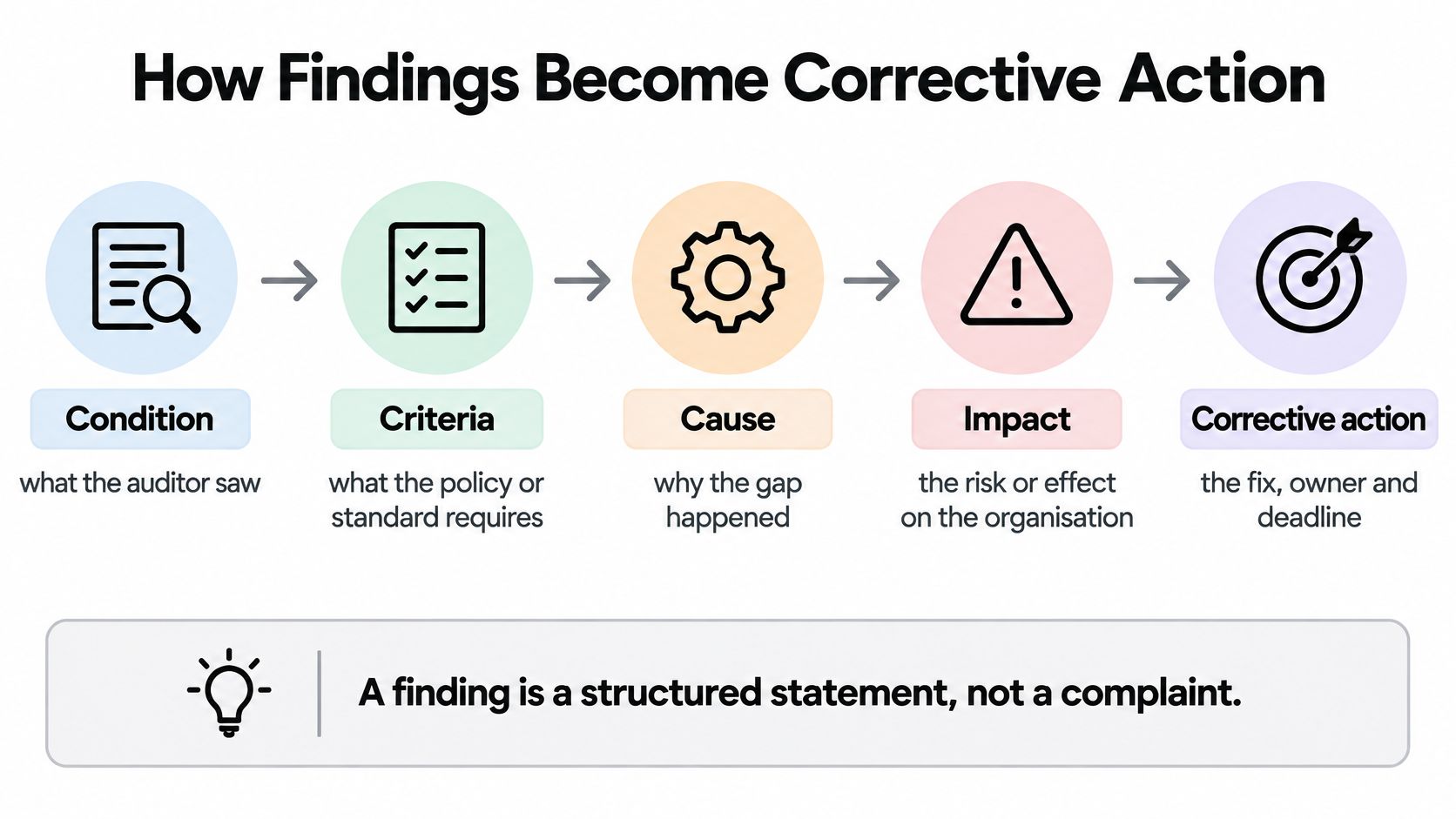
A typical entry reads like this. Privileged administrator accounts have no signed access review on record, measured against the quarterly review requirement in the access control policy, caused by no assigned owner for the review, creating unnecessary standing administrator rights. The recommendation is to appoint an owner, complete the review and schedule the next one.
Rating Findings in Plain Terms
High findings threaten a critical service or a legal duty. They need a funded plan with a date, and they get escalated if the date slips. Medium findings weaken a control that still works in part, such as a review that happens but isn't signed. Low findings are improvements: a stale template, an unversioned document. If your organisation reports against ISO 27001, the same logic applies to grading nonconformities, explained in this guide to major versus minor nonconformity.
The Lifecycle From Fieldwork to Closure
- Plan and scope: criteria agreed and signed before fieldwork.
- Fieldwork: interviews, inspection and sampling against the criteria.
- Draft findings: written in the five-part format and shared for factual correction.
- Management response: the owner agrees, disagrees or accepts the risk in writing.
- Agreed corrective action: named owner, specific action, deadline.
- Verification of the fix: the auditor inspects the evidence that the action landed.
- Closure in the final report: the finding is marked closed with a date and a reference.
A finding stays open until the owner submits closure evidence and someone independent of the fix verifies it. No other rule matters as much. Escalate any delayed high-rated item to the accountable executive with the residual risk stated in plain business terms, and keep every action in one log rather than four departmental trackers.
Attention usually falls short here. 72% of UK businesses regard cyber security as a high priority for senior management, according to the Cyber Security Breaches Survey 2025 statistics, yet a priority doesn't fund a fix. An internal audit programme built on risk-based audits of the applicable Annex A controls, with findings, reports and corrective-action tracking, gives management something to review rather than something to admire.
A finding is closed by evidence of the fix, not by a promise to fix it.
What the Audit Report Contains and How Often to Repeat It
A usable report follows a fixed order: the scope and audit period, the criteria tested, the methods used, the rated findings in the five-part format, management responses with owners and dates, the status of every action in the log, and a residual-risk statement for anything still open. Anything else is a summary, not a report.
A worked entry shows the shape. Finding 3, high: privileged administrator accounts have no signed access review on record, measured against the quarterly requirement in the access control policy, no named owner, effect is unnecessary privileged access. Action: owner appointed and review completed by a set date, with residual risk escalated to the accountable executive if the date slips.
How Often to Repeat It
Frequency follows risk rather than the calendar. High-risk roles, critical suppliers and repeat failures get tested more often, and management watches completion rates, simulation failure, reporting speed and overdue remediation between audits. Where the organisation pursues ISO 27001, the standard requires internal audits at planned intervals, so the calendar is set in advance and feeds the management review.
A short evidence pack of risk register, action log and recorded decisions usually serves a small firm better than a long technical report nobody acts on.
Confirm Your Audit Scope and Start Mobilisation
Commission the audit once three things exist: a named owner, an agreed boundary and an evidence trail someone can retrieve. Miss any one of them, and you get a long list of findings with no route to closure.
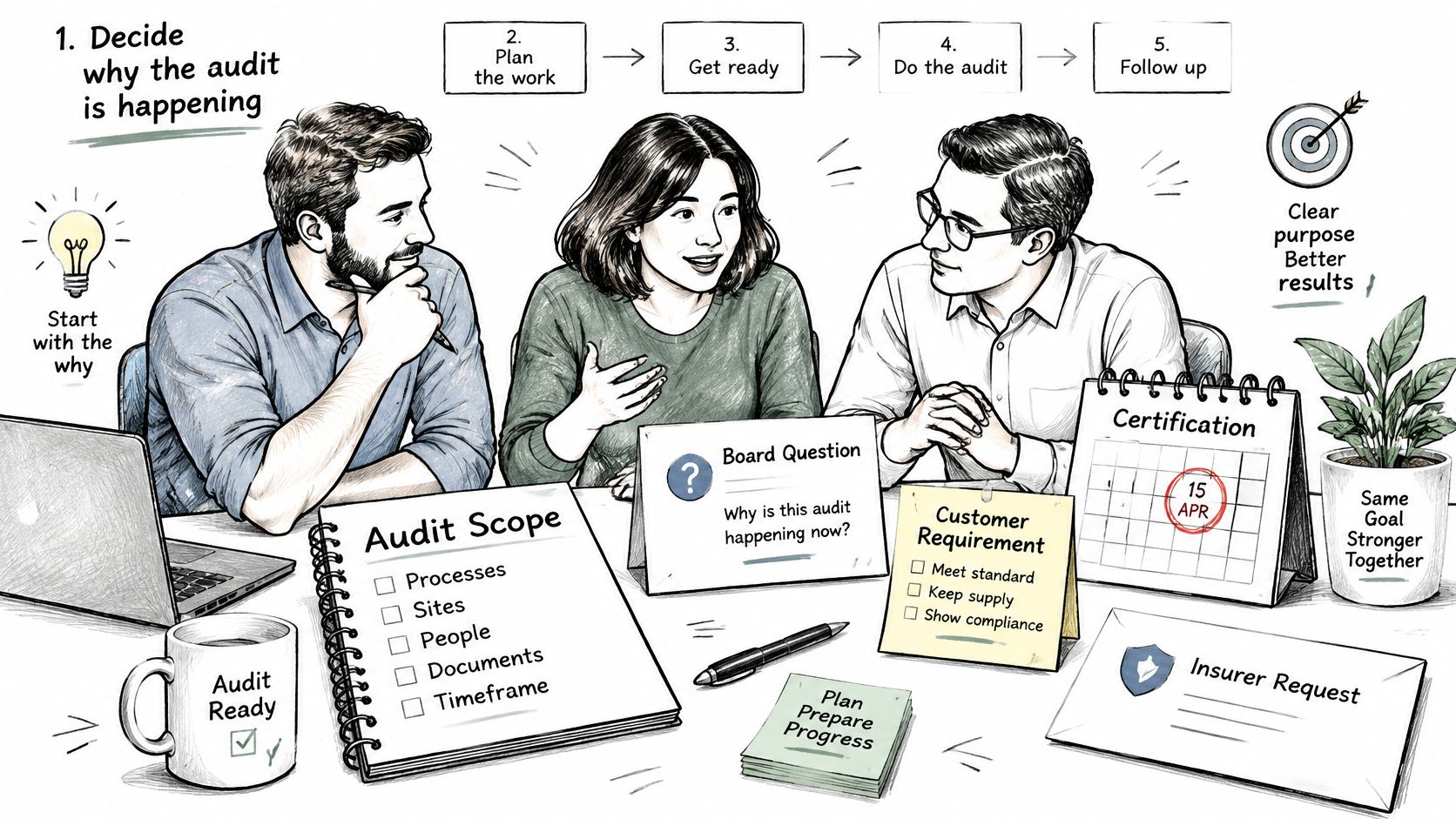
Five actions turn this month's intention into a scheduled audit.
- Write down the reason. A customer requirement, a certification date, an insurer request or a board question. The reason sets the criteria, and the criteria set the scope.
- Draw the boundary. List the services, locations, data, suppliers and time period, using the method set out earlier.
- Name one accountable owner who can make decisions and fund corrective action.
- Gather what already exists: the policy set, risk register, access reviews, training records and last audit findings.
- Agree the evidence sources the team can reach without buying new tools.
Each item feeds the next. The reason determines what gets tested, the boundary determines where, and the owner determines who answers when the findings land.
If you want outside help, the work starts with an arranged readiness discussion in which you explain who is asking for the audit and what exactly they have asked for. A mobilisation step then reviews your existing ISMS documents, risks, controls, audits, management reviews and certification dates, using one day of the annual allocation, so the first fieldwork day goes to testing rather than discovering what exists.
A rushed audit without an owner, a boundary and a retrievable evidence trail produces exactly what you would expect: accurate findings, no decisions, and the same open items on next year's list.
If your customers, insurers or tender panels are asking for assurance you can evidence, ISO Security runs ISO 27001 gap analysis, readiness assessments and internal audits against the applicable Annex A controls, then tracks findings and corrective actions through to verified closure. The practice works with consultancies, insurance businesses and charities across the UK, and every engagement starts with that same conversation about who is asking and what they have requested. Visit ISO Security to arrange it.