Internal audit is an independent, objective assurance and advisory activity that evaluates and improves governance, risk management and internal controls. In everyday terms, it tests whether the safeguards an organisation relies on work in practice, rather than just looking tidy on paper.
An invitation to your first internal audit meeting can easily feel like a surprise inspection. You might run a tight team, keep your policies up to date in SharePoint, and still wonder why someone outside your department wants to review your access logs or supplier sign-offs. Managers who search for what an internal audit is usually want two practical answers: what the auditor is going to check, and who remains responsible once problems come to light.
Whether you run an owner-managed firm without a dedicated audit team, sit on a charity board, or oversee an ISO 27001 management system, understanding that boundary removes most of the friction. An internal audit isn't a trap, and it isn't a substitute for management doing its job.
Table of Contents
- Internal Audit Defined in Plain English
- How Internal Audit Differs From Other Checks
- How an Internal Audit Runs From Plan to Follow-Up
- Why Boards and Managers Rely on Internal Audit
- Charity and ISO 27001 Examples
- Decide Whether Your Organisation Needs One Now
Internal Audit Defined in Plain English
An internal audit is a structured check carried out by someone independent of the day-to-day process, designed to tell senior leaders whether governance, risk management and internal controls are working as intended and where they need fixing.
Three words carry almost all the weight in that definition. Independent means the auditor didn't design, operate or approve the process being tested. Objective means conclusions rest on verifiable evidence, such as system logs, invoices or signed approvals, rather than gut feel or friendly assurances. Evaluate and improve means the work doesn't stop at finding faults; it produces a clear judgement alongside practical recommendations.
A simple analogy helps. Say you're buying a newly renovated house and hire a qualified building inspector who had nothing to do with the construction. The inspector compares the electrical wiring against the architectural plans, tests the circuits, and hands you a list of defects to fix before you move in. They don't rewire the kitchen themselves, and they didn't build the walls, yet their independent report protects you from moving into a house with hidden hazards.
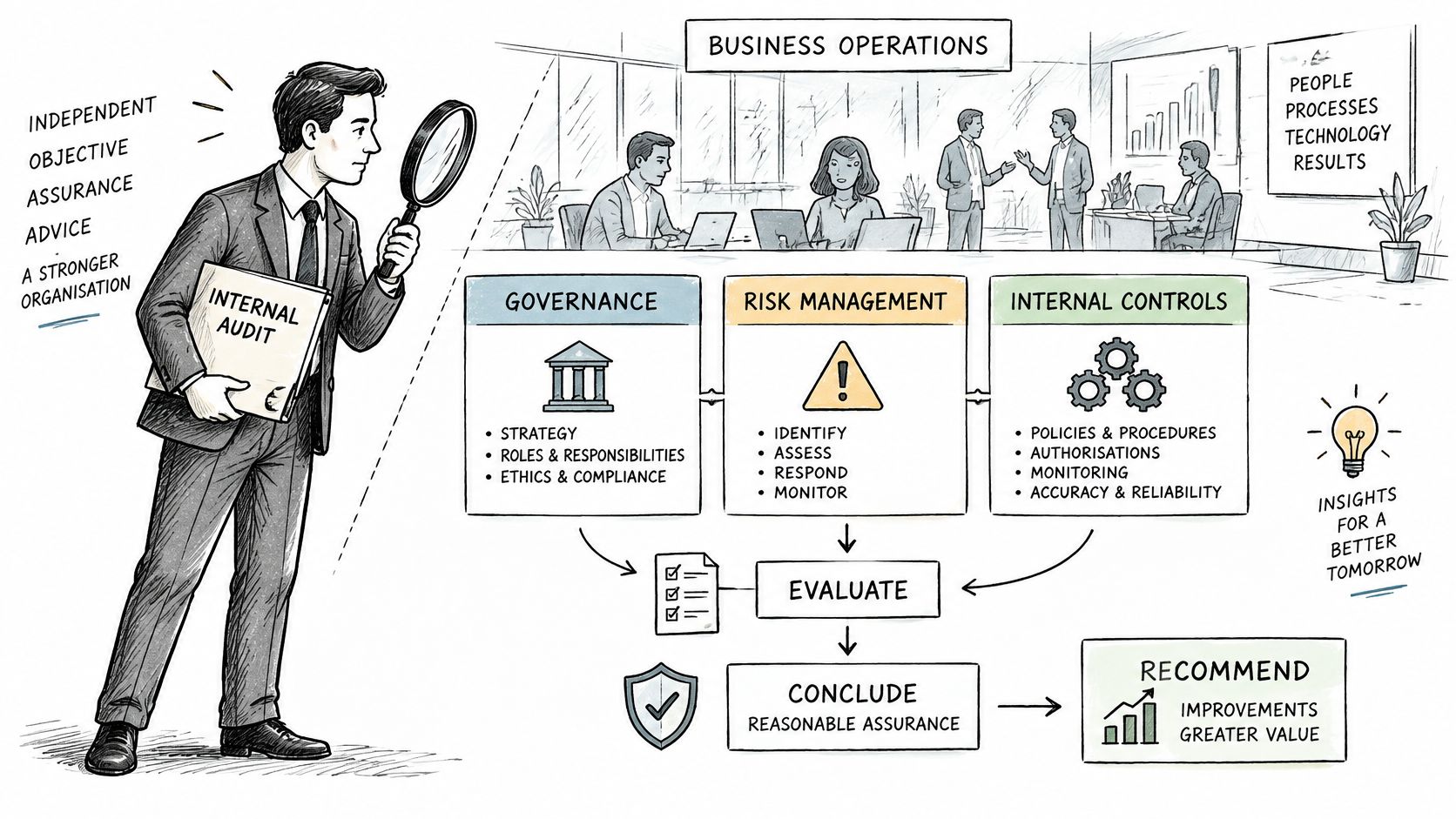
People often confuse "internal" with "informal", or assume it means an employee checking their own team's files. In reality, "internal" describes who the function serves. An internal audit sits inside the organisation's governance structure (even when the work is outsourced to a specialist) and reports to senior management, the board or the audit committee. An external audit, by contrast, is carried out by an outside firm primarily for shareholders, lenders or regulators.
In the UK, that governance focus is written directly into public-sector rules. The UK Public Sector Internal Audit Standards (PSIAS), published in 2013 and made mandatory for central government departments, agencies and executive non-departmental public bodies, define internal audit's formal purpose as helping organisations achieve their objectives through a systematic and disciplined evaluation of risk management, internal control and governance processes. Those standards address accounting officers, boards, audit committees, heads of internal audit and senior finance leaders, making it clear that the work reaches far beyond financial transactions.
An internal audit of an ISO 27001 information security management system follows the exact same rule: it tests whether the system is implemented, maintained and effective, not merely whether a policy folder exists.
Four Audit Terms in Plain English
Audit reports use a handful of technical terms that can trip up first-time readers. Keeping these four straight makes every audit meeting easier to follow:
- Residual risk: The level of risk that remains after your existing controls have done their job. Zero risk rarely exists, so leaders need to know whether the remaining exposure is acceptable.
- Nonconformity: A specific requirement from a standard, contract or internal policy that hasn't been met in practice.
- Annex A: The reference list of information security controls inside ISO 27001, covering organisational, people, physical and technological safeguards that an organisation selects based on its risks.
- The three lines: A governance model separating operational teams who own and run controls (first line), risk and compliance functions that oversee them (second line), and independent internal audit assessing both (third line).
You now have the plain-English picture of the function itself. The confusion most organisations run into starts when they treat internal audit as interchangeable with routine management checks, compliance inspections or certification visits.
How Internal Audit Differs From Other Checks
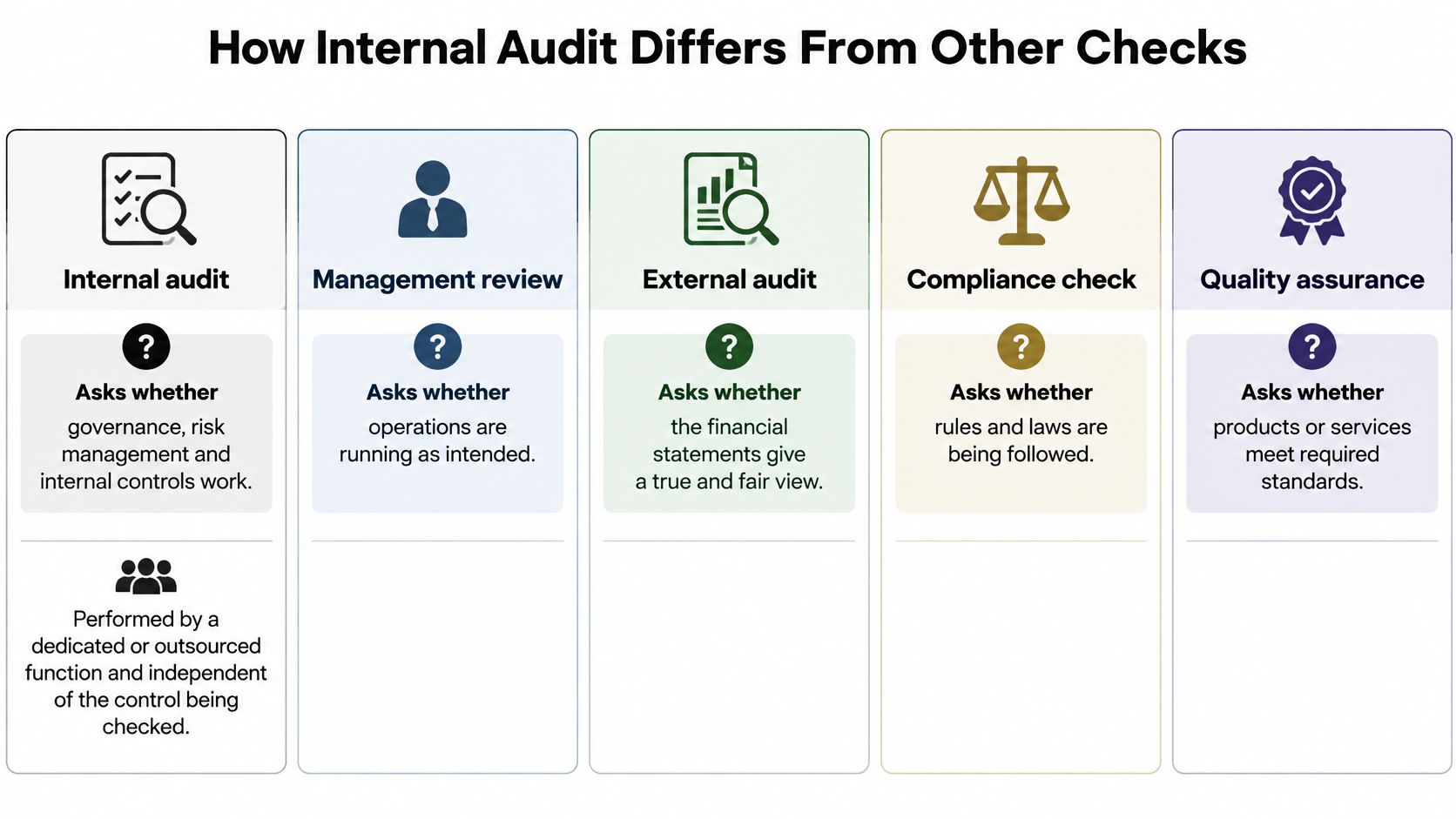
Most growing organisations already perform several kinds of review without realising how differently they behave. Comparing five common checks side by side shows why an internal audit answers a question none of the others can replace.
| Check | Who carries it out | Independent of the control owner? | Main question it answers |
|---|---|---|---|
| Internal audit | Dedicated or outsourced internal audit function | Yes | Do our controls work, and can the board rely on them? |
| Management self-check | Control owner | No | Is my team doing the task correctly today? |
| Compliance check | Compliance or quality team | Partly | Does the activity meet the stated rules? |
| External statutory audit | Appointed external auditor | Yes | Do the financial statements give a true and fair view? |
| ISO 27001 certification audit | Accredited certification body | Yes | Does the management system meet the standard? |
A team manager who reviews their own staff's system access permissions on a Friday afternoon is carrying out a management self-check. That work is valuable and keeps day-to-day operations clean, yet it doesn't provide independent assurance. The manager designed the rota, approved the requests, and knows what they expect to see, which makes blind spots almost unavoidable.
A compliance checklist creates a similar trap when organisations mistake paperwork for protection. A checklist asks whether a password policy exists in the handbook. An internal audit goes further: it tests whether password complexity and multi-factor authentication are enforced in Microsoft Entra ID, checks whether departing staff lose access on time, and examines what happened the last time someone bypassed the rule.
That same evidence-first mindset separates a paper exercise from a genuine cyber security audit. Rather than accepting a verbal "yes" from IT or operations, the auditor interviews control owners, inspects real records, tests a sample of events and confirms whether issues raised previously were resolved.
Who Owns the Control and Who Fixes the Finding
Where managers most often get caught out is responsibility. Many assume that once an internal auditor reviews a process, or once an external specialist runs the internal audit programme, the auditor now owns the security or compliance outcome. They don't.
UK government guidance draws a sharp line here. As HMRC Internal Audit explains, operational teams own and operate controls, internal assurance tests whether those controls give management enough confidence, and Internal Audit sits independently above both to give the Chief Executive an overall assessment of whether governance, risk management and internal controls operate effectively and efficiently. When a control owner marks their own homework, conflicts of interest weaken the credibility of the findings. When an independent function samples evidence and verifies corrective actions, senior leaders get a far more defensible picture of their residual risk.
The UK government's GovS 009 Internal Audit standard reinforces this split, placing internal audit in the "third line" to assess both the design and operation of first- and second-line controls while management keeps full responsibility for managing risks and fixing weaknesses. This matters acutely in owner-managed and mid-sized businesses, where the person who wrote a procedure is often asked to audit it six months later. In our own ISO 27001 work, the client's organisation retains accountability for the ISMS, control operation, technical implementation, risk acceptance, management decisions and remediation.
Practical test for any control: Before your next review, write down three names against each critical process: who owns the control day to day, who tests it independently, and who holds authority to approve and fund the fix.
If the same name appears in the first two columns, you have a self-check rather than an internal audit. Separating those roles is what turns a routine operational review into evidence a board, customer or certification assessor can trust.
How an Internal Audit Runs From Plan to Follow-Up
An effective internal audit isn't a surprise raid or an endless trawl through every spreadsheet in the building. It follows a predictable six-step cycle, where each stage produces a concrete output that feeds the next.
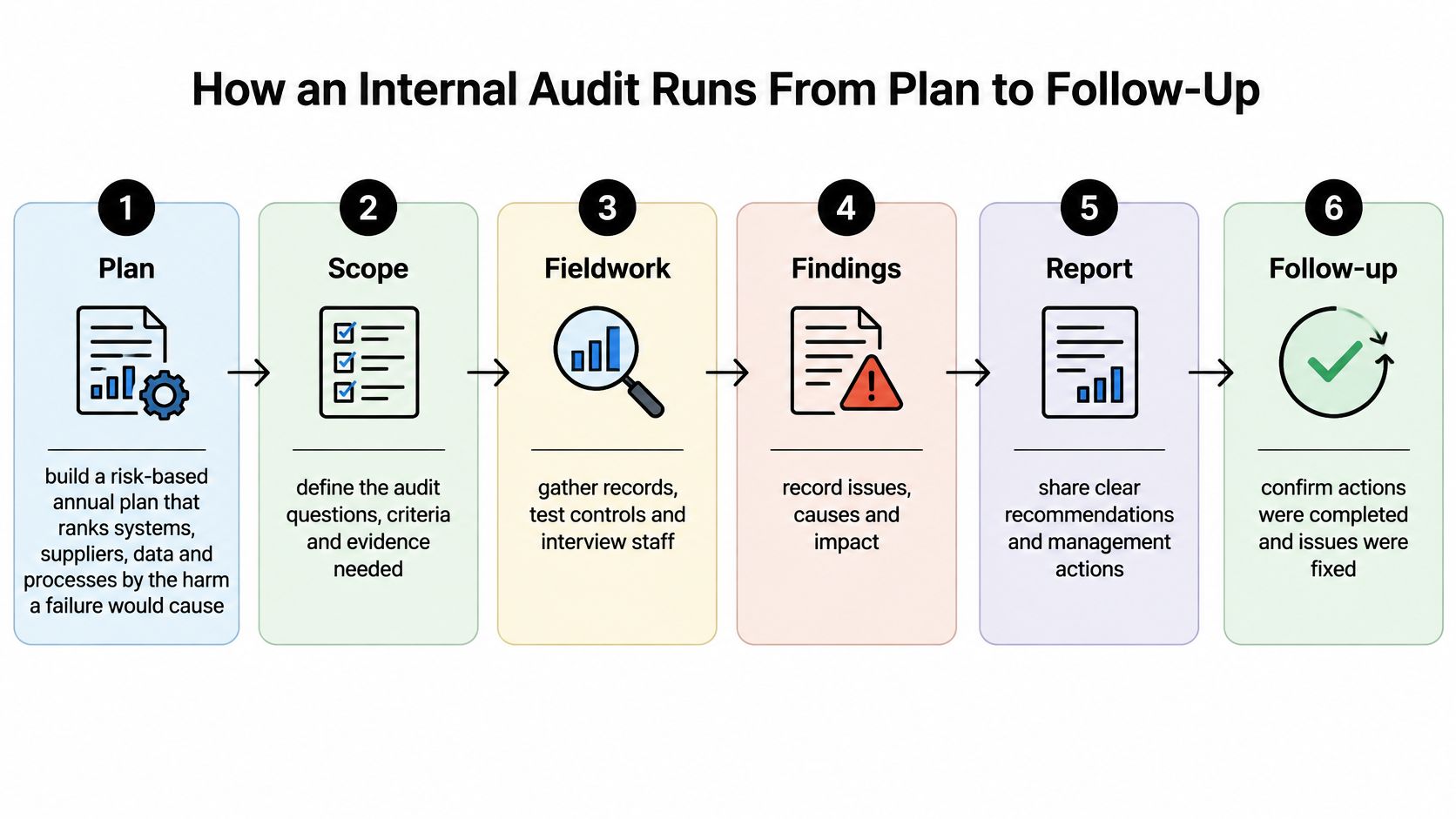
- Plan: Build a risk-based annual audit plan that ranks systems, suppliers, information assets and processes by the harm a failure would cause, then agree it with senior management or the audit committee. In our ISO 27001 work, the internal audit programme consists of risk-based audits of the applicable Annex A controls, with findings, reports and corrective-action tracking. Output: an approved annual audit schedule with clear priorities.
- Define scope and criteria: State exactly which processes, locations or periods are in scope, and name the benchmark you're testing against (an ISO 27001 clause, a contract obligation, a regulation or an internal policy). Skipping this step invites scope creep and arguments during interviews. Output: written terms of reference shared with control owners before testing starts.
- Fieldwork: Interview the people who run the controls, observe key workflows and inspect objective records. Auditors don't need to check every single record to reach a reliable view. Say your company has 2,000 active user accounts, and the biggest access risk sits with former staff keeping live logins. Rather than checking all 2,000 accounts, the auditor targets a sample of 20 leaver accounts from the past six months and traces each one against HR departure dates and active directory logs. Because the sample targets the highest-risk population, even one active former account exposes a real control breakdown. Output: documented test sheets and retained evidence.
- Findings: Record every gap or exception alongside its root cause, its real business consequence and a severity rating so leaders can separate urgent threats from minor housekeeping. Output: a draft findings log reviewed for factual accuracy with control owners.
- Report: Deliver a clear written report to management and the board, separating formal nonconformities that require corrective action from optional improvement opportunities. Each required action needs a named owner and a realistic due date. Output: a signed-off internal audit report.
- Follow-up: Return after the due date to verify that agreed actions were completed and work as intended, rather than accepting a verbal promise that the issue is sorted. Output: verified closure evidence and an updated action tracker.
Keeping the Audit Model Proportionate
Smaller UK organisations often avoid internal audits because they imagine a heavyweight corporate department conducting months of disruption. Even large teams struggle to balance depth with capacity: in Deloitte's 2025 UK internal-audit survey, improving assurance coverage was the top priority for 93% of respondents, followed by improving efficiency at 83% and upskilling at 72%.
More testing doesn't automatically produce better assurance. Checking low-risk administrative checklists every quarter wastes effort while critical supplier, payment or cyber controls go untouched. A lightweight operating model keeps the work proportionate for SMEs, charities and consultancies: maintain a short risk-led audit universe, assign one owner to each control, gather routine evidence as work happens throughout the year, apply targeted sampling, and report unresolved high-risk actions straight to senior leaders.
For a short walkthrough of how audit planning, fieldwork and reporting connect in practice, watch the overview below.
You know the six-step cycle is working when two quiet things happen: corrective actions close on time with solid proof, and next year's audit plan changes based on what this year's testing uncovered.
Why Boards and Managers Rely on Internal Audit
Every managing director, trustee or finance lead faces the same structural blind spot: almost every operational report that lands on their desk was written by the person running that operation. Staff rarely hide problems out of malice, yet optimism bias, busy quarters and unclear handovers mean routine status updates stay green long after a safeguard has stopped working.
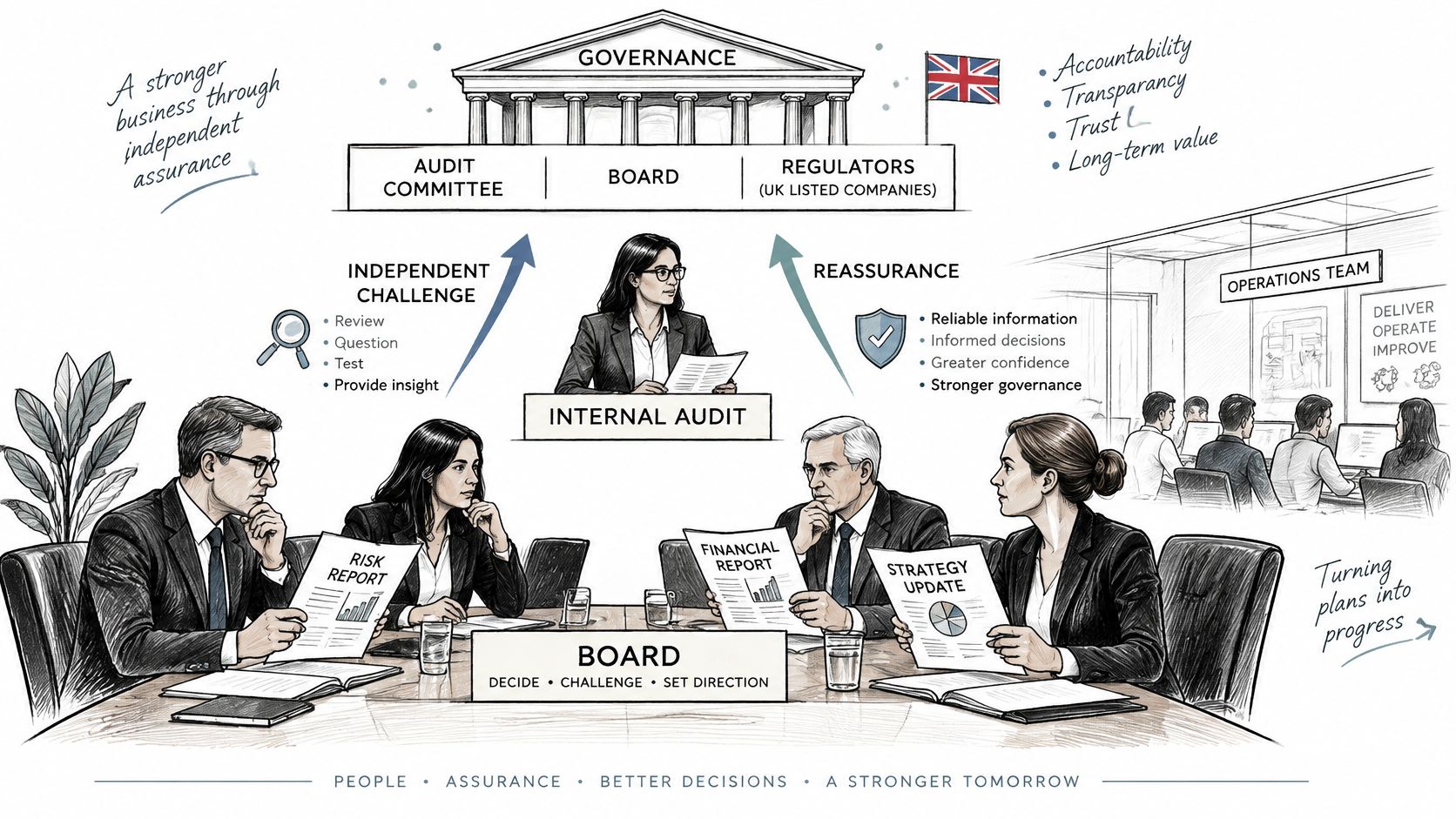
For UK listed companies, the Financial Reporting Council's UK Corporate Governance Code 2024 requires boards to maintain transparent arrangements supporting audit independence and effectiveness, with the audit committee reviewing the internal audit mandate, approving its annual plan, monitoring its work and overseeing material operational, reporting and compliance controls alongside financial ones.
Owner-managed firms, charities and mid-sized businesses don't answer to listed-company rules, yet their leaders rely on internal audit for three practical reasons that hit the bottom line just as hard:
- Earlier warning of control failure: Independent testing catches broken backups, unapproved supplier changes or lapsed access reviews before an outage, fraud or regulator forces the issue.
- A defensible view of risk: When a major client, insurer or trustee asks how you know your safeguards work, dated audit evidence carries weight that verbal reassurances never will.
- Operational clarity over paperwork: A risk-led audit cuts out duplicated procedures and highlights controls that nobody is running, turning compliance overhead into cleaner ways of working.
Why Systems Stall Between Audits
Even well-designed management systems lose momentum once the initial implementation project ends. Teams get pulled into client delivery, staff change roles, and responsibilities blur across IT, HR and operations.
"Ambiguity is the reason most management systems stall between audits." (Alan Hutson, ISO Security)
Say a finance director receives six consecutive monthly dashboards showing green status across procurement and supplier onboarding. Everyone assumes the dual-approval rule for bank detail changes is running smoothly. During an annual internal audit, the auditor samples ten recent supplier updates and discovers that the second verification call stopped four months earlier when an accounts supervisor went on leave and nobody picked up the duty. Without an independent check, that silent gap could have sat open until a fraudulent invoice drained the account.
Stronger IT in governance depends on closing exactly those handoff gaps between technical teams and senior decision-makers. Internal audit isn't a cure-all for every operational snag, and tiny businesses with simple processes don't need layers of bureaucracy. It earns its keep when failure would cause real contractual, financial or reputational harm, when external stakeholders demand credible proof, and when an organisation has grown past the point where a founder can see everything personally.
Charity and ISO 27001 Examples
Abstract definitions click into place much faster when you see how an audit behaves inside real organisations. The two cases below are illustrative composites rather than named clients, and they don't imply real outcomes or guaranteed certification results.
A UK Charity Preparing for a Funder Review
Say a medium-sized UK charity handles sensitive beneficiary records, manages safeguarding logs across regional volunteers, and processes grant payments through a small finance team. Ahead of a major institutional funder review, the trustees want independent proof that their stated controls match daily practice.
An internal audit is scoped around three high-risk areas: data protection access controls, safeguarding record completeness and finance approval thresholds. The auditor interviews the operations lead and finance officer, checks a sample of volunteer onboarding files, and tests whether dual sign-off was applied to recent grant disbursements. Importantly, the trustees review the audit findings formally rather than delegating them out of sight, recording named owners and completion dates for every gap. In our own work helping a UK charity achieve certification, ISO Security ran the charity's internal audit and management review with trustee involvement an auditor could see, then prepared the charity for independent assessment through to certification. Organisations in the third sector exploring structured assurance can review our guide on ISO 27001 for charities.
A Consultancy Preparing for ISO 27001
Now consider a 60-person digital consultancy bidding for enterprise contracts that require ISO 27001 certification. Before inviting an accredited certification body on site, management schedules an internal audit covering both Clauses 4 to 10 of the standard (context, leadership, risk assessment, competence, monitoring and management review) and the applicable Annex A controls on a risk basis, including access reviews, supplier assurance and incident response records.
The boundary between internal audit and certification stays clear throughout. Internal audit prepares the organisation and uncovers weaknesses privately; audit outcomes sit with the certification body and can't be guaranteed by ISO Security or any adviser.
Walking Through a Single Audit Finding
To see how the cycle turns a weakness into lasting protection, trace one common finding from start to finish:
- The finding: During fieldwork, the auditor checks a targeted sample of recent leavers against Microsoft Entra ID and CRM logs and discovers a former consultant's account still active 30 days after their departure date.
- The root cause: Interviews show that HR records resignations in the payroll system, yet no formal step triggers an IT offboarding ticket for client-facing tools.
- The corrective action: Management assigns the IT lead and HR manager to introduce a mandatory leaver checklist and run a monthly reconciliation comparing HR departures against active system accounts.
- Proof of closure: At follow-up three months later, the auditor doesn't just read the new checklist. They inspect three consecutive monthly reconciliations signed off by both owners, confirming zero orphaned accounts before marking the nonconformity closed.
A finding only reduces risk once it has a named owner, a realistic due date and objective proof of closure.
Decide Whether Your Organisation Needs One Now
Timing an internal audit doesn't require guesswork. Mapping your current situation against the practical trigger and starting point below shows where independent assurance delivers immediate value.
| Situation | Why internal audit helps | Where to start |
|---|---|---|
| Owner-managed business with no separate audit role | Someone independent checks controls the owner designed | Review the top five risks and their controls |
| Preparing for ISO 27001 certification | Finds nonconformities before the certification body does | Schedule an internal audit of Clauses 4 to 10 and the Annex A controls |
| Listed company or board wants assurance | Gives the audit committee evidence beyond management reports | Agree a risk-based annual audit plan |
| Charity with trustee oversight | Tests whether governance and controls match trustee expectations | Start with finance, safeguarding and data controls |
| Growing firm with informal security processes | Shows where responsibilities are unclear | Map an owner for each key control first |
Waiting until an incident forces a review is a risky habit in the UK market. In 2025, 79% of UK businesses and charities reported experiencing some form of cyber-security incident during the previous 12 months, according to DSIT's Cyber Security Longitudinal Survey. Yet in 2025, only 29% of UK businesses conducted cyber-security risk assessments, according to the Department for Science, Innovation and Technology's Cyber Security Breaches Survey 2025. That gap explains why so many organisations discover missing controls only after a breach or failed tender.
Three Quick Tests for Leadership
Ask yourself three direct questions about your current setup:
- Independent eyes: Is anyone independent of your operational teams testing the controls you rely on most?
- Clear accountability: Does every critical risk have one named owner responsible for running and fixing its controls?
- Early visibility: Would you hear about a control failure from your own assurance cycle before a customer, regulator or security incident told you?
If the answer to any of those questions is no, an internal audit will almost certainly repay the effort. Smaller organisations don't need an internal audit department or full-time staff to get started. A targeted, risk-based review of your top five controls, run once a year, captures most of the protection without drowning your team in paperwork.
Set your audit frequency by risk rather than habit. High-risk controls (such as privileged access, backups, payment approvals and critical suppliers) deserve review every year or whenever the underlying system or risk changes, while lower-risk controls can run on a longer cycle. You have enough evidence when targeted samples from the highest-risk population show the control operating consistently and every recorded finding closes with verifiable proof.
For organisations without a dedicated internal security lead, ongoing vISO support is suited to certified organisations without an internal ISMS owner, growing businesses whose security responsibilities have outgrown informal processes, businesses preparing for surveillance or recertification audits, organisations receiving complex customer security questionnaires, and leadership teams needing clearer information-security reporting. Having someone who understands both sides helps keep the programme realistic: Alan Hutson has implemented management systems inside live organisations and has audited them from the other side of the table.
Take one concrete step this week. Sit down for thirty minutes, list your organisation's top five operational or information risks, put one named owner beside each control, and sketch a short risk-based audit plan for the next twelve months.
ISO Security provides independent ISO 27001 internal audits, implementation support and ongoing vISO oversight for UK businesses, charities and corporate groups that want proportionate, evidence-led assurance without unnecessary paperwork. If you're preparing for certification, closing gaps between surveillance visits or looking for an independent eye on your key controls, visit ISO Security to discuss a practical, risk-based audit plan for your organisation.