Most advice about an IT security policy for ISO 27001 boils down to one instruction: download a template, swap in your company name, get a director to sign it. That gets you a document. It doesn't get you a management system, and it's the reason so many policy sets unravel the moment an auditor asks a service manager what the access control rule means for their team. The policy is evidence that controls operate, not a certificate of good intentions to file in a shared drive. Write it so that every statement points to a named person and a record you can produce on request, and the audit becomes a sampling exercise rather than an argument.
Table of Contents
- What an ISO 27001 IT Security Policy Must Contain
- How to Build the Policy From Your Risks
- Assigning Owners Who Can Actually Act
- Writing and Maintaining Policies People Follow
- Scaling Policy Governance for Small Firms and Charities
- Common Policy Gaps and How to Fix Them
- Confirm Your Policy Set Before the Audit
What an ISO 27001 IT Security Policy Must Contain
A template fails because it describes a tidy organisation that does not exist. The policy set has to match the way the organisation runs, then give an auditor evidence that each rule is used. If the policy says access rights are reviewed at planned intervals, the organization needs a named owner, a review record and a route for exceptions. Auditors read the policy first because it frames what they test next, then sample records against those promises.
| Policy element | What an auditor looks for | Where it comes from |
|---|---|---|
| Purpose, scope and objectives | Measurable objectives and a clear boundary of systems, sites and services | Clauses 5.2 and 6.2 |
| Management commitment | Top management approval and a statement of commitment to the ISMS | Clause 5.2 |
| Risk-based direction | Policy statements traceable to the risk assessment and treatment plan | Clause 6.1 |
| Topic-specific policies | Access control, acceptable use, supplier security, backup and logging policies | Annex A control 5.1, plus the relevant topic-specific controls |
| Roles and responsibilities | A named owner for each policy and control | Clause 5.3 and Annex A control 5.2 |
| Approval, version and review date | Approver, version history and a stated review interval | Annex A control 5.1 |
| Documented evidence | Records showing controls operate, not only that documents exist | Clause 7.5 |
This document carries commercial weight in the UK because larger buyers already expect it. In the Cyber Security Breaches Survey 2023, 9% of 1,152 surveyed UK businesses reported adhering to ISO 27001, rising to 27% of large businesses. Those are self-reported adherence figures rather than certification counts, but they explain why a procurement team at a large customer treats your policy as a normal request.
Annex A control 5.1 expects the policy and its topic-specific policies to be approved, published, communicated and reviewed at planned intervals and when significant changes occur. Annual review is the common baseline, with an out-of-cycle review triggered by a new platform, a new supplier or a change of ownership. The trade-off is simple. A short policy set with clear owners and records is easier to maintain than a long handbook that nobody can evidence.
Testing your existing set in an afternoon
Print the policy list, then work down the table above with a highlighter. For each policy, write the owner, the record used to show operation and the last review date. If you cannot fill those three fields, the document is not ready to rely on as evidence.
The gaps that show up first are usually the same three: no named approver on the current version, objectives stated but never measured, and topic policies referencing control numbers from the 2013 edition. Fix those before writing another word. Keep the language plain enough for the person who has to follow the rule, then tie each statement to a review record an auditor can sample.
How to Build the Policy From Your Risks
Scope comes first. Writing policies before you've decided which services, suppliers and legal duties sit inside the ISMS is the most common way to end up with documents nobody can implement. The Cyber Security Longitudinal Survey wave four results found 15% of businesses reported ISO 27001 adherence compared with 9% of charities, with adoption higher among large businesses than medium-sized ones, which is exactly where proportionate scope design and assigned ownership earn their keep.
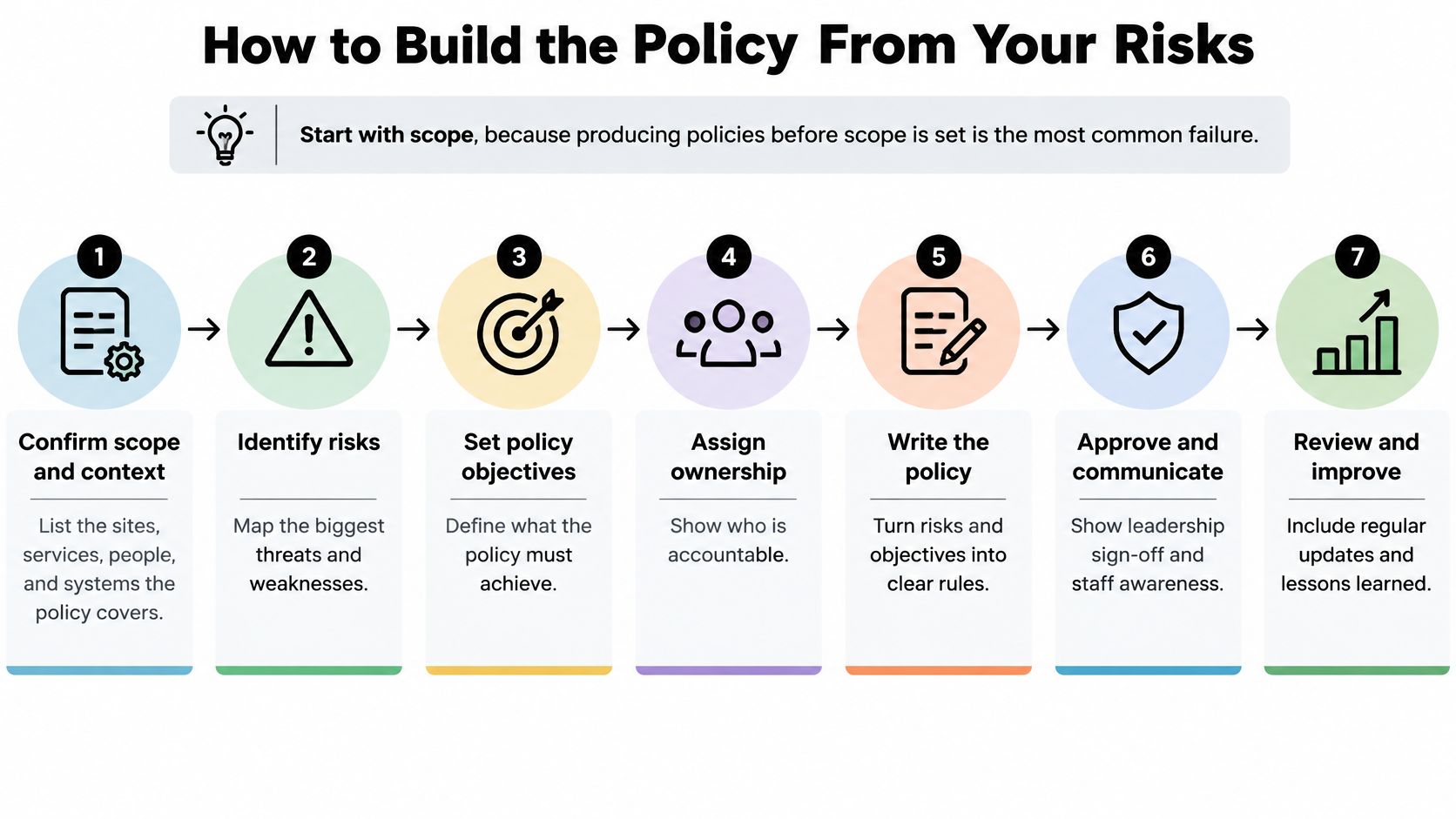
- Confirm scope and context. List the sites, services, customer contracts, suppliers and legal duties the ISMS covers. Every later decision inherits this boundary, so a vague scope produces vague policies.
- Record assets and processes with the people who run them. Use their words, not an IT asset export. We build risk assessments with the people who run the services, in language they recognise, covering the information they hold, because a finance administrator will describe a real weakness that a server inventory never shows.
- Score likelihood and impact. Name the threat and the weakness it exploits in the same line. "Data loss" isn't a risk; "unencrypted laptop left in a car during a home visit" is.
- Choose a treatment and record the remainder. Modify, retain, avoid or share, then write down the residual risk, the accountable owner and a target date. A treatment without a date is a wish.
- Select Annex A controls from the treatment plan. Justify every inclusion and exclusion in the Statement of Applicability. Copying all 93 controls wholesale guarantees you'll be audited against controls you never intended to run.
- Draft only the policies those controls require. Each policy then traces back to a risk, which is the answer you give when an auditor asks why a rule exists. A structured ISO 27001 risk assessment template keeps that traceability visible in one place.
- Get approval, publish, brief. Top management signs, staff are told what changes for them, and you keep the record of that briefing.
A finished register entry reads something like this for a fictional payroll bureau: process, monthly client payroll run; threat, credential theft; vulnerability, no multi-factor authentication on the payroll portal; likelihood, medium; impact, high; treatment, modify by enforcing MFA and restricting access to two named administrators; owner, operations manager; target date, end of next month; residual risk, low; management acceptance, signed by the managing director. Every field is populated, so nobody has to invent an answer under audit conditions.
How long this takes depends on your size, scope, complexity and current readiness. The certification body makes the certification decision, not the adviser who helped you build the system.
Assigning Owners Who Can Actually Act
Say a 60-person engineering firm puts every policy in the IT manager's name. He's competent and overloaded. Nobody reviews access rights because reviewing access rights means chasing three department heads, and at the first audit no one can say who approved the cloud hosting supplier or on what basis. The paperwork is tidy. The accountability is fictional.
Spread ownership across roles with deliberate limits, and the same firm becomes auditable.
| Role | What it owns |
|---|---|
| Top management | Approves the policy, provides resources and accepts residual risk |
| Information security lead | Keeps the policy set, risk register and Statement of Applicability current |
| Control owners (IT, HR, facilities) | Operate specific controls and hold the evidence |
| Service or process owners | Confirm risks for their own services and processes |
| Internal auditor | Tests that controls operate, independent of the work being audited |
The distinction that matters most is between the person who operates a control and the person who checks it. An IT engineer who resets leavers' accounts is the control owner; the operations director who samples ten leavers against the HR exit list each quarter is the reviewer. Collapse those into one person and you've built a control that marks its own homework, which is precisely what an internal auditor will flag. Our guidance on who should own your ISMS sets out how to split those responsibilities in a small team without inventing new job titles.
Practical rule: if a control has no named owner who can produce its last three records, treat it as not implemented, whatever the policy says.
Record assignments so they survive staff changes. Put the role, the person, the control reference and the review frequency in one register, and reference that register from the policy rather than embedding names in the policy body. When someone leaves, you update one line and the handover has a defined scope. Policies that name individuals in every clause need re-approval each time someone resigns, which is why they go stale.
Writing and Maintaining Policies People Follow
A policy document isn't a working ISMS, and the UK figures make that gap hard to ignore. The 2025 Cyber Security Breaches Survey reported that 43% of businesses experienced a cyber breach or attack during the preceding 12 months, approximately 612,000 businesses. Current risk registers, access reviews, supplier records, backup tests and corrective-action logs are what stand between those businesses and a repeat.
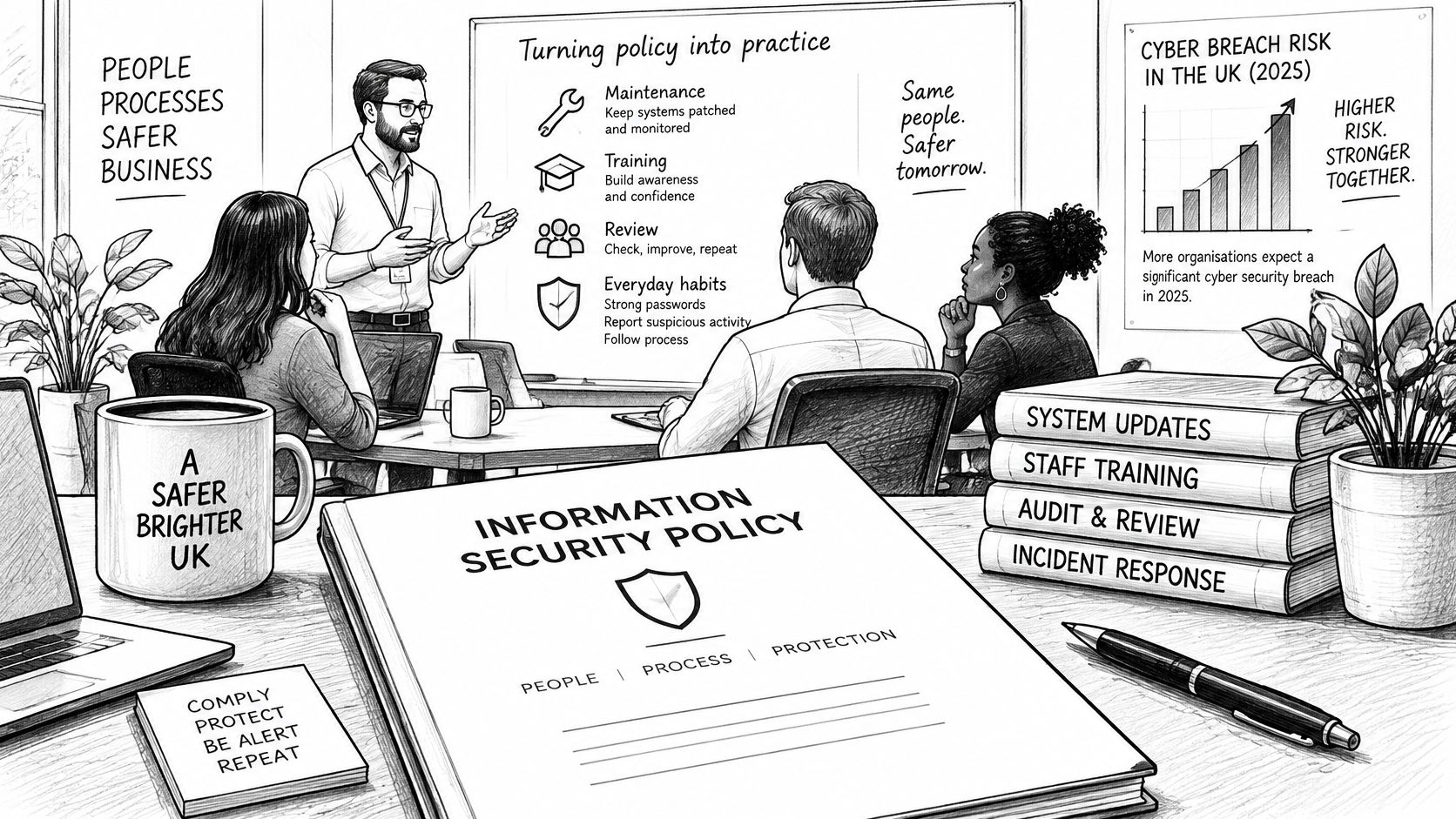
The trend in the 2025/2026 Cyber Security Breaches Survey is more pointed still: the proportion of small businesses with a formal policy covering cyber risks fell to 52%, from 59% the year before, risk assessments fell to 41% from 48%, and cyber-related business continuity planning fell to 44% from 53%. Documents are disappearing faster than the threats are. I'd take a two-page policy that managers review over a forty-page pack nobody opens.
Writing rules that survive contact with staff
- One or two pages per policy. If a topic needs more, split it into a policy and a procedure so the technical detail can change without re-approving the whole set.
- Must-statements with an owner. "Access rights are reviewed quarterly by the system owner" is testable. "Access is managed appropriately" isn't.
- Link each statement to what delivers it. Name the procedure, the tool or the report that produces the evidence, so an auditor can follow the chain in one step.
- Don't copy rules you won't run. A template clause demanding monthly penetration testing becomes a finding, not an aspiration.
Take remote working. A usable rule states the device requirement (company-managed laptop with disk encryption and endpoint protection), the home network standard (router admin password changed, WPA2 or better, no shared family accounts for work), the reporting deadline for lost equipment (immediately, and in any case within the same working day), and the owner who approves exceptions (the information security lead, with an expiry date on every exception). Four sentences, four things you can evidence.
Here's the walkthrough I'd point a management team to before their first review meeting.
The maintenance rhythm and the evidence it produces
| Activity | Frequency | Evidence to keep |
|---|---|---|
| Risk register review | Monthly | Dated register with owner sign-off |
| High-risk treatment actions | Each management meeting | Minutes recording decisions and overdue actions |
| Critical control tests | Quarterly | Test records with results and follow-up |
| Full internal audit | Annual | Audit report and corrective-action log |
| Out-of-cycle policy review | After material change | Change log and revised policy version |
| Policy review date check | Annual | Version history showing approver and next review date |
Once responsibilities and priorities are agreed, we provide a scheduled governance and audit plan for the year, so these activities land in diaries rather than in someone's good intentions. The failures are consistent: stale review dates, unowned risks, undocumented exceptions, supplier assurances accepted without validation, and evidence reconstructed in the fortnight before Stage 1 or Stage 2.
A shorter policy that people use gives more assurance than a comprehensive one they don't understand.
Test that with a five-minute experiment. Ask three people from different teams to explain one rule in their own words, without opening the document. If they can't, the policy is decoration, and no amount of formatting will fix it.
Scaling Policy Governance for Small Firms and Charities
Small organisations don't need an enterprise policy library, and importing one is how a charity with two administrators ends up with governance it can't staff. Four moves keep it proportionate:
- Limit scope to the services customers buy and the systems holding their data.
- Combine related topic policies, such as access control and acceptable use, only where each statement keeps its own control reference so the Statement of Applicability still maps cleanly.
- Assign owners from existing roles. A finance lead can own supplier records; an operations manager can own continuity testing.
- Use the management meeting you already hold as the review forum rather than creating a separate governance board.
Adoption among charities and smaller firms lags well behind large businesses, so there's rarely a proven local template to copy, which makes deliberate scope decisions more valuable than borrowed paperwork. A lightweight, risk-led framework with fewer, better controls owned by named people builds stronger governance than imported bureaucracy. Our resources on ISO 27001 for small businesses cover how to keep that control set slim. Record every reduction in scope or control set in the Statement of Applicability with its reason, so an auditor reads a decision rather than an omission.
Common Policy Gaps and How to Fix Them
Documentation that has drifted
Stale review dates. The header says reviewed in 2023, the business has since moved to a new cloud platform, and the policy still describes the old one. Put the next review date and the approver in the document header and in a calendar entry with a named owner, so the review happens because it's scheduled, not because an audit is booked.
Rules nobody follows. A policy demands a control the team has abandoned because it was impractical. Rewrite the rule to match a workable control, then evidence that control, rather than leaving an aspiration on the page.
Ownership, exceptions and evidence
Unowned risks. A register line with a blank owner cell will never be treated. Refuse to close or accept a risk without a named person and a target date, and make that a rule of the register itself.
Undocumented exceptions. Someone runs an unapproved file-sharing tool because a client asked for it. Use a one-page exception form with the risk, the compensating measure, the approver and an expiry date, then review the exception log at each management meeting.
Supplier assurances accepted unchecked. A cloud provider sends a certificate that expired months ago, or one covering a different service. Record the date, the scope and who validated it for each supplier assurance, and diarise the renewal.
Evidence rebuilt in the final fortnight. Collect records monthly so the audit samples what already exists. Prioritise the fixes by risk: unowned high risks and unvalidated suppliers with access to customer data come before formatting and version numbering.
Confirm Your Policy Set Before the Audit
Run this check this week, not the week before your assessment:
- Scope consistency. The boundary in the policy matches the Statement of Applicability and the risk treatment plan.
- Document control. Every policy has a named owner, an approver, a version and a next review date.
- One record per control. Sample a single piece of evidence for each control and confirm it shows the control operating, not just existing.
- Management review minutes. They record decisions, resources, exceptions and overdue actions, with owners against each.
A policy is only as strong as the evidence behind it.
The sensible next step is a readiness discussion, where we explain what ISO 27001 requires and work through your objectives, likely certification scope, existing controls and timescale before proposing anything new. We arrange and coordinate a separate independent audit of Clauses 4 to 10, included in the plan, and track findings and corrective actions from both audits to closure. We aren't a certification body and don't award, issue or guarantee ISO/IEC 27001 certification; that decision sits with the independent certification body.
If your policy set has drifted or you're starting from a blank page, ISO Security builds ISO 27001 policy frameworks that reflect how your organisation works, with named owners, traceable risks and evidence you can produce between audits rather than before them. Ongoing vISO support keeps the risk register, reviews and action tracking current through surveillance and recertification. Visit ISO Security to book a readiness discussion and find out where your current documents stand.