43% of UK businesses experienced a cyber breach or attack during the previous 12 months, yet only 25% had a formal incident response plan, according to the UK Government's Cyber Security Breaches Survey 2025. That gap reframes information technology security management: buying protection isn't enough if nobody has agreed who takes charge when it fails.
Table of Contents
- Why Security Management Is a Governance Task
- Ownership Models Core Components and Who Decides
- The Management Cycle from Risk to Review
- Managing Supplier and Third-Party Security Risk
- Measuring Security and Reporting to Senior Management
- Recovery and Incident Response in Practice
- Confirm Who Owns Your Security Management This Week
Why Security Management Is a Governance Task
Information technology security management is the set of principles, roles and processes that determines how an organisation protects information and systems, who answers for those decisions, and how managers review them over time.
Start with the things you're protecting:
- Confidentiality: Only authorised people can see information.
- Integrity: Information and systems remain accurate and aren't altered without authorisation.
- Availability: People can use services and information when they need them.
Apply working rules alongside those principles: base decisions on a documented risk assessment, give every control a named owner, and grant access through least privilege, meaning only the permissions needed for the job.
Why a good lock isn't enough
Buying a good lock doesn't run a building. Someone must decide who holds the keys, check whether the locks work, recover keys from departing staff and record what happened when a door was left open.
Technical security provides the locks: multifactor authentication, encryption, endpoint protection and backups. Governance establishes who approves their use, pays for maintenance, checks performance and accepts any remaining exposure. The relationship between IT and organisational governance matters because those decisions affect service delivery, contracts and budgets, not just computers.
An information security management system, or ISMS, connects those decisions to repeatable work. It isn't a folder of policies assembled before an audit. A policy becomes useful when somebody follows it, someone checks the result and management resolves exceptions.
Practical rule: Ask for the decision, the person authorised to make it and the record showing what happened.
You should be able to trace a line from a business risk to a control, its owner and evidence that it operates. Before buying another tool, check whether you have a documented incident response, an identified security decision-maker and a review date in the calendar.
Ownership Models Core Components and Who Decides
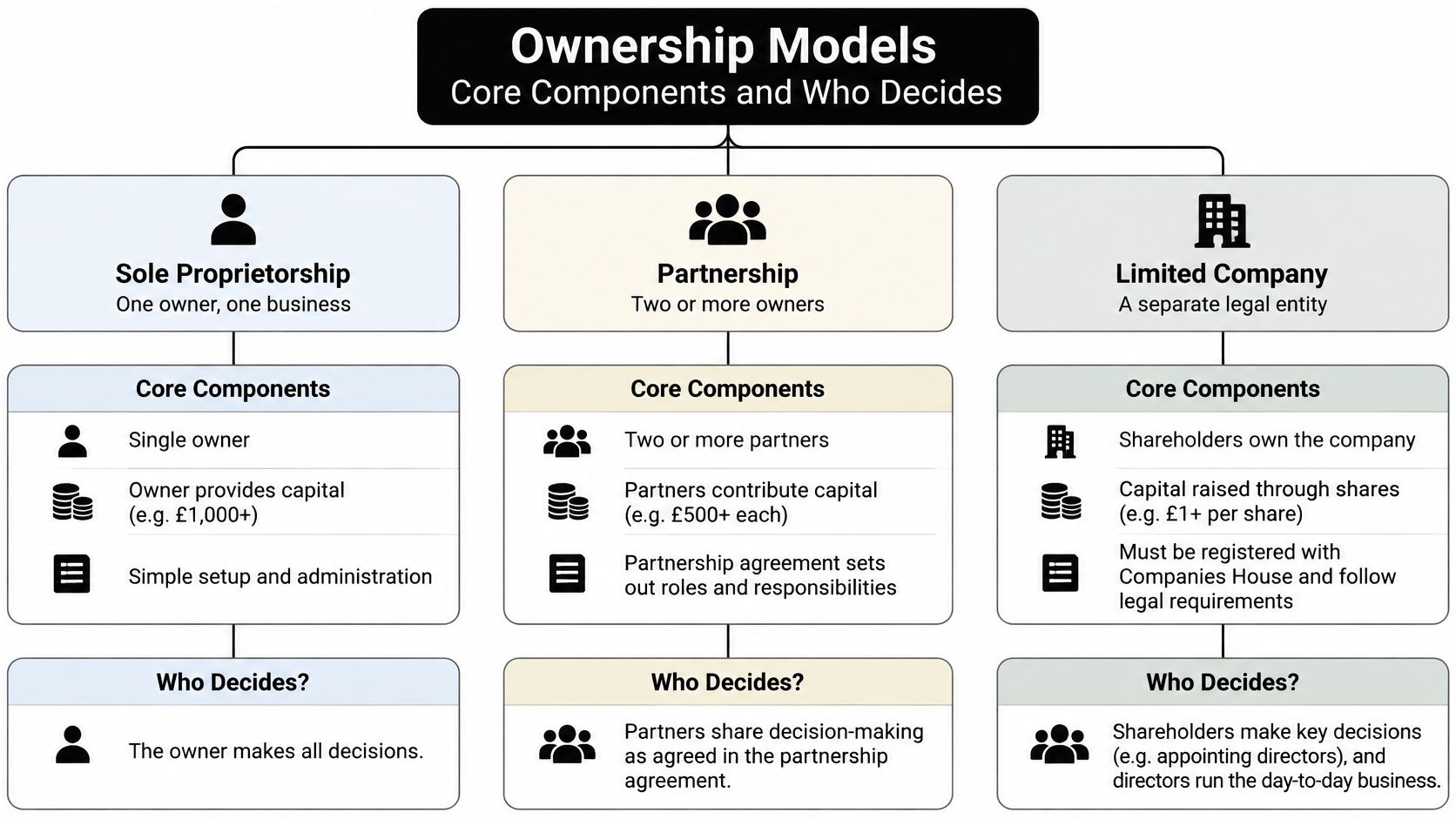
A key cut for "the office" opens every door until someone loses it, and then nobody can say who else holds a copy. Security ownership fails the same way. Write a person's name beside every component below. A department can perform the work, but a department name alone doesn't tell you who must resolve a missed deadline or approve an exception.
The board or senior management approves the ISMS scope and overall approach to risk. Individual risk owners make decisions about the services they run, within their delegated authority. The security lead coordinates the framework rather than becoming responsible for every business risk, in the same way a building manager maintains the inspection log without personally insuring every flat.
Core components, accountable owners and evidence
| Component | What it covers | Accountable owner | Evidence to keep |
|---|---|---|---|
| Governance and scope | Purpose, boundaries and management commitment | Board or senior management | Approved policy and scope statement |
| Risk assessment and treatment | Threats, likelihood, impact and chosen responses | Named risk owners | Risk register and risk treatment plan |
| Policies and Statement of Applicability | Rules and the controls selected for each risk | Security lead | Approved policies and Statement of Applicability |
| Asset and access management | Inventory of information and who can use it | IT manager with system owners | Asset register and access reviews |
| Operational security controls | Technical and physical safeguards | Named IT and operations managers | Configuration records and test results |
| Supplier and third-party security | Assurance over external providers | Procurement or supplier owner | Supplier assessments and contract clauses |
| Awareness and training | Staff behaviour and role-specific learning | HR lead with security lead | Training records and phishing test results |
| Incident response and recovery | Detection, containment, recovery and lessons learned | Incident lead and senior management | Tested response plan and incident records |
| Monitoring and management review | Performance, audits and corrective actions | Senior management | Management review minutes and action log |
Read the table as a signature map. Each row answers three questions: who decided, who carries it out, and what written record proves it happened. An empty owner column is a gap in the building, because a control nobody signs for tends to exist only on paper.
The Statement of Applicability records which controls are necessary, why they're included, their implementation status and the justification for exclusions. Link it to the risk assessment and treatment plan so that reviewers can understand the choices rather than just inspect a checklist. Treat it as the master key register: it explains which doors exist, which ones you chose to lock and why a few were left open on purpose.
Joiners and leavers show why split duties matter. HR should trigger onboarding, role-change and leaver processes, while IT implements access changes and system owners approve permissions. Keep the request, approval and completion evidence together. Otherwise, everyone may believe somebody else removed a departing employee's access, and the key stays in circulation after the person has gone.
Organisational structure affects where decision-making authority sits, but security responsibilities still need explicit assignment regardless of size or legal form.
Choose support that matches the missing capability
The UK Government's cyber-security labour-market study found that 49% of businesses reported a basic technical cyber-skills gap. Technical capability matters, but recruiting an engineer doesn't automatically establish risk acceptance, management reporting or independent challenge. Those are signatures on paper, not fixes on servers.
| Ownership model | Best-suited situation | Strength | Limit |
|---|---|---|---|
| Named internal owner | An organisation with a capable manager who has time and authority | Understands daily operations and can coordinate colleagues | Needs training, protected time and escalation access |
| Fractional security leadership | A business needing experienced governance without a full-time leadership role | Connects risk, reporting and follow-through | Relies on internal people to implement decisions |
| Specialist external support | A defined assessment, implementation or assurance task | Provides focused expertise and structured challenge | Project delivery doesn't replace ongoing ownership |
| Further technical specialist | An operational backlog involving patching, configuration or monitoring | Improves hands-on control delivery | Doesn't by itself establish executive risk decisions |
The fractional row trips up smaller organisations most often. An external security lead can maintain oversight of the ISMS, keep policies and evidence current, support management reviews and prepare the organisation for surveillance and recertification audits, but the moment stays internal: your service owners still accept the risks, and your managers still implement the decisions.
Separate preparation, approval and execution in every significant decision. The security lead can prepare a treatment proposal; the service's risk owner approves the residual risk; an IT manager implements the agreed safeguard. Where exposure exceeds delegated authority, senior management signs the decision. That three-way split mirrors a cheque that needs one person to write it, another to sign it and a third to bank it.
Keep accepted risks time-bound, with a rationale and a review trigger. A signature without an explanation leaves the next reviewer unable to judge whether the decision still makes sense. Record the date, the reason and the event that should reopen the question, such as a new contract, a system change or an incident.
Even when an external adviser designs the system, the organisation retains accountability for the ISMS, control operation, technical implementation, risk acceptance, management decisions and remediation. Whichever model you choose, keep risk decisions, audit evidence, corrective actions and board accountability in a controlled, accessible record, because the person who signed last year may not be in the room when the auditor asks why.
The Management Cycle from Risk to Review
An MOT certificate doesn't replace servicing a car throughout the year. Treat certification similarly: it doesn't perform access reviews, investigate alerts or repair failed controls for you.
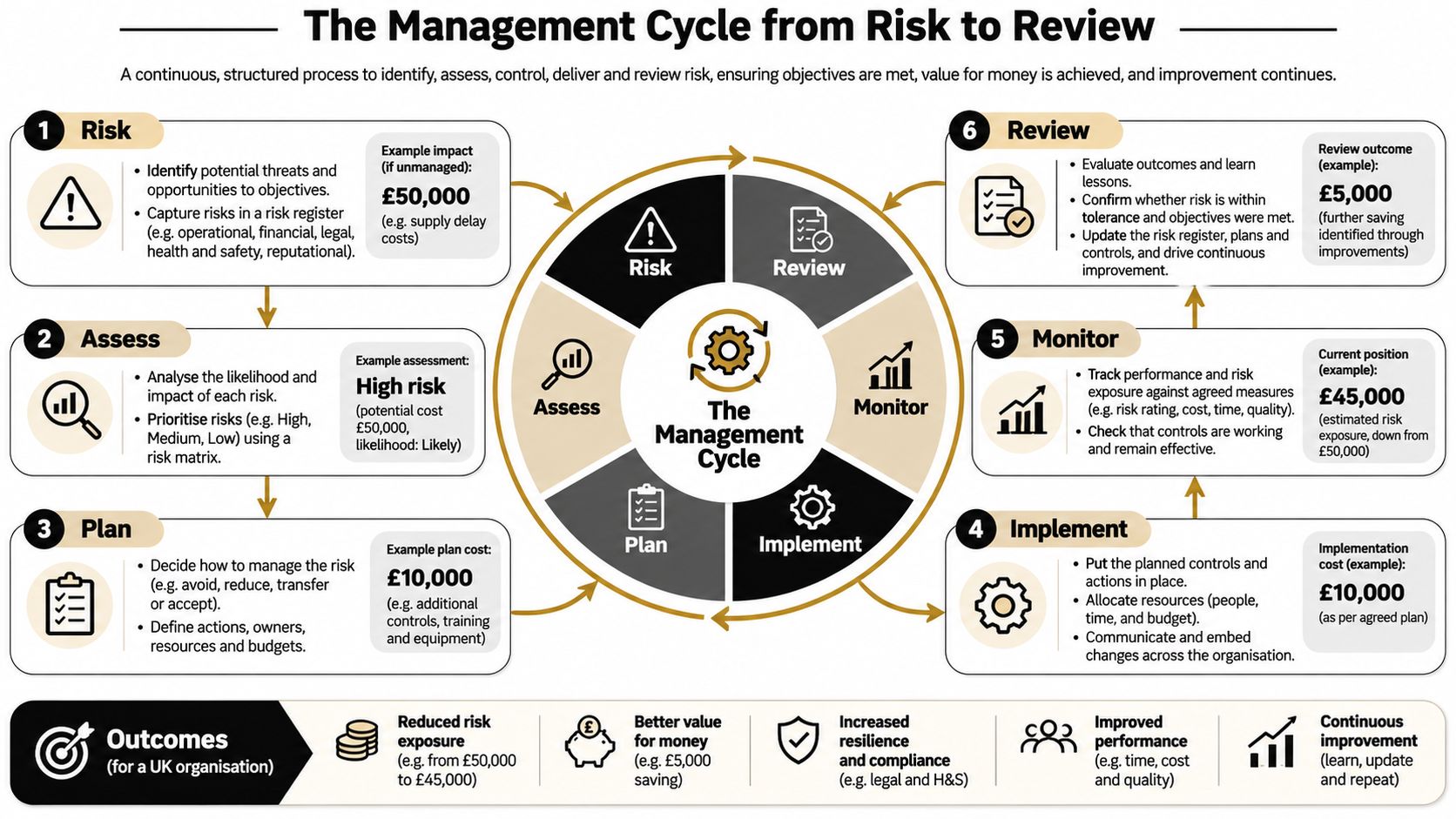
The management cycle connects planning with operation and correction.
Turn decisions into operating work
Define scope. List the services, systems and information that matter, including who depends on them and relevant supplier interfaces. Avoid an ambitious boundary that nobody can explain or manage.
Identify assets and owners. Record information stores, applications, devices and supporting services, then assign ownership. Don't mistake a hardware inventory for a complete picture: customer records and cloud accounts need owners too.
Assess risks with service owners. Agree a simple likelihood-and-impact scale and describe consequences in operational language. Scoring risks without the people running the service can miss deadlines, dependencies and contractual commitments.
Choose a treatment. Reduce, accept, transfer or avoid each risk, recording the decision-maker, planned action and deadline. Transferring part of a financial consequence through insurance doesn't remove responsibility for operating the service safely.
Implement and document controls. Link necessary controls to the Statement of Applicability, assign implementation tasks and retain verification evidence. Don't close a patching task because a deployment command ran; check the resulting system state.
Operate and monitor. Review logs, investigate alerts, check access and manage exceptions according to the service's needs. Collecting logs without assigning someone to examine actionable events creates storage, not oversight.
Audit and review. Internal audit checks whether the system meets its requirements and works as intended; management review addresses performance, changes and resource decisions. Neither should become a meeting devoted only to reading documents aloud.
Act on findings. Record corrective actions, investigate causes and update risks when assumptions change. Close an action only when someone has verified that the correction addresses the problem.
At ISO Security, we begin discovery by learning how the business operates, who depends on it and what information matters most before defining scope. We build risk assessments with the people running the services, using language they recognise.
The video provides another way to approach the relationship between risk and management activity.
Managing Supplier and Third-Party Security Risk
Only 14% of UK businesses reviewed the cyber risk of their immediate suppliers during the year, according to the NCSC Annual Review 2025. Your own access controls won't compensate for an external provider holding an unmanaged route into important systems.
Think of a contractor holding a key to your building. You need to know which doors it opens, who can copy it and how you'll recover it when the contract ends.
Supplier tiers and review depth
Classify suppliers by the information they can reach, service criticality and personal-data processing. A payroll provider holding bank details warrants deeper scrutiny than a catering company without system access.
The following is a suggested review model, not a universal compliance timetable.
| Tier | Criteria | Review depth |
|---|---|---|
| Tier 1 | Holds bank details or sensitive personal data, or runs a critical service | Full questionnaire, certification evidence and annual review |
| Tier 2 | Reaches internal systems or non-sensitive data | Scaled questionnaire and contract clause check at each renewal |
| Tier 3 | Limited access, no personal data, easily replaced | Declaration at onboarding and periodic spot check |
Maintain a supplier register containing the service owner, access granted, information handled, tier, assurance status and next review date. Scale questionnaires to the actual exposure rather than sending every supplier the same lengthy form.
ISO 27001 certification or Cyber Essentials can contribute evidence, but inspect what the assurance covers. A certificate covering a different service or organisational boundary doesn't answer your specific concern.
Make the contract operational
Agree breach-notification arrangements, data return or deletion, audit rights and escalation contacts before signing. The contract should help your incident lead get answers and your service owner arrange an orderly exit.
A completed questionnaire records an assessment at a point in time. It isn't permission to stop checking.
Revisit assurance when a provider changes its service, ownership, hosting arrangements or access. Use a structured third-party risk management approach to connect procurement decisions with ongoing oversight.
This month, identify your most important suppliers, assign their tiers and record when each last underwent a meaningful security review. Start with providers whose failure would stop you serving customers or paying staff.
Measuring Security and Reporting to Senior Management
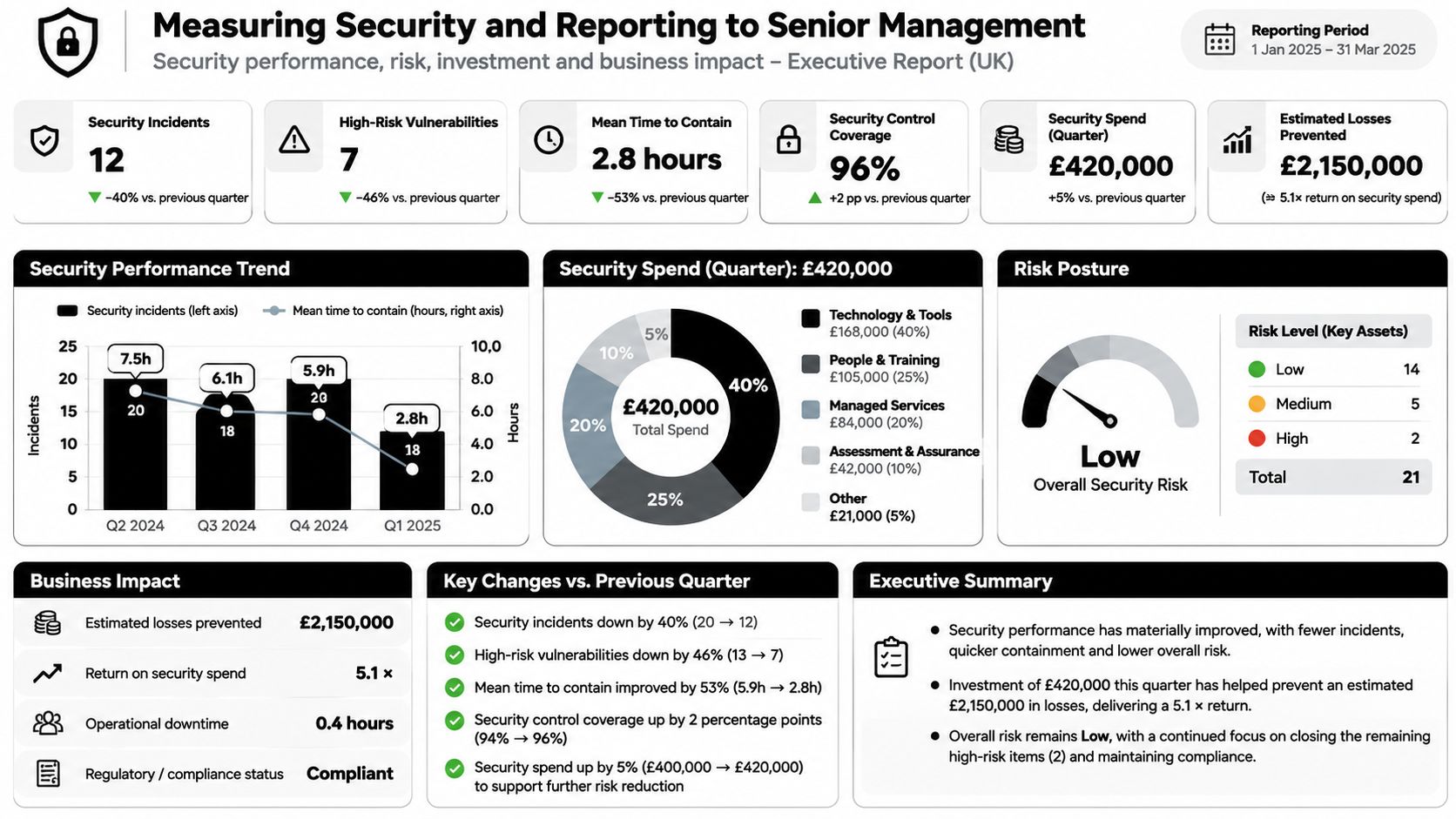
A useful security report answers a management question: what needs a decision? Start with operating indicators, not a count of policies written or alerts generated.
Security indicators for management review
These are suggested review frequencies and targets. Adjust them to service criticality, contractual commitments and the organisation's agreed risk tolerance.
| Indicator | What it shows | Review frequency | Target or example |
|---|---|---|---|
| Critical assets covered by multifactor authentication | Strength of account protection | Monthly | All supported critical assets covered; exceptions approved |
| Overdue high-risk vulnerabilities | Speed of remediation | Fortnightly | None beyond the agreed deadline |
| Tested backup recovery time | Recovery readiness | Quarterly | Within the agreed recovery objective |
| Supplier assurance status | Third-party coverage | Quarterly | All highest-tier suppliers within their annual review window |
| Time from detection to escalation | Incident handling speed | Per incident and monthly trend | Within the response plan timeframe |
| Overdue corrective actions | Follow-through on decisions | Monthly | None without a documented decision |
The UK Government's Cyber Security Breaches Survey 2025/2026 reports that 29% of firms reported incidents at least weekly, and that 31% of businesses were rushing to adopt or explore AI, with 76% of those lacking cyber-security practices for managing its associated risks. Recurring incidents require recurring oversight, while technology changes require fresh decisions rather than automatic approval under an old policy.
Show trends and business consequences alongside the indicators.
Treat AI adoption as a controlled change
Before staff use an AI service with business information, assess data classification, model access, prompt and training-data exposure, third-party processing, logging and acceptable use. Identify who can approve the service and whether existing supplier and access controls address its use.
For example, a team proposing AI-assisted customer correspondence should identify whether staff will submit personal information, who can retrieve stored conversations and how outputs will be checked. Update the treatment plan and applicable controls when the answers introduce new exposure.
Reporting standard: Every exception needs a named owner, a target date and a clear request for a management decision.
Give senior management trends rather than isolated snapshots. Explain whether an overdue vulnerability threatens a customer-facing service, what temporary protection exists and who must approve further delay.
Use the ISO 27001 management review process to record decisions on resources, accepted exceptions and improvement actions. Meeting minutes should show what management decided, not merely that security appeared on the agenda.
Recovery and Incident Response in Practice
The UK Government's Cyber Security Breaches Survey 2025/2026 reports that 19% of businesses were victims of at least one cyber crime, while 8% of affected businesses reported temporary loss of access to files or networks. Recovery planning must therefore address whether people can resume useful work, not just whether a server starts.
A Monday-morning ransomware alert
Say a firm receives a ransomware alert before staff begin work on Monday. The analyst records the detection time and contacts the incident lead named in the response plan, rather than searching for someone senior enough to take responsibility.
The incident lead authorises isolation of affected laptops under pre-agreed authority. IT preserves relevant logs, checks privileged accounts and investigates whether shared storage or cloud services are affected.
The communications decision-maker coordinates client updates and obtains appropriate privacy or legal input on regulatory notification. The plan identifies who assesses reporting obligations, who authorises notification and how to escalate if that person is unavailable.
Recovery checkpoint: Don't reconnect a restored service until the incident lead has evidence that the route used by the attacker has been addressed.
Restore the service, then verify the outcome
In this scenario, IT restores information from backups protected against unauthorised alteration and ransomware access. Earlier restore exercises have established the procedure, dependencies and likely constraints, so the team can compare actual recovery against the agreed objective.
The service owner checks that staff can access accurate records and complete business tasks. Technical restoration isn't complete business recovery if payment processing, customer communications or authentication still fails.
The investigation identifies an unpatched VPN appliance as the entry point. The corrective action addresses both the appliance and the missed patching decision, with verification before closure and management consideration of any wider exposure.
Every incident record should retain:
- Detection and containment times: When the organisation identified the event and restricted its spread.
- Affected assets: Systems, information and services involved.
- Root cause and control failure: How the incident occurred and why safeguards didn't prevent it.
- Residual risk: Remaining exposure and the person authorised to accept it.
Confirm Who Owns Your Security Management This Week
You don't need a new platform to discover the first management gaps. You need the right people, access to existing records and a short working session.
A practical working-week checklist
Put names against the components. Complete the ownership table with actual people, confirm their authority and ask each person to acknowledge their responsibilities. Resolve blanks rather than assigning everything to IT.
Confirm the operating boundary. List the services and information the ISMS covers, including dependencies outside the organisation. Ask senior management to approve unclear inclusions or exclusions.
Inspect the risk register. Check its last substantive review and whether recent service, supplier or technology changes appear. Book a review with service owners where the record no longer reflects operations.
Request restore evidence. Choose an important recovery objective and inspect the most recent test result. If nobody can demonstrate successful restoration against it, assign an exercise and a decision date.
Put a decision on the management agenda. Select an indicator showing a meaningful exception, name its owner and specify the approval, funding or action needed.
Where outside help fits
Specialist support can help organisations establish governance when nobody internally has the time or experience to coordinate it. We offer gap analysis, ISMS scoping, design and implementation, risk assessment and treatment, and ongoing vISO support for organisations needing continuing oversight.
That support is particularly relevant when informal responsibilities no longer suit a growing business, customer questionnaires become complex or an existing ISMS needs clearer leadership reporting. We work alongside the client's team because the organisation must operate the system long after an implementation project ends.
Keep approval authority and remediation responsibility inside the organisation. The aim is a management system your people understand and can run without depending permanently on advisers.
ISO Security helps organisations turn security responsibilities into a practical ISMS through gap analysis, implementation and ongoing vISO oversight. Visit ISO Security to discuss your current scope, ownership gaps and the support needed to prepare for independent certification or maintain an existing system.