The most common advice on ISO 27001 Stage 1 vs Stage 2 reduces certification to a neat two-step formula: write your policies for Stage 1, then tidy up the paperwork and show a few screenshots for Stage 2. Teams following that script often spend months building an impressive library of templates, sail through a desk review, and then stall when an external auditor asks how the system runs on a Tuesday afternoon.
That popular shorthand misses what trips up UK organisations in practice. Passing Stage 1 proves your Information Security Management System (ISMS) looks coherent on paper, not that anyone follows it. Worse still, postponing Stage 2 for months so you can polish every policy document often weakens your position, because operating records go stale, responsibilities drift, and the system you audited in design no longer matches how the business works.
Independent certification remains rare across the UK market. According to the 2024 ISO Survey figures analysed by Farshid, the United Kingdom held 4,455 accredited ISO/IEC 27001 certificates, equivalent to roughly 0.08% of the country's 5.69 million businesses, or about one certificate for every 1,277 businesses. That gap exists because customers and tenders aren't paying for policy binders; they want third-party proof that governance works under real operating pressure.
Accountability inside UK firms is often thinner than leadership assumes. As UK Cyber Compliance points out when citing UK government survey data, only 31% of businesses had formally assigned board-level cyber-security responsibility. Treating the space between Stage 1 and Stage 2 as an evidence-continuity problem, rather than a document-formatting exercise, is what separates a smooth certification audit from months of expensive rework.
Table of Contents
- Stage 1 and Stage 2 Side by Side
- What Auditors Probe at Stage 1
- What Auditors Sample at Stage 2
- Findings Auditors Raise at Each Stage
- How Audit Effort and Timing Differ
- Building Evidence Between the Two Audits
- Confirm Readiness Before You Book Stage 2
Stage 1 and Stage 2 Side by Side
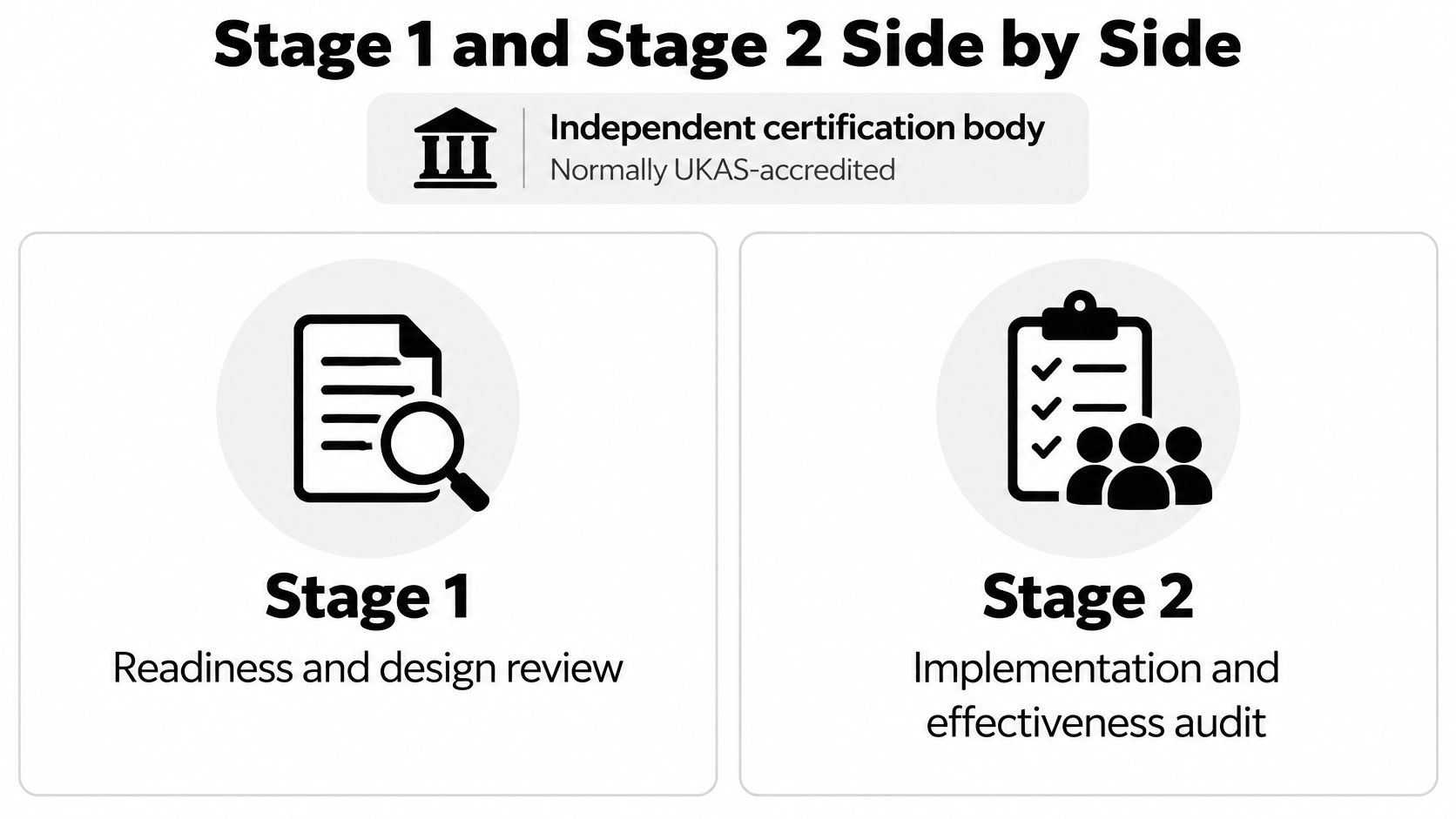
Initial ISO/IEC 27001 certification in the UK is two external audits, not one inspection. A UKAS-accredited certification body uses the first audit to test whether the system is designed coherently, then uses the second to test whether that design operates in practice. The distinction matters because a strong policy library can pass a document review and still fail at Stage 2 if records, interviews and sampled controls do not show the same system being followed. Tempo Audits' UKAS accreditation guide is useful context for understanding UKAS accreditation and certification oversight.
The stages connect through evidence. Stage 1 concerns shape the sampling plan for Stage 2, and the ISMS needs enough operating time to produce records that show risk treatment, internal audit, management review, corrective action and control checks are real routines. Delaying Stage 2 to perfect documents can weaken that continuity, because the system under audit starts to diverge from how the business works.
Comparing Both Audits Across Seven Criteria
| Criterion | Stage 1: readiness review | Stage 2: effectiveness audit |
|---|---|---|
| Core question | Is the ISMS designed and documented well enough to be audited? | Does the ISMS operate in practice and stay effective? |
| Main focus | Scope, policy, risk method, risk treatment, Statement of Applicability, documented processes | Records, interviews, sampled controls, corrective actions, management reviews |
| Evidence type | Documents and design decisions | Operational records and observed practice |
| Typical outcome | Readiness determination with gaps or improvement requests | Certification recommendation subject to independent review and decision |
| Can it stand alone? | No; passing does not produce certification | No; certification follows the decision and closure of nonconformities |
| Common weakness | Missing or immature scope, risk method or Statement of Applicability | Records that do not show the process was actually followed |
| Typical timing | Once documents are in place | Once the ISMS has generated enough operating records |
The scope decision deserves particular care before Stage 1. Scope choices made at this point are expensive to revisit, especially where they shape risk assessment, controls, audit sampling and the certificate boundary. A narrow scope can remove unnecessary work, but it must still reflect the services and information the certification requirement concerns. A broad scope can create evidence demands that a small team cannot maintain between audits.
Stage 2 is where evidence continuity is tested. Auditors look for a trace from risks to treatments, from treatments to controls, from controls to records, and from findings to corrective action. If management reviews, internal audits or risk updates appear only as last-minute artifacts, the system looks designed for certification rather than operated for security. That is where organisations lose time, because explanations cannot replace records.
One detail catches leadership teams off guard at the end of Stage 2. Even when the lead auditor recommends certification at the closing meeting, that recommendation goes through an independent technical review inside the certification body before a formal certification decision is issued. Any unresolved major nonconformity holds that decision back until closure evidence has been verified.
A Stage 1 audit verifies the blueprint you intend to run; a Stage 2 audit tests whether your people actually run it when nobody is chasing them for audit files.
What Auditors Probe at Stage 1
Every external auditor walks into Stage 1 with one primary question in mind: is the proposed ISMS scope, policy framework, risk method, and Statement of Applicability complete and coherent enough to withstand a full operational test? They aren't there to give consultancy advice on how to rewrite your procedures. They're checking whether booking a full certification audit would be a fair, workable assessment or a waste of everyone's time.
Core Documents Under the Microscope
During the readiness review, the auditor works methodically through your foundational documentation and checks how each piece ties back to the mandatory ISO 27001 clauses. Expect detailed questions on six core artefacts:
- ISMS scope statement: Your physical sites, cloud environments, business units, products, and third-party interfaces included in the boundary, plus clear justifications for anything excluded.
- Information security policy: High-level direction approved by top management that aligns with business objectives and gives a clear framework for setting measurable security targets.
- Risk assessment methodology: A repeatable scoring system with defined likelihood, impact, and risk acceptance criteria, showing how two different managers would reach consistent results.
- Risk treatment approach: The link between identified risks, chosen controls, named risk owners, and recorded management acceptance of residual risk.
- Statement of Applicability (SoA): Every Annex A control marked as included or excluded, with specific operational rationale rather than copy-pasted boilerplate.
- Internal audit and management review arrangements: A realistic audit programme, auditor competence records, and a scheduled management review agenda showing you understand how governance loops close.
The practical output of Stage 1 is a readiness determination. Rather than handing you a certificate, the auditor produces a report highlighting missing elements, immature processes, or areas of concern that could become formal nonconformities if left unresolved before Stage 2. Passing Stage 1 never constitutes certification, and treating it as a minor warm-up leads to painful surprises weeks later.
Why Early Scope Mistakes Cost So Much
Scope decisions made at Stage 1 are expensive to revisit. If your scope boundary leaves out a shared IT team, a development environment, or a data flow that directly supports the certified service, the auditor will challenge that exclusion immediately. Fixing a flawed boundary mid-stream forces you to redo risk assessments, update your Statement of Applicability, expand internal audit coverage, and sometimes recalculate audit days with the certification body.
Say a Manchester software provider applies to certify its customer-facing cloud platform, yet excludes its internal support desk to save time. Because support engineers access live customer databases via ticketing tools like Zendesk and administer user accounts in Microsoft Entra ID, the exclusion doesn't hold up under scrutiny. The business now has to pull the support function into scope, train staff, assess support tooling, and push Stage 2 back while fresh records accumulate.
Before Stage 1 closes, your team should leave the room with three concrete assets in hand. You need a stable, management-approved scope that reflects real data flows, a risk method already applied to actual assets rather than blank templates, and a dated plan showing exactly how operational evidence will be generated ahead of Stage 2.
What Auditors Sample at Stage 2
Stage 2 is where polished prose stops helping you. According to TUV NORD UK's ISO 27001 certification overview, Stage 2 is the conformance and effectiveness assessment in which auditors test whether Clauses 4 to 10 and your selected Annex A controls are implemented and operating. Certification follows only after the certification body's independent decision and satisfactory closure of any applicable nonconformities.
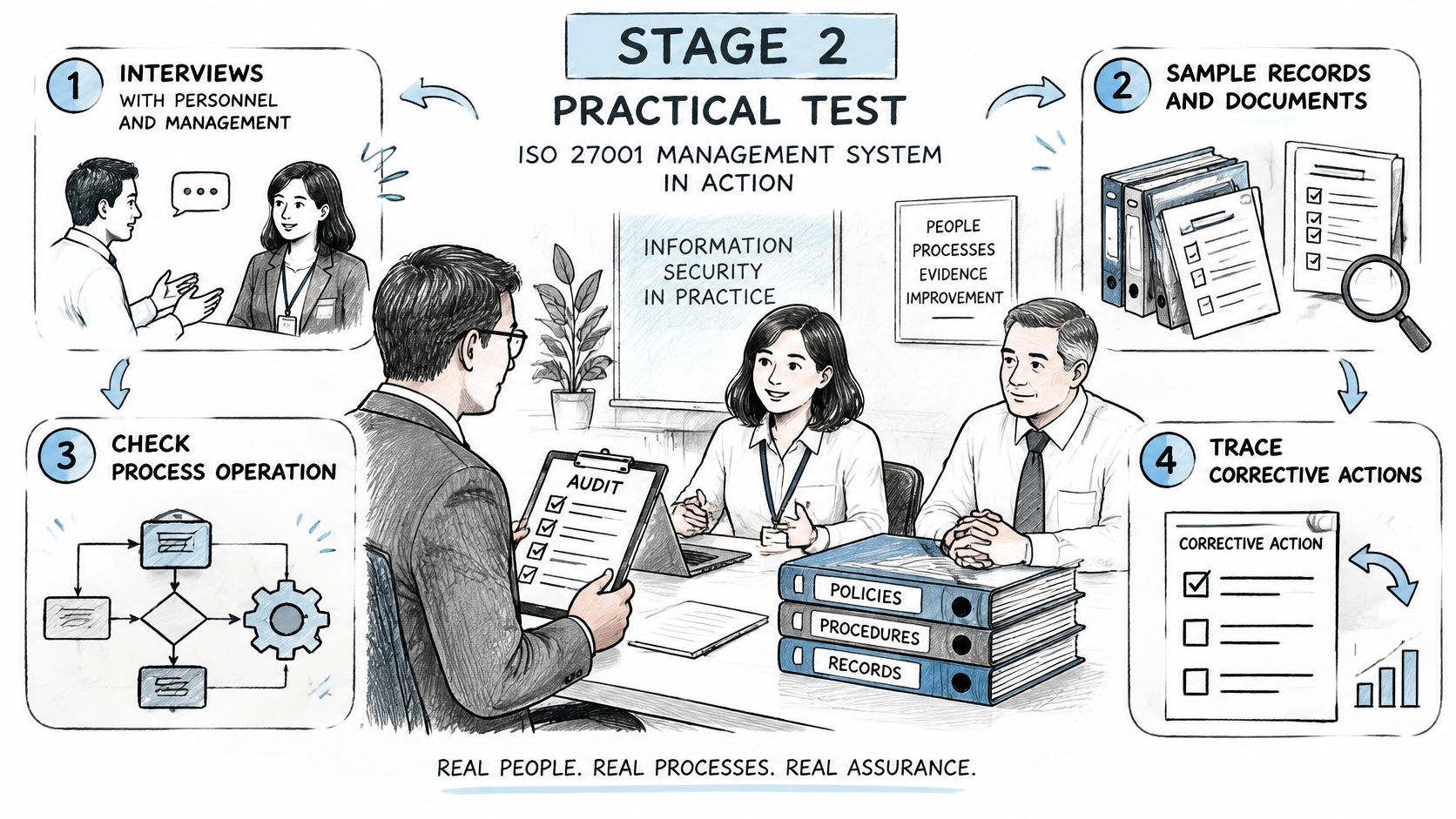
Auditors look through two overlapping lenses throughout the assessment. First, they test your management system engine across Clauses 4 to 10: context of the organisation, leadership commitment, risk planning, resource and competence support, operational control, performance evaluation, and continual improvement. Second, they sample technical, organisational, physical, and people controls straight from your Statement of Applicability.
Four Evidence Methods Auditors Rely On
Rather than reading policies back to you, an experienced lead auditor triangulates four types of live evidence across the business.
First come interviews with personnel and management. Auditors don't restrict themselves to the compliance manager or security lead. They speak directly to software engineers, HR coordinators, IT administrators, and directors to verify that people know their specific responsibilities, understand how to report a suspected phishing email or data loss, and describe the same workflow written in your procedures.
Second is direct sampling of operational records. If your Statement of Applicability states that leavers lose system access within 24 hours, the auditor asks HR for a list of recent departures, picks three names at random, and asks an IT administrator to open Microsoft Entra ID or Okta logs on screen to verify exact revocation timestamps. The same sampling logic applies to backup restore tests, change-approval tickets in Jira or ServiceNow, vulnerability scan remediation logs, and security awareness training completions.
Third, auditors test risk reviews and treatment plans in motion. They pick high-scoring entries from your risk register and trace whether planned mitigations were funded, completed on time, and reviewed for effectiveness, or whether overdue items remain unchallenged.
Fourth, they inspect governance outputs: completed internal audit reports, dated management review minutes containing every mandatory input, and corrective-action logs demonstrating root-cause analysis rather than quick patches.
For a concise walkthrough of how these two stages play out during an external audit, watch this overview before digging into common failure patterns.
Why a Well-Written Policy Fails a Live Sample
A clean policy document or neatly formatted Statement of Applicability can't compensate for absent operating records. Say a consultancy has a thorough supplier security policy requiring annual due-diligence checks on every cloud vendor handling client data. When the auditor asks to see the completed assessments for AWS, HubSpot, and the payroll provider, nobody can produce a dated review, questionnaire, or risk sign-off. The policy itself looks textbook, yet the control fails the sample immediately because the process never ran.
At every screen share, record check, and interview, the auditor is effectively asking one twin question: did the process run, and did someone act on what it found?
Findings Auditors Raise at Each Stage
Many leadership teams fear audit findings and try to hide rough edges until the last moment. In practice, findings are the sharpest diagnostic tool you'll get during certification, provided you understand how your certification body categorises them. Because different UKAS-accredited bodies use slightly different wording for areas of concern, observations, opportunities for improvement, and formal nonconformities, ask your certification body to confirm its grading scheme in writing before Stage 1 begins.
Common Stage 1 and Stage 2 Findings Compared
Across UK assessments, the same structural weaknesses appear repeatedly at each stage, though closing them requires very different work.
| Finding type | Stage | Typical example | How to close it |
|---|---|---|---|
| Scope not justified | Stage 1 | Boundary excludes a business unit that handles client data, with no reason recorded | Document inclusions and exclusions with rationale approved by management |
| Risk method not documented | Stage 1 | Risk criteria exist but no repeatable method or named owner | Adopt a written method and apply it to the full risk register |
| Statement of Applicability out of step | Stage 1 | Controls marked applicable with no link to the treatment plan | Reconcile the Statement of Applicability with the treatment plan and record reasons for exclusions |
| Internal audit not yet run | Stage 1 | Audit programme exists on paper with no planned dates | Schedule and complete an internal audit before Stage 2 |
| Records do not show process followed | Stage 2 | Access reviews documented but no action recorded from them | Keep dated review outputs and track resulting actions to closure |
| Management review missing inputs | Stage 2 | Minutes record discussion but not risk or internal audit results | Use the required inputs and record decisions and owners |
| Corrective action unverified | Stage 2 | Internal audit nonconformity closed without checking the fix worked | Verify effectiveness and retain closure evidence |
| Supplier risk not assessed | Stage 2 | Cloud provider in use with no security assessment on file | Assess and record supplier security before Stage 2 |
Notice the sharp operational divide between the two halves of that table. Stage 1 findings are mostly design gaps: you close them by clarifying scope boundaries, documenting repeatable criteria, aligning your Statement of Applicability, and recording management decisions. Stage 2 findings are execution gaps, and they're far harder to fix under deadline pressure because you need genuine, dated operating evidence showing a control ran and produced follow-up action. You can't backdate six months of missing quarterly access reviews or unverified corrective actions.
Severity Splits and Closure Discipline
Most certification bodies split formal Stage 2 nonconformities into two tiers. A major nonconformity signals a systemic breakdown or total absence of a mandatory requirement, and it blocks certification until root-cause analysis, correction, and verified closure are accepted by the certification body. A minor nonconformity indicates an isolated lapse that doesn't undermine the whole system; it normally requires an approved corrective action plan and gets verified at the next surveillance visit. Understanding the exact threshold between a major and minor ISO 27001 nonconformity helps your team prioritise fixes accurately instead of panicking over minor administrative observations.
The cleanest way to prevent avoidable Stage 1 and Stage 2 findings is to surface them before an external auditor enters the building. A structured gap analysis produces a prioritised action plan showing exactly what needs to change against ISO 27001 before the certification body sees your ISMS. Once you have that list, run every gap through a simple discipline: log the finding, assign one named owner, define what proof of closure looks like, and set a hard verification date.
How Audit Effort and Timing Differ
Stage 1 and Stage 2 differ sharply in auditor time, disruption to your staff, and budget. According to ISO 27001 Kit's UK-oriented Stage 1 vs Stage 2 breakdown, audit effort is materially greater at Stage 2 because the auditor is sampling operational performance across the organisation rather than reviewing a centralised set of design documents. That pattern holds at every headcount: Stage 2 always requires more auditor days than Stage 1 for the same organisation.
Typical planning figures for two illustrative bands look like this:
| Effective personnel | Stage 1 audit days | Stage 2 audit days |
|---|---|---|
| 1-15 | 0.5 | 1.5 |
| 66-85 | 1.5 | 5 |
Treat these numbers strictly as planning benchmarks, never as guaranteed quotes or fixed schedules. Certification bodies calculate exact UK audit duration under formal accreditation rules, adjusting the day count for six specific variables:
- Scope breadth: Covering one cloud SaaS product takes far less sampling time than certifying an entire corporate group across multiple service lines.
- Organisational complexity: Regulated sectors, high-risk data processing, and bespoke software development require deeper technical verification.
- Physical locations: Multiple UK offices, data centres, or remote-heavy working arrangements add site-sampling or remote-interview time.
- Effective personnel: Headcount working inside the defined ISMS boundary drives the base table calculation, including contractors who operate in-scope controls.
- Technology stack: Hybrid on-premise servers, legacy applications, and multi-cloud environments expand the operational controls needing sample checks.
- Outsourced activities: Heavy reliance on managed service providers or third-party hosting requires extra scrutiny of supplier oversight and contractual security clauses.
Balancing Calendar Time and Budget Reality
The day count is only half the timing question. The other half is how much calendar time your system needs between the two audits, and organisations most often misjudge the effort involved here. Your exact implementation approach and timeframe depend directly on your organisation's size, scope, complexity, and current level of readiness. Rushing into Stage 2 just weeks after writing your policies backfires because recurring controls haven't had time to run naturally. An auditor can't verify a quarterly access review or an incident response loop if the calendar hasn't allowed those activities to happen and produce real follow-up records.
Delaying has its own cost. Teams sometimes push Stage 2 back repeatedly to perfect the document library, and the system loses credibility in the process: policies drift away from what staff do, review dates pass unactioned, and the evidence trail develops gaps that no amount of rewriting will fill. A modest set of controls that has operated for a few months beats a polished manual with no operating history behind it.
Budget planning requires the same realism. Timescales and fees for regulated ISO 27001 scopes rarely fall in the smallest band, whether you're budgeting for external certification-body days or internal implementation support. Before locking board budgets, ask your chosen certification body and advisers for a written estimate tied explicitly to your proposed scope, locations, and regulatory obligations.
Booking rule: Schedule your Stage 2 audit dates once representative operating records for every in-scope control already exist, not because an ambitious date on an initial project plan says you should.
Building Evidence Between the Two Audits
The gap between Stage 1 and Stage 2 is where certification projects either settle into a sustainable operating rhythm or collapse into frantic last-minute file creation. UK organisations don't operate in a frozen lab while preparing for certification; suppliers change, staff join and leave, cloud services migrate, and security threats keep landing in inboxes.
Recent official data shows how live that threat environment really is. The UK government's Cyber Security Breaches Survey 2025/2026 found that cyber breaches or attacks affected 43% of businesses and 28% of charities in the preceding 12 months, even though 57% of medium-sized and 74% of large businesses already had a cyber-security strategy in place. Having a strategy and passing a design review don't equal operational audit readiness.
A Six-Step Evidence Continuity Routine
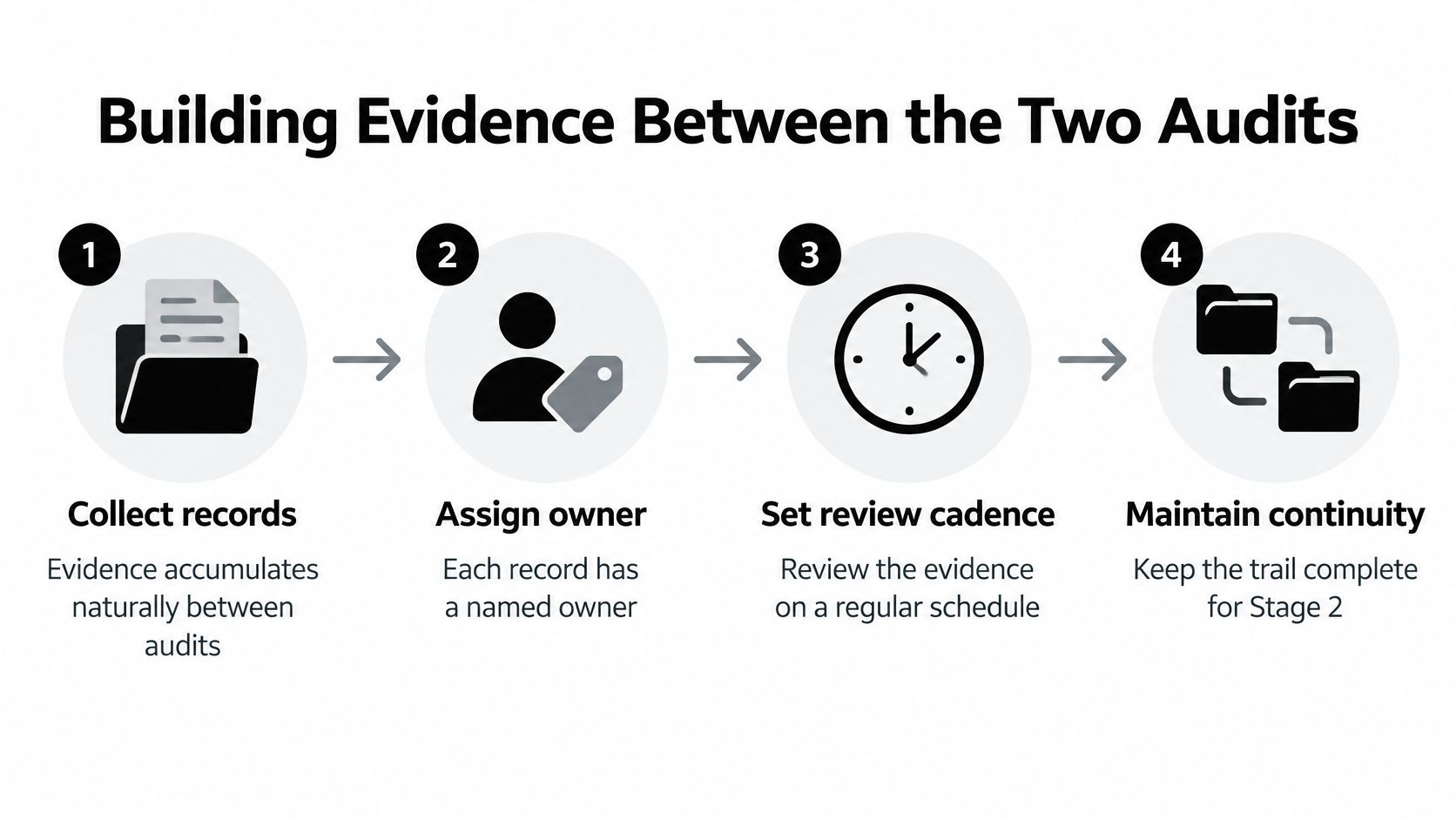
Instead of scrambling two weeks before the auditor arrives, run a simple operational routine so records accumulate naturally as part of normal work:
- Map every material risk to a named owner, treatment plan, and review date. Don't leave "IT" or "Management" listed as the owner in your risk register. Put an actual person's name beside each risk so someone answers for progress when the review date arrives.
- Set a realistic review cadence for each record type. Quarterly user-access reviews, monthly vulnerability-remediation checks, semi-annual backup restore tests, and annual full risk reviews give you predictable, repeatable evidence points without drowning a small team in admin.
- Lock in your internal audit and management review dates early, and keep them. Treat both meetings like statutory board dates. Running them properly gives you time to log findings, fix root causes, and show senior leadership reviewing real metrics rather than rubber-stamping slides.
- Log operational events as they happen. Record security incidents, phishing reports, new supplier assessments, leaver revocations, and staff training completions in your live ticketing or HR tools at the moment they occur. Real timestamps in Jira, SharePoint, or your HRIS beat spreadsheets assembled retrospectively every time.
- Track every corrective action through to verified closure. Fixing a misconfigured cloud storage bucket is only correction. Document why it happened, update the provisioning checklist or automated guardrail, and retain dated proof that the new check works.
- Escalate material business changes immediately. When you onboard a critical SaaS vendor, migrate workloads to a new cloud region, open a new office, or change a customer-facing service, trigger a formal review of your scope, risk assessment, Statement of Applicability, internal audit coverage, and management review agenda before Stage 2.
The Traceability Test and Avoiding Audit Theatre
After setting up that routine, test your ISMS with one sharp question: can you trace every material risk decision cleanly from its named owner, through the risk treatment plan, into dated operating evidence, and right up to management oversight? If that chain breaks at any link, an auditor will find the gap quickly.
That's also how you distinguish genuine continual improvement from "audit theatre", where teams manufacture retrospective meeting minutes or backdated sign-offs purely to pass sampling. Auditors spot synthetic records almost instantly because timestamps cluster in a single week and interviewed staff can't recall the meetings. Conversely, delaying Stage 2 indefinitely just to polish every policy document increases risk rather than lowering it: earlier records age out, staff move roles, and the audit no longer reflects the business you're running. Manage preparation as a controlled change programme, escalating operational shifts as they occur.
For lean teams juggling day jobs alongside compliance, maintaining that rhythm is often the hardest part. Ongoing virtual information security leadership (vISO support) keeps the engine moving by reviewing the risk register, updating policies and procedures, tracking actions and control effectiveness, supporting management reviews, coordinating internal audit activity, and maintaining live audit evidence so nothing goes cold between audits.
Adding more policies to your SharePoint folder doesn't make you audit-ready. Every extra rule nobody follows creates another gap an auditor can sample and fail.
Confirm Readiness Before You Book Stage 2
Once Stage 1 is behind you and operating records are accumulating, you face a practical judgement call: confirm your Stage 2 booking or hold off until specific gaps close. Getting that timing right saves you from paying for re-audits while keeping your certification momentum intact.
Go Ahead Versus Hold Criteria
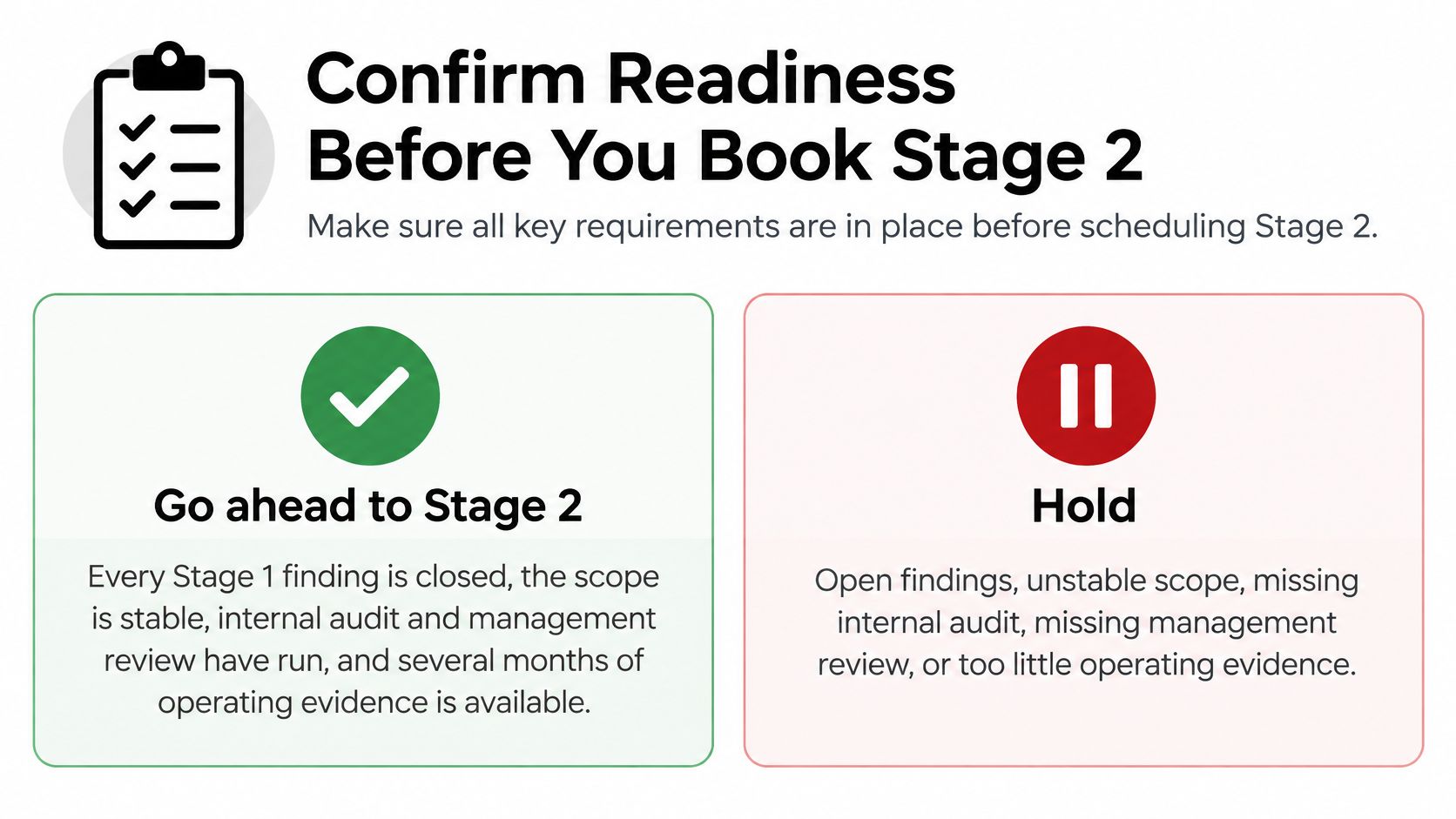
Go ahead and confirm Stage 2 when every Stage 1 finding or area of concern has documented closure, your scope boundaries haven't shifted unexpectedly, your full internal audit and management review have already taken place, and your control owners can pull several months of dated operating records straight from live systems. At that point, waiting longer to tweak policy wording adds little value and risks letting evidence go stale.
Hold and adjust your schedule when a material shift in scope, a new critical supplier, or a major technology migration hasn't yet run through your escalation triggers, risk assessment, and Statement of Applicability updates. You should also hold if internal audit corrective actions remain open without verified closure, or if key risk decisions still lack named owners who can explain them in an interview. Pausing for a defined, targeted remediation sprint is far cheaper than walking into Stage 2 with a guaranteed major nonconformity.
Final Pre-Booking Readiness Checklist
Run through these eight verification points with your leadership team and control owners before signing off the Stage 2 audit plan:
- Approved scope: Boundaries, sites, services, and exclusions are documented, signed off by top management, and still match day-to-day operations.
- Live risk register: Your documented risk methodology has been applied consistently across all in-scope assets, with dated treatment progress and residual risk sign-off.
- Reconciled Statement of Applicability: Included and excluded Annex A controls tie directly back to your risk treatment plan with plain-English justifications.
- Completed internal audit: An impartial ISO 27001 internal audit covering both management clauses and operational controls has finished, with a written report on file.
- Complete management review: Dated minutes prove senior leadership reviewed every mandatory input, including risk status, audit results, objectives, and resource needs, and recorded resulting decisions.
- Verified corrective actions: Nonconformities raised during internal checks or Stage 1 show root-cause analysis and proof that each fix worked.
- Briefed control owners: Named individuals across IT, HR, operations, and engineering know they may be interviewed and can demonstrate their controls live.
- Current supplier records: Security due-diligence assessments and contractual reviews sit on file for every critical cloud, software, and outsourced provider in scope.
Starting Cleanly and Staying Audit-Ready
If you're earlier in the journey and want to avoid building an unworkable system in the first place, start with a clear baseline rather than a blank policy template. At ISO Security, the first step is a readiness discussion where we explain what ISO 27001 requires and understand your commercial objectives, likely certification scope, existing controls, and target timescale. From there, a gap analysis mapped to both ISO 27001 and any existing regulatory control set ensures you do the remediation once instead of running parallel compliance tracks.
Once your certificate is issued, keeping evidence alive matters just as much for annual surveillance and three-year recertification. Ongoing vISO support works particularly well for certified organisations without an internal ISMS owner, growing businesses whose security responsibilities have outgrown informal habits, teams preparing for surveillance or recertification audits, firms answering complex customer security questionnaires, and leadership teams wanting clearer information-security reporting.
If you want a practical ISMS built around how your UK organisation operates, rather than a stack of unused policies, we can guide you from initial scope and gap analysis through Stage 1, Stage 2, and ongoing vISO oversight. Explore how our implementation and certification support works at ISO Security to book an initial readiness discussion.